Question
Explain why
A spinning cricket ball in air does not follow a parabolic trajectory.

Answer

A spinning cricket ball has two simultaneous motions – rotatory and linear. These two types of motion oppose the effect of each other. This decreases the velocity of air flowing below the ball. Hence, the pressure on the upper side of the ball becomes lesser than that on the lower side. An upward force acts upon the ball. Therefore, the ball takes a curved path. It does not follow a parabolic path.

Need a full question paper?

Generate a complete, print-ready paper with questions like this in minutes — across 16+ boards, with answer keys.
Start Generating Free

Similar questions

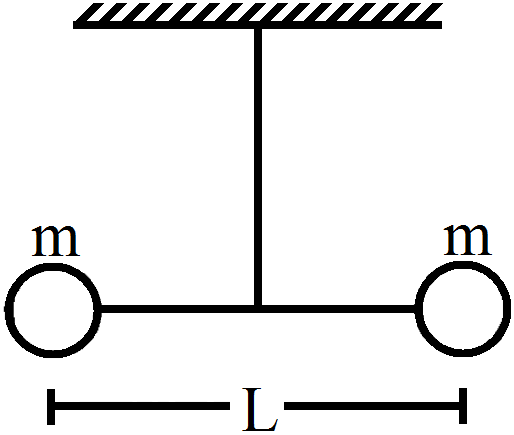
Two small balls, each of mass m are connected by a light rigid rod of length L. The system is suspended from its centre by a thin wire of torsional constant k. The rod is rotated about the wire through an angle $\theta_0$ and released. Find the tension in the rod' as the system passes through the mean position.

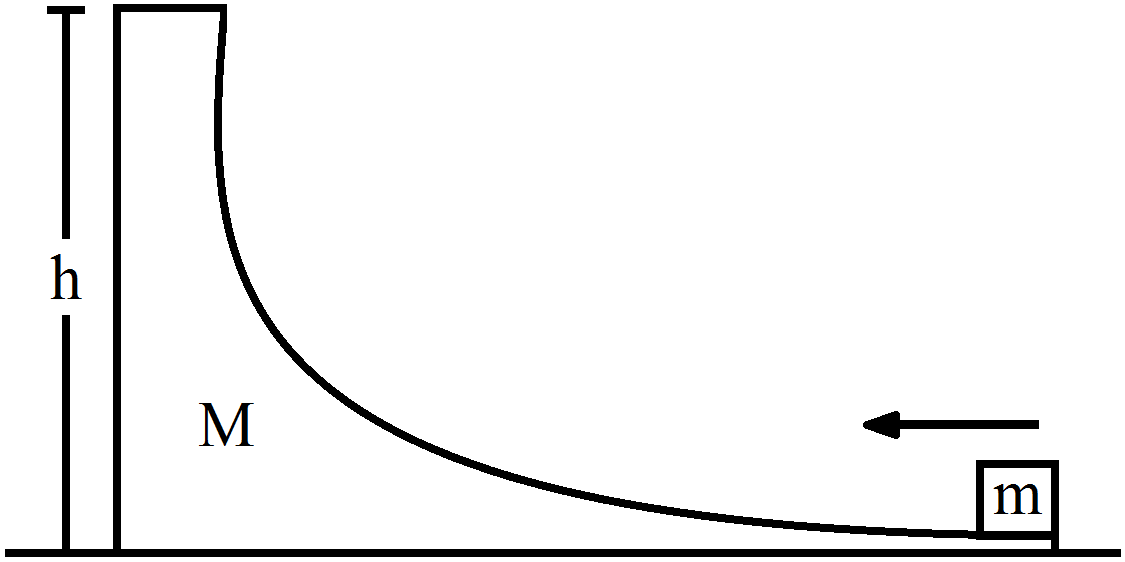
Figure shows a small body of mass m placed over a larger mass M whose surface is horizontal near the smaller mass and gradually curves to become vertical. The smaller mass is pushed on the longer one at a speed v and the system is left to itself. Assume that all the surfaces are frictionless.
  1. Find the speed of the larger block when the smaller block is sliding on the vertical part.
  2. Find the speed of the smaller mass when it breaks off the larger mass at height h.
  3. Find the maximum height (from the ground) that the smaller mass ascends.
  4. Show that the smaller mass will again land on the bigger one. Find the distance traversed by the bigger block during the time when the smaller block was in its flight under gravity.
​​​​​​​
Calculate the frequency of beats produced in air when two sources of sound are activated, one emitting a wavelength of 32cm and the other of 32.2cm. The speed of sound in air is 350m/s.
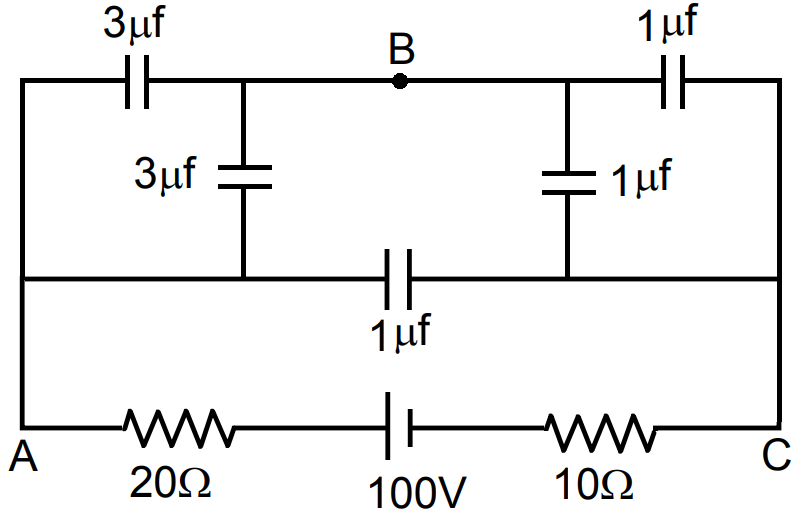
Find the potential difference between the points A and B and between the points B and C of the figure. in steady state.

A $5.0\mu\text{F}$ capacitor is charged to 12V. The positive plate of this capacitor is now connected to the negative terminal of a 12V battery and vice versa. Calculate the heat developed in the connecting wires.
Explain the molecular nature of matter. What are the factors affecting Brownian motion? Describe them.
Derive expression for rate of flow of fluid as measured by venturimeter.
Explain how Carnot's cycle works with the heat flow diagram. Using the same, explain the working of a refrigerator. Also, give its coefficient of performance.
A ballon has 5.0g mole of helium at 7°C. Calculate.
  1. The number of atoms of helium in the balloon,
  2. The total internal energy of the system.
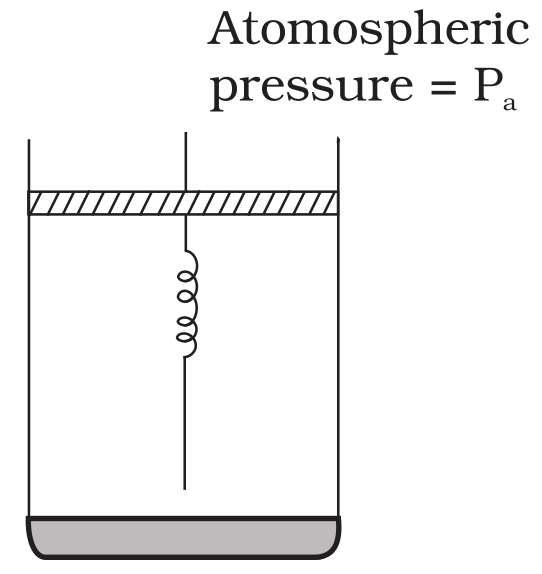
Consider one mole of perfect gas in a cylinder of unit cross section with a piston attached (Fig.) A spring (spring constant k) is attached (unstretched length L) to the piston and to the bottom of the cylinder. Initially the spring is unstretched and the gas is in equilibrium. A certain amount of heat Q is supplied to the gas causing an increase of volume from Vo to V1.

  1. What is the initial pressure of the system.
  2. What is the final pressure of the system.
  3. Uing the first law of thermodynamics, write down a relation between Q, Pa, V, Vo and k.