Questions

5 Marks Questions

Take a timed test

11 questions · self-marked practice — reveal the answer and mark yourself.

Question 15 Marks
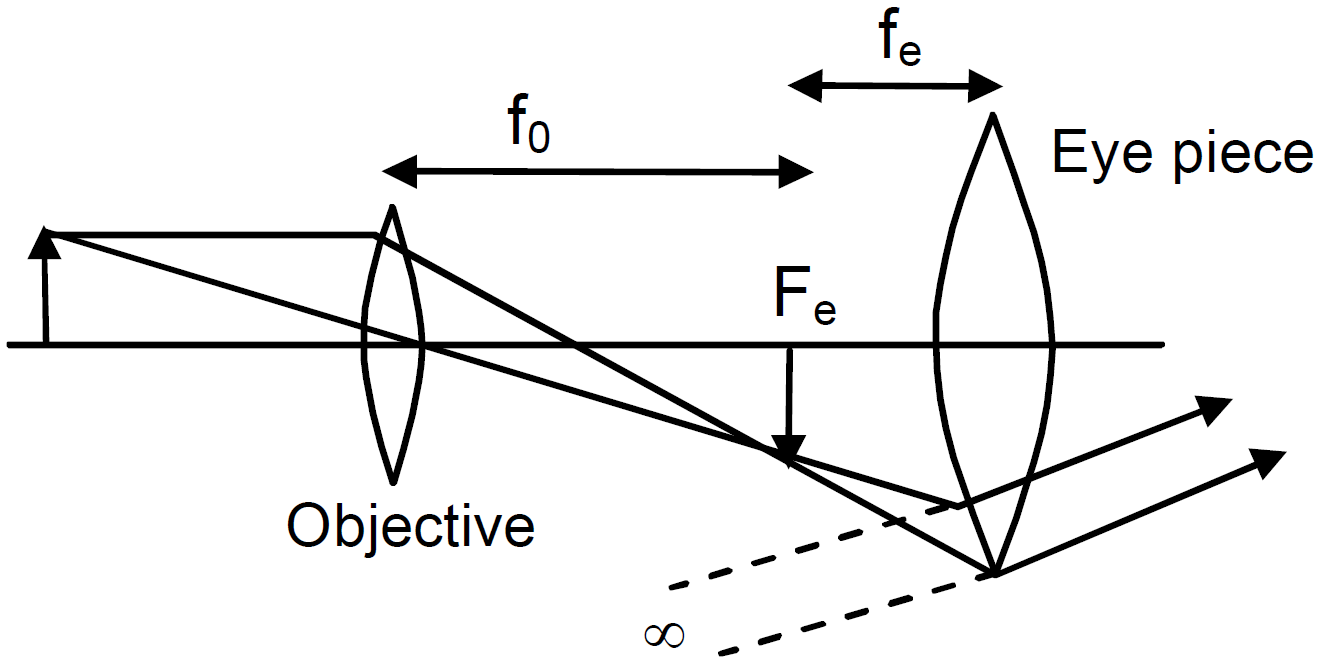
An eye can distinguish between two points of an object if they are separated by more than 0.22mm when the object is placed at 25cm from the eye. The object is now seen by a compound microscope having a 20D objective and 10D eyepiece separated by a distance of 20cm. The final image is formed at 25cm from the eye. What is the minimum separation between two points of the object which can now be distinguished?
Answer
For the given compound microscope

$\text{f}_0=\frac{1}{20\text{D}}=0.05\text{m}=5\text{cm},$ $\text{f}_\text{e}=\frac{1}{10\text{D}}=0.1\text{m}=10\text{cm.}$

D = 25cm, separation between objective & eyepiece= 20cm

For the minimum separation between two points which can be distinguished by eye using the microscope, the magnifying power should be maximum.

For the eyepiece, v0 = -25cm, fe = 10cm

So, $\frac{1}{\text{u}_\text{e}}=\frac{1}{\text{v}_\text{e}}-\frac{1}{\text{f}_\text{e}}=\frac{1}{-25}-\frac{1}{10}$

$=-\Big[\frac{2+5}{50}\Big]\Rightarrow\text{u}_\text{e}=-\frac{50}{7}\text{cm}$

So, the image distance for the objective lens should be,

$\text{v}_0=20-\frac{50}{7}=\frac{90}{7}\text{cm}$

Now, for the objective lens,

$\frac{1}{\text{u}_0}=\frac{1}{\text{v}_0}-\frac{1}{\text{f}_0}=\frac{7}{90}-\frac{1}{5}=-\frac{11}{90}$

$\Rightarrow\text{u}_\text{o}=-\frac{90}{11}\text{cm}$

So, the maximum magnifying power is given by,

$\text{m}=\frac{-\text{V}_0}{\text{u}_0}\Big[1+\frac{\text{D}}{\text{f}_\text{e}}\Big]$

$=\frac{\big(\frac{90}{7}\big)}{\big(-\frac{90}{11}\big)}\Big[1+\frac{25}{10}\Big]$

$=\frac{11}{7}\times3.5=5.5$

Thus, minimum separation eye can distinguish $=\frac{0.22}{5.5}\text{mm}=0.04\text{mm}$
View full question & answer
Question 25 Marks
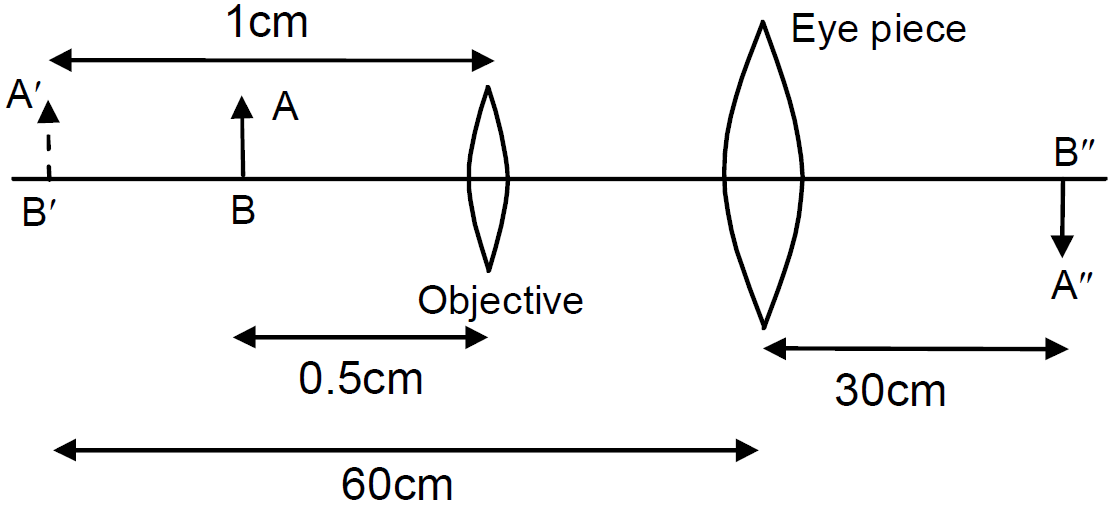
A compound microscope consists of an objective of focal length 1cm and an eyepiece of focal length 5cm. An object is placed at a distance of 0.5cm from the objective. What should be the separation between the lenses so that the microscope projects an inverted real image of the object on a screen 30cm behind the eyepiece?
Answer
Given that,

f0 = = 1cm, fe = 5cm, u0 = 0.5cm, ve = 30cm

For the objective lens, u0 = – 0.5cm, f0 = 1cm.

From lens formula.

$\frac{1}{\text{v}_0}-\frac{1}{\text{u}_0}=\frac{1}{\text{f}_0}$

$\Rightarrow\frac{1}{\text{v}_0}-\frac{1}{\text{u}_0}=\frac{1}{\text{f}_0}$

$\Rightarrow\frac{1}{\text{v}_0}=\frac{1}{\text{u}_0}+\frac{1}{\text{f}_0}$

$\Rightarrow\frac{1}{\text{v}_0}=\frac{1}{-0.5}+\frac{1}{1}=-1$

$\Rightarrow\text{v}_0=-1\text{cm}$

So, a virtual image is formed by the objective on the same side as that of the object at a distance of 1cm from the objective lens. This image acts as a virtual object for the eyepiece.

For the eyepiece,

$\frac{1}{\text{v}_0}-\frac{1}{\text{u}_0}=\frac{1}{\text{f}_0}$

$\Rightarrow \frac{1}{\text{u}_0}=\frac{1}{\text{v}_0}-\frac{1}{\text{f}_0}$

$\Rightarrow\frac{1}{\text{u}_0}=\frac{1}{30}-\frac{1}{5}=\frac{-5}{30}=\frac{-1}{6}$

$\Rightarrow\text{u}_\text{o}=-6\text{cm}$

So, as shown in figure,

Separation between the lenses = u0 – v0 = 6 – 1 = 5cm

View full question & answer
Question 35 Marks
A lady uses +1.5D glasses to have normal vision from 25cm onwards. She uses a 20D lens as a simple microscope to see an object. Find the maximum magnifying power if she uses then microscope
  1. Together with her glass
  2. Without the glass. Do the answers suggest that an object can be more clearly seen through a microscope without using the correcting glasses?
Answer
The lady uses +1.5D glasses to have normal vision at 25cm.

So, with the glasses, her least distance of clear vision = D = 25cm

Focal length of the glasses $=\frac{1}{1.5}\text{m}=\frac{100}{1.5}\text{cm}$

So, without the glasses her least distance of distinct vision should be more

If, $\text{u}=-25\text{cm},$

$\text{f}=\frac{100}{1.5}\text{cm}$

Now, $\frac{1}{\text{v}}-\frac{1}{\text{u}}=\frac{1}{\text{f}}=\frac{1.5}{100}-\frac{1}{25}=\frac{1.5{-4}}{100}=\frac{-2.5}{100}$

$\Rightarrow \text{v}=-40\text{cm}$ = near point without glasses

Focal length of magnifying glass $=\frac{1}{20}\text{m}=0.05\text{m}=5\text{cm}=\text{f}$

  1. The maximum magnifying power with glasses

$\text{m} =1+\frac{\text{D}}{\text{f}}=1+\frac{25}{5}=6$

  1. Without the glasses, D = 40cm.

So, $\text{m}=1+\frac{\text{D}}{\text{f}}=1+\frac{40}{5}=9$

View full question & answer
Question 45 Marks
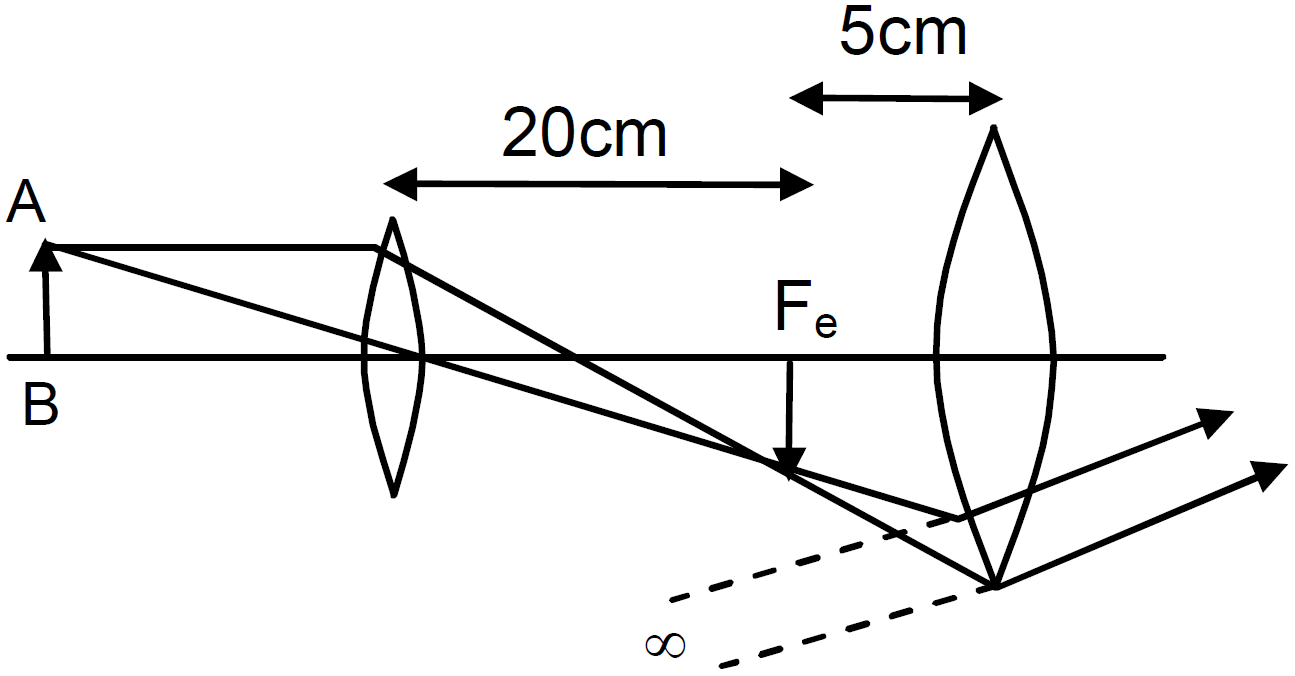
An optical instrument used for angular magnification has a 25D objective and a 20D eyepiece. The tube length is 25cm when the eye is least strained.
  1. Whether it is a microscope or a telescope?
  2. What is the angular magnification produced?
Answer
The optical instrument has

$\text{f}_0=\frac{1}{25\text{D}}=0.04\text{m}=4\text{cm}$

$\text{f}_\text{e}=\frac{1}{20\text{D}}=0.05\text{m}=5\text{cm}$

tube length = 25cm (normal adjustment)

  1. The instrument must be a microscope as f0 < fe
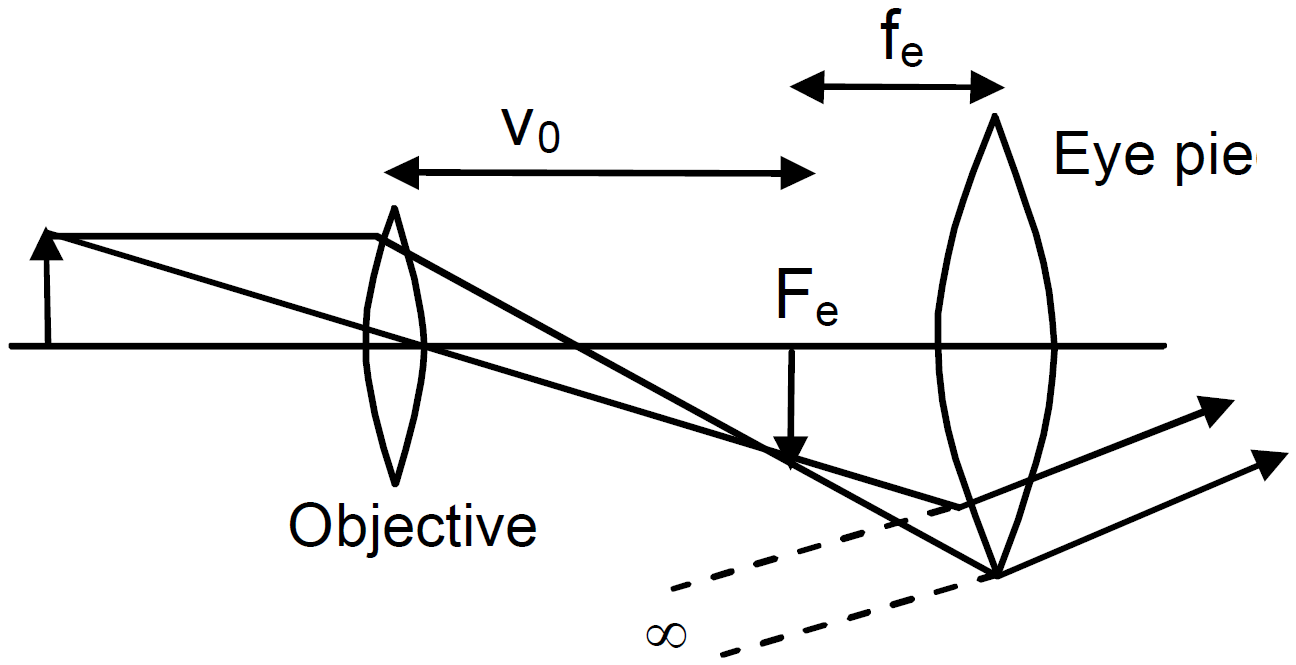
  2. Since the final image is formed at infinity, the image produced by the objective should lie on the focal plane of the eye piece.

So, image distance for objective = v0 = 25 – 5 = 20cm

Now, using lens formula.

$\frac{1}{\text{v}_0}-\frac{1}{\text{u}_0}=\frac{1}{\text{f}_0}$

$\Rightarrow\frac{1}{\text{u}_0}=\frac{1}{\text{v}_0}-\frac{1}{\text{f}_0}=\frac{1}{20}-\frac{1}{4}$

$=\frac{-4}{20}=\frac{-1}{5}\Rightarrow\text{u}_0=-5\text{cm}$

So, angular magnification $\text{m}=-\frac{\text{v}_0}{\text{u}_0}\times\frac{\text{D}}{\text{f}_\text{e}}$[Taking D = 25cm]

$=-\frac{20}{-5}\times\frac{25}{5}=20$

View full question & answer
Question 55 Marks
A professor reads a greeting card received on his 50th birthday with +2.5D glasses keeping the card 25cm away. Ten years later, he reads his farewell letter with the same glasses but he has to keep the letter 50cm away. What power of lens should he now use?
Answer
On the 50th birthday, he reads the card at a distance 25cm using a glass of +2.5D.

Ten years later, his near point must have changed.

So after ten years,

$\text{u}=-50\text{cm},$

$\text{f}=\frac{1}{2.5\text{D}}=0.4\text{m}=40\text{cm}$

$\text{v}=\text{near point}$

Now, $\frac{1}{\text{v}}-\frac{1}{\text{u}}=\frac{1}{\text{f}}$

$\Rightarrow \frac{1}{\text{v}}=\frac{1}{\text{u}}+\frac{1}{\text{f}}=\frac{1}{-50}+\frac{1}{40}=\frac{1}{200}$

So, near point = v = 200cm

To read the farewell letter at a distance of 25cm,

U = –25cm

For lens formula,

$\Rightarrow\frac{1}{\text{v}}-\frac{1}{\text{u}}=\frac{1}{\text{f}}$

$\Rightarrow\frac{1}{\text{f}}=\frac{1}{200} -\frac{1}{-25}=\frac{1}{200}+\frac{1}{25}=\frac{9}{200}$

$\Rightarrow\text{f}=\frac{200}{9}\text{cm}=\frac{2}{9}\text{m}$

⇒ Power of the lens $=\frac{1}{\text{f}}=\frac{9}{2}=4.5\text{D.}$

$\therefore$ He has to use a lens of power +4.5D.

View full question & answer
Question 65 Marks
An astronomical telescope is to be designed to have a magnifying power of 50 in normal adjustment. If the length of the tube is 102cm, find the powers of the objective and the eyepiece.
Answer
For the astronomical telescope in normal adjustment.

Magnifying power = m = 50, length of the tube = L = 102cm

Let f0 and fe be the focal length of objective and eye piece respectively.

$\text{m}=\frac{\text{f}_0}{\text{f}_\text{e}}=50\Rightarrow\text{f}_0=50\text{f}_\text{e}\dots(1)$

and, $\text{L}=\text{f}_0+\text{f}_\text{e}=102\text{cm}\dots(2)$

Putting the value of f0 from equation (1) in (2), we get,

f0 + fe = 102 ⇒ 51fe = 102 ⇒ fe = 2cm = 0.02m

So, f0 = 100cm = 1m

$\therefore$ Power of the objective lens$=\frac{1}{\text{f}_0}=1\text{D}$

And Power of the eye piece lens$=\frac{1}{\text{f}_\text{e}}=\frac{1}{0.02}=50\text{D}$

View full question & answer
Question 75 Marks
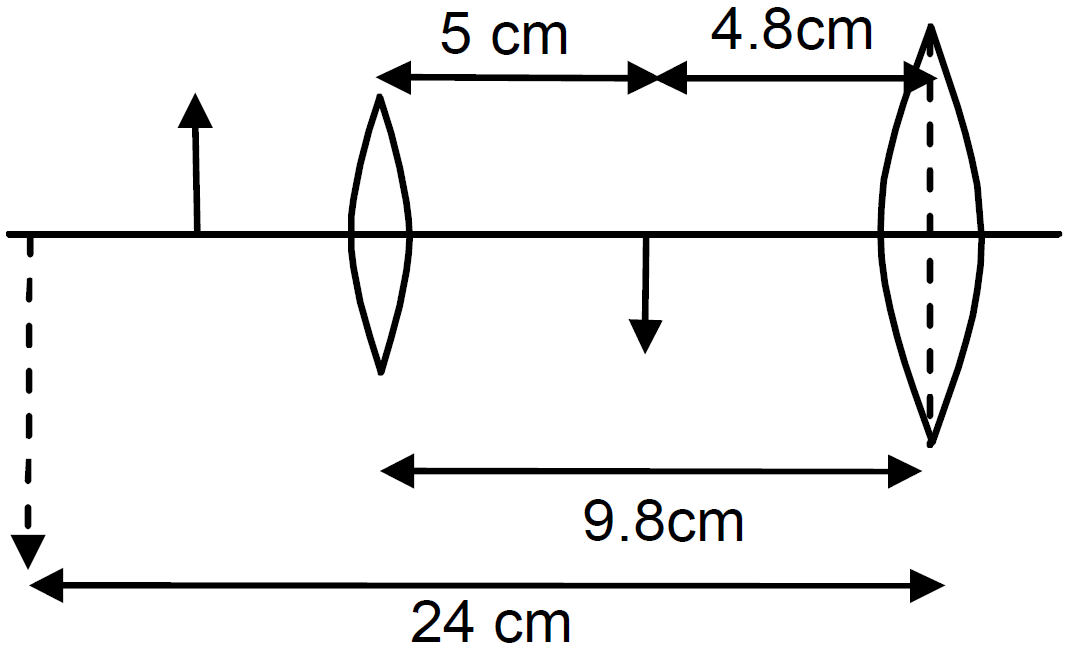
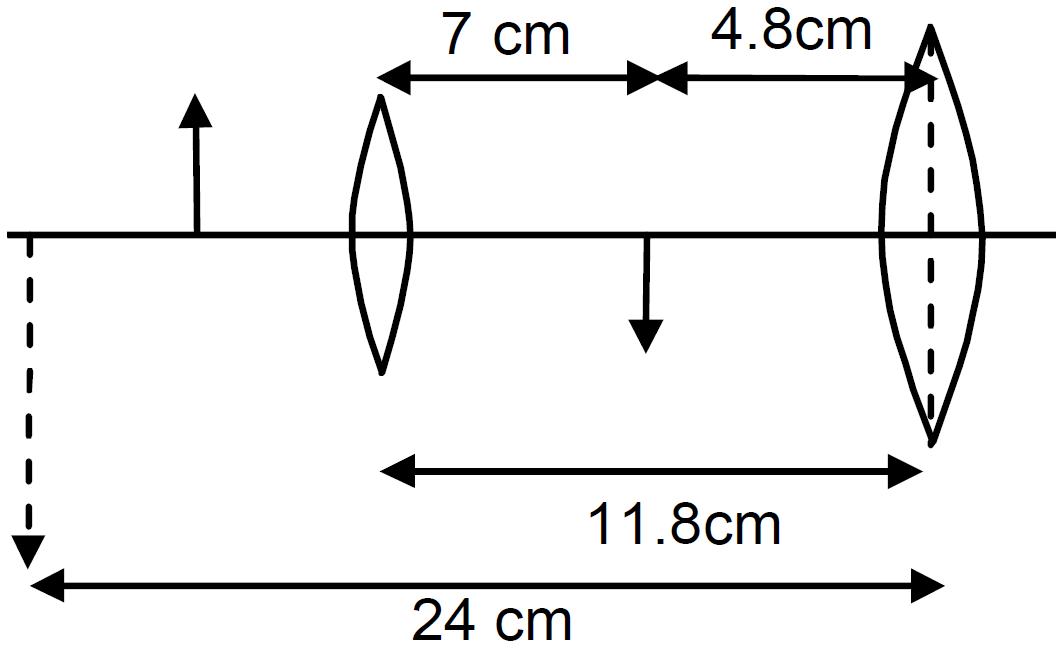
The separation between the objective and the eyepiece of a compound microscope can be adjusted between 9.8cm to 11.8cm. If the focal lengths of the objective and the eyepiece are 1.0cm and 6cm respectively, find the range of the magnifying power if the image is always needed at 24cm from the eye.
Answer
For the given compound microscope

f0 = 1cm, fe = 6cm, D = 24cm

For the eye piece, ve = -24cm, fe = 6cm

Now, $\frac{1}{\text{v}_\text{e}}-\frac{1}{\text{u}_\text{e}}=\frac{1}{\text{f}_\text{e}}$

$\Rightarrow\frac{1}{\text{u}_\text{e}}=\frac{1}{\text{v}_\text{e}}-\frac{1}{\text{f}_\text{e}}\Rightarrow-\Big[\frac{1}{24}+\frac{1}{6}\Big]=-\frac{5}{24}$

$\Rightarrow \text{u}_\text{e}=-4.8\text{cm}$

  1. When the separation between objective and eye piece is 9.8cm, the image distance for the objective lens must be (9.8) - (4.8) = 5.0cm

Now, $\frac{1}{\text{v}_0}-\frac{1}{\text{u}_0}=\frac{1}{\text{f}_0}$

$\Rightarrow\frac{1}{\text{u}_0}=\frac{1}{\text{v}_0}-\frac{1}{\text{f}_0}=\frac{1}{5}-\frac{1}{1}=-\frac{4}{5}$

$\Rightarrow\text{u}_0=-\frac{5}{4}=-1.25\text{cm}$

So, the magnifying power is given by,

$\text{m}=\frac{\text{v}_0}{\text{u}_\text{0}}\Big[1+\frac{\text{D}}{\text{f}}\Big]=\frac{-5}{-1.25}\Big[1+\frac{24}{6}\Big]=4\times5=20$

  1.  When the separation is 11.8cm,

v0 = 11.8 - 4.8 = 7.0cm, f0 = 1cm

$\Rightarrow\frac{1}{\text{u}_0}=\frac{1}{\text{v}_0}-\frac{1}{\text{f}_0}=\frac{1}{7}-\frac{1}{1}=-\frac{6}{7}$

So, $\text{m}=-\frac{\text{v}_0}{\text{u}_\text{o}}\Big[1+\frac{\text{D}}{\text{f}}\Big]=\frac{-7}{-\Big(\frac{7}{6}\Big)}\Big[1+\frac{24}{6}\Big]=6\times5=30$

So, the range of magnifying power will be 20 to 30.

View full question & answer
Question 85 Marks
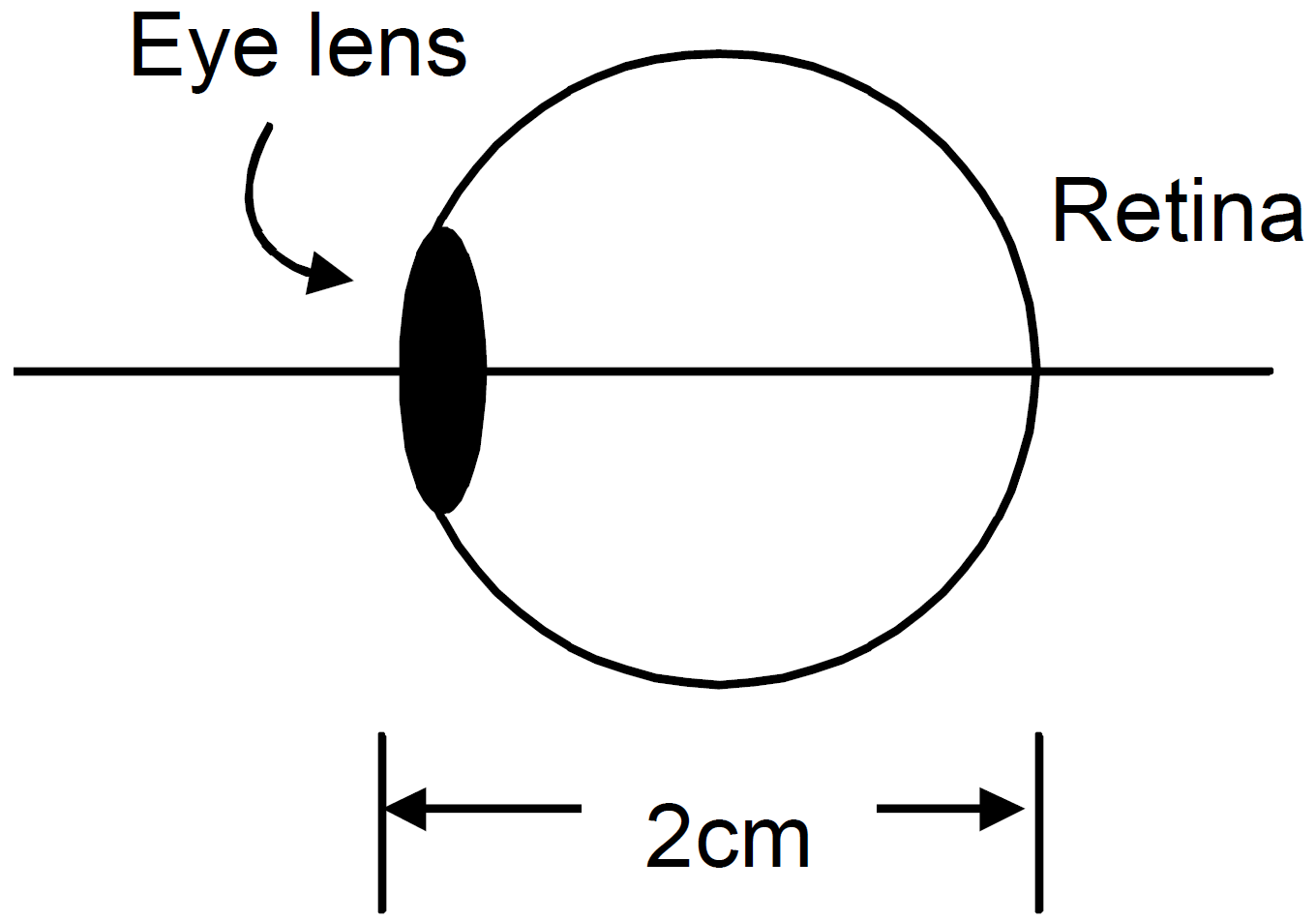
A normal eye has retina 2cm behind the eye-lens. What is the power of the eye-lens when the eye is
  1. Fully relaxed,
  2. Most strained?
Answer
Since, the retina is 2cm behind the eye-lens

v = 2cm

  1. When the eye-lens is fully relaxed

$\text{u}=\infty,$

$\text{v}=2\text{cm}=0.02\text{m}$

$\Rightarrow\frac{1}{\text{f}}=\frac{1}{\text{v}}-\frac{1}{\text{u}}=\frac{1}{0.02}-\frac{1}{\infty}=50\text{D}$

So, in this condition power of the eye-lens is 50D

  1. When the eye-lens is most strained,

$\text{u}=-25\text{cm}=-0.25\text{m}$

$\text{v}=+2\text{cm}=+0.02\text{m}$

$\Rightarrow\frac{1}{\text{u}}=\frac{1}{\text{v}}-\frac{1}{\text{u}}=\frac{1}{0.02}-\frac{1}{-0.25}=50+4=54\text{D}$

In this condition power of the eye lens is 54D.

View full question & answer
Question 95 Marks
A compound microscope has a magnifying power of 100 when the image is formed at infinity. The objective has a focal length of 0.5cm and the tube length is 6.5cm. Find the focal length of the eyepiece.
Answer
For the give compound microscope, f0 = 0.5cm, tube length = 6.5cm magnifying power = 100 (normal adjustment) Since, the image is formed at infinity, the real image produced by the objective lens should lie on the focus of the eye piece.

So, vo + fe = 6.5cm ...(1)

Again, magnifying power $\text{m}=\frac{\text{v}_0}{\text{u}_0}\times\frac{\text{D}}{\text{f}_\text{e}}$ [for normal adjustment]

$\Rightarrow\text{m}=\Big[1-\frac{\text{V}_0}{\text{f}_0}\Big]\frac{\text{D}}{\text{f}_\text{e}}$ 

$\Rightarrow100=-\Big[1-\frac{\text{V}_0}{0.5}\Big]\times\frac{25}{\text{f}_\text{e}}$ [Taking D = 25cm]

$\Rightarrow100\text{f}_\text{e}=-(1-2\text{v}_0)\times25$

$\Rightarrow2\text{v}_0-4\text{f}_\text{e}=1 $ ...(2)

Solving equation (1) and (2) we can get,

V0 = 4.5cm and fe = 2cm

So, the focal length of the eye piece is 2cm.

View full question & answer
Question 105 Marks
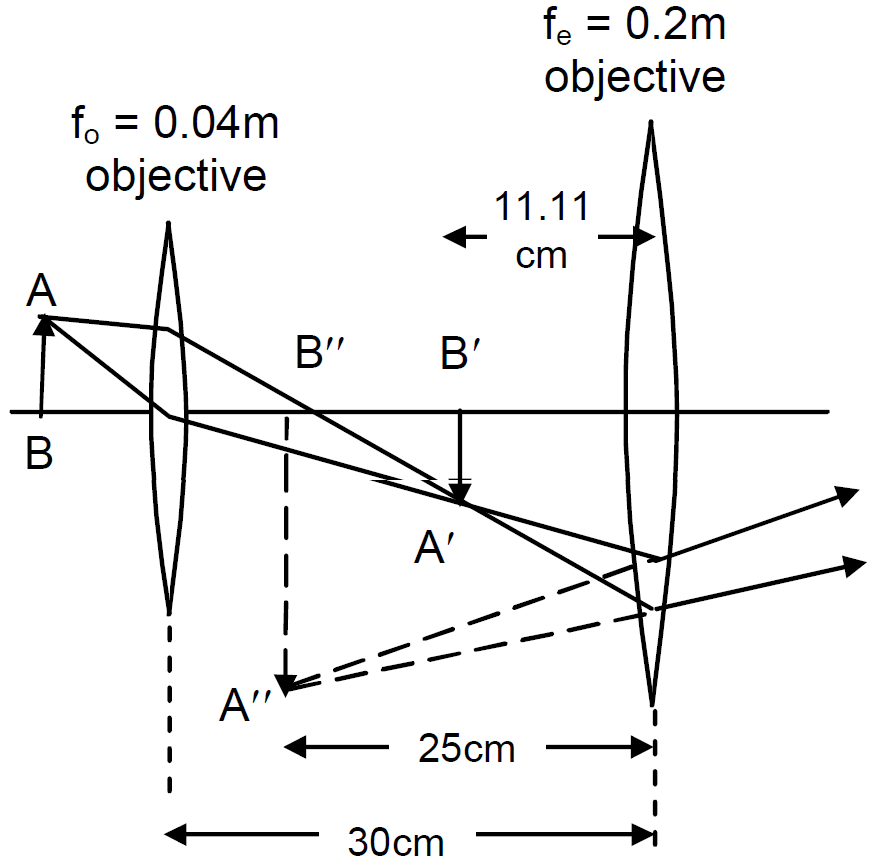
Find the maximum magnifying power of a compound Microscope having a 25 diopter lens as the objective, a 5 diopter lens as the eyepiece and the separation 30cm between the two lenses. The least distance for clear vision is 25cm.
Answer
For the given compound microscope

$\text{f}_0=\frac{1}{25\text{ diopter}}=0.04\text{m}=4\text{cm,}$ $\text{f}_\text{e}=\frac{1}{5\text{ diopter}}=0.2\text{m}=20\text{cm}$

D = 25cm, separation between objective and eyepiece = 30cm

The magnifying power is maximuwm hen the image is formed by the eye piece at least distance of clear vision i.e. D = 25cm

for the eye piece, ve = -25cm, fe = 20cm

For lens formula, $\frac{1}{\text{v}_\text{e}}-\frac{1}{\text{u}_\text{e}}=\frac{1}{\text{f}_\text{e}}$

$\Rightarrow\frac{1}{\text{u}_\text{e}}=\frac{1}{\text{v}_\text{e}}-\frac{1}{\text{f}_\text{e}}$

$\Rightarrow\frac{1}{\text{u}_\text{e}}\frac{1}{-25}-\frac{1}{20} $

$\Rightarrow\text{u}_\text{e}=11.11\text{cm}$

So, for the objective lens, the image distance should be

v0 = 30 - (11.11) = 18.89cm

Now, for the objective lens,

v0 = +18.89cm (because real image is produced)

f0 = 4cm

So, $\frac{1}{\text{u}_\text{o}}=\frac{1}{\text{v}_\text{o}}-\frac{1}{\text{f}_\text{o}}\Rightarrow \frac{1}{18.89}-\frac{1}{4}\\=0.053-0.25=-0.197$

$\Rightarrow\text{u}_\text{o}=-5.07\text{cm}$

So, the maximum magnificent power is given by

$\text{m}=-\frac{\text{v}_\text{o}}{\text{u}_\text{o}}\Big[1+\frac{\text{D}}{\text{f}_\text{e}}\Big]=\frac{18.89}{-5.07}\Big[1+\frac{25}{20}\Big]$

$=3.7225\times2.25=8.376$

View full question & answer
Question 115 Marks
An object is placed at a distance of 30cm from a converging lens of focal length 15cm. A normal eye (near point 25cm, far point infinity) is placed close to the lens on the other side.
  1.  Can the eye see the object clearly?
  2.  What should be the minimum separation between the lens and the eye so that the eye can clearly see the object?
  3.  Can a diverging lens, placed in contact with the converging lens, help in seeing the object clearly when the eye is close to the lens?
Answer
Object distance, u = -30cm

Focal length, f = 15cm

Image distance, v = ?

The lens formula is given by

$\frac{1}{\text{v}}-\frac{1}{\text{u}}=\frac{1}{\text{f}}$

$\Rightarrow\frac{1}{\text{v}}-\frac{1}{-30}=\frac{1}{15}$

$\Rightarrow\frac{1}{\text{v}}=\frac{1}{30}$

$\Rightarrow \text{v}=+30\text{cm}$

(on the opposite side of the object)

  1. No, the eye placed close to the lens cannot see the object clearly.
  2. The eye should be 30cm away from the lens to see the object clearly.
  3. The diverging lens will always form an image at a large distance from the eye this image cannot be seen through the human eye.
View full question & answer
5 Marks Questions - Physics STD 11 Science Questions - Vidyadip