An organ pipe of length $L$ open at both ends is found to vibrate in its first harmonic when sounded with a tuning fork of $480\, Hz$. What should be the length of a pipe closed at one end, so that it also vibrates in its first harmonic with the same tuning fork ?
Medium


Download our appand get started for free
Experience the future of education. Simply download our apps or reach out to us for more information. Let's shape the future of learning together!No signup needed.*
Similar Questions
- 1A steel rod $100 cm$ long is clamped at its mid-point. The funda-mental frequency of longitudinal vibrations of the rod is given to be $2.53 kHz$. What is the speed of sound in steel .... $km/s$View Solution
- 2Two trains $A$ and $B$ are moving with speeds $20 \mathrm{~m} / \mathrm{s}$ and $30 \mathrm{~m} / \mathrm{s}$ respectively in the same direction on the same straight track, with $B$ ahead of $A$. The engines are at the front ends. The engine of train $A$ blows a long whistle.View Solution
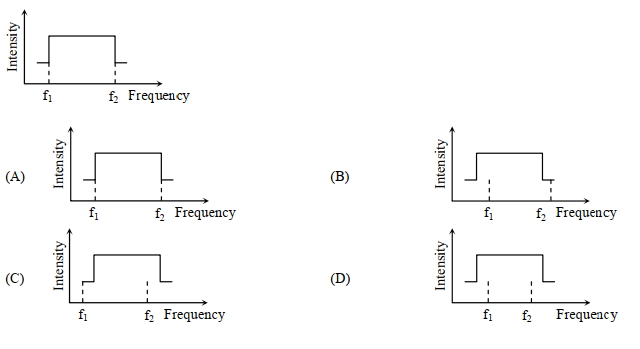
Assume that the sound of the whistle is composed of components varying in frequency from $f_1=800 \mathrm{~Hz}$ to $f_2=1120 \mathrm{~Hz}$, as shown in the figure. The spread in the frequency (highest frequency - lowest frequency) is thus $320 \mathrm{~Hz}$. The speed of sound in still air is $340 \mathrm{~m} / \mathrm{s}$.
$1.$ The speed of sound of the whistle is
$(A)$ $340 \mathrm{~m} / \mathrm{s}$ for passengers in $A$ and $310 \mathrm{~m} / \mathrm{s}$ for passengers in $B$
$(B)$ $360 \mathrm{~m} / \mathrm{s}$ for passengers in $A$ and $310 \mathrm{~m} / \mathrm{s}$ for passengers in $B$
$(C)$ $310 \mathrm{~m} / \mathrm{s}$ for passengers in $A$ and $360 \mathrm{~m} / \mathrm{s}$ for passengers in $B$
$(D)$ $340 \mathrm{~m} / \mathrm{s}$ for passengers in both the trains
$2.$ The distribution of the sound intensity of the whistle as observed by the passengers in train $\mathrm{A}$ is best represented by
$Image$
$3.$ The spread of frequency as observed by the passengers in train $B$ is
$(A)$ $310 \mathrm{~Hz}$ $(B)$ $330 \mathrm{~Hz}$ $(C)$ $350 \mathrm{~Hz}$ $(D)$ $290 \mathrm{~Hz}$
Give the answer question $1,2$ and $3.$
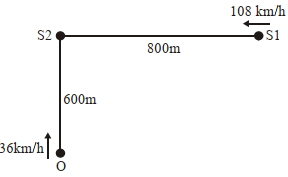
- 3A train $S1$, moving with a uniform velocity of $108 km / h$, approaches another train $S 2$ standing on a platform. An observer $O$ moves with a uniform velocity of $36 km / h$ towards $S 2$, as shown in figure. Both the trains are blowing whistles of same frequency $120 Hz$. When $O$ is $600 m$ away from $S 2$ and distance between $S 1$ and $S 2$ is $800 m$, the number of beats heard by $O$ is. . . . . [Speed of the sound $=330 m / s$ ]View Solution
- 4The speed of sound in air at a given temperature is $350 m/s$. An engine blows whistle at a frequency of $1200 \,cps$. It is approaching the observer with velocity $50 m/s$. The apparent frequency in cps heard by the observer will beView Solution
- 5The frequency changes by $10 \%$ as a sound source approaches a stationary observer with constant speed $V_s$. What would be percentage change in the frequency as the source recedes the observer with same speed $\left(V_s < V\right)$ is ........... $\%$View Solution
- 6An open pipe of length $33 cm$ resonates with frequency of $100 Hz$. If the speed of sound is $330 m/s$, then this frequency isView Solution
- 7The pressure wave, $P = 0.01\,sin\,[1000t -3x]\,Nm^{-2},$ corresponds to the sound produced by a vibrating blade on a day when atmospheric temperature is $0\,^oC.$ On some other day when temperature is $T,$ the speed of sound produced by the same blade and at the same frequency is found to be $336 \,ms^{-1}$. Approximate value of $T$ is .... $^oC$View Solution
- 8The number of beats produced per second by two vibrations: $x_1 =x_0$ sin $646\pi t$ and $x_2 = x_0 sin 652 \pi t$ isView Solution
- 9For the stationary wave $y = 4\sin \,\left( {\frac{{\pi x}}{{15}}} \right)\cos (96\,\pi t)$, the distance between a node and the next antinode isView Solution
- 10In a closed organ pipe the frequency of fundamental note is $50 Hz$. The note of which of the following frequencies will not be emitted by it .... $Hz$View Solution