An unbanked curve has a radius of $60\,m$. The maximum speed at which a car can make a turn if the coefficient of static friction is $0.75$, is ...... $m/s$
Easy
Download our app for free and get started
(c)${v_{\max }} = \sqrt {\mu rg} = \sqrt {0.75 \times 60 \times 9.8} = 21\,m/s$

Download our appand get started for free
Experience the future of education. Simply download our apps or reach out to us for more information. Let's shape the future of learning together!No signup needed.*
Similar Questions
- 1A gramophone record is revolving with an angular velocity $\omega$. A coin is placed at a distance $r$ from the centre of the record. The static coefficient of friction is $\mu .$ The coin will revolve with the record ifView Solution
- 2A bullet of mass $4\,g$ is fired horizontally with a speed of $300\,m/s$ into $0.8\,kg$ block of wood at rest on a table. If the coefficient of friction between the block and the table is $0.3,$ how far will the block slide approximately?View Solution
- 3A block of wood resting on an inclined plane of angle $30^o$, just starts moving down. If the coefficient of friction is $0.2$, its velocity (in $ms^{-1}$) after $5\, seconds$ is : $(g = 10\, ms^{-2})$View Solution
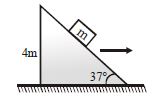
- 4If the coefficient of friction between block & wedge is $\mu $, then the maximum horizontal acceleration of the wedge for which block will remain at rest w.r.t. the wedge isView Solution
- 5If the radius of curvature of the path of two particles of same mass are in the ratio $3:4,$ then in order to have constant centripetal force, their velocities will be in the ratio of:View Solution
- 6A road is $10\, m$ wide. Its radius of curvature is $50\, m$. The outer edge is above the lower edge by a distance of $1.5\, m$. This road is most suited for the velocity .......... $m/\sec$View Solution
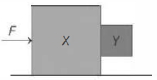
- 7Consider the system shown below. A horizontal force $F$ is applied to a block $X$ of mass $8 \,kg$, such that the block $Y$ of mass $2 \,kg$ adjacent to it does not slip downwards under gravity. There is no friction between the horizontal plane and the base of the block $X$. The coefficient of friction between the surfaces of blocks $X$ and $Y$ is $0.5$. The minimum value of $F$ is ............ $N$ (take, acceleration due to gravity to be $10 \,ms ^{-2}$ )View Solution
- 8If the radius of curvature of the path of two particles of same mass are in the ratio $3:4,$ then in order to have constant centripetal force, their velocities will be in the ratio of:View Solution
- 9Consider a car moving on a straight road with a speed of $100\, m/s$. The distance at which car can be stopped, is ........ $m$. $[\mu_k = 0.5]$View Solution
- 10View SolutionThe limiting friction between two bodies in contact is independent of