MCQ
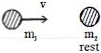
An unknown nucleus collides with a ${}^4He$ nucleus, and after the collision the two nuclei travel in perpendicular directions relative to each other. If kinetic energy is lost in the collision, the unknown nucleus must be 
  • A
     ${}^{28}N$
  • B
     ${}^4He$
  • C
     ${}^{12}C$
  • a nucleus with mass lighter than  ${}^4He$
Answer

Correct option: D.
a nucleus with mass lighter than  ${}^4He$
d
The two nuclei travel in perpendicular directions relative to each other when

$\mathrm{m}_{2}=\frac{\mathrm{m}_{1}}{\mathrm{e}}$

$e<1$

$m_{2}>m_{1}$

Need a full question paper?

Generate a complete, print-ready paper with questions like this in minutes — across 16+ boards, with answer keys.

Start Generating Free

Similar questions

The specific heat of a gas at constant pressure is more than that of the same gas at constant volume because
A person with his hand in his pocket is skating on ice at the rate of $10 m / s$ and describes a circle of radius $50 m$. What is his inclination to vertical: $\left( g =10 m / sec ^2\right)$
If velocity $v$, acceleration $A$ and force $F$ are chosen as fundamental quantities, then the dimensional formula of angular momentum in terms of $v,\,A$ and $F$ would be
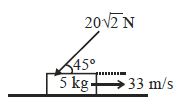
A block of mass $5\, kg$ is kept on a rough horizontal floor. It is given a velocity $33\, m/s$ towards right. A force of $20\sqrt {2\,} \,N$ continuously acts on the block as shown in the figure. If the coefficient of friction between block and floor is $0.5$ the velocity of block after $3\, seconds$ is ........ $m/s$  ($g = 10\, m/s^2$)
When a mass is rotating in a plane about a fixed point, its angular momentum is directed along 
The root mean square speed of the molecules of a gas is
A force $\vec F = k[y\,\hat i\, + x\,\hat j]$ where $k$ is a positive constant acts on a particle moving in $x-y$ plane starting from the point $(3,5)$, the particle is taken along a straight line to $(5, 7)$. The work done by the force is : ............... $\mathrm{K}$
A string fixed at both ends resonates at a certain fundamental frequency. Which of the following adjustments would not affect the fundamental frequency?
The common physical property which is to be used as the basis for constructing thermometer is:
Which of the following is a unit that of force?