Question
Analyse the differences in relationship between India and Bangladesh.

Answer

Differences in relationship between India and Bangladesh:
  1. Sharing of Ganga and Bhahamputra river waters.
  2. Illegal immigration of Bangladeshi’s to India.
  3. Bangladesh’s support to anti-Indian Islamic fundamental groups.
  4. Bangladesh’s refusal to allow Indian troops to move through its territory to north-eastern India.
  5. Bangladesh’s refusal to export natural gas to India.
  6. Bangladesh refusal to allow Myanmar to supply gas to India through its territory.
  7. Bangladesh governments have felt that the Indian Government behaves like regional bully over the sharing of river water and encouraged rebellion in the Chittangong Hill tracts, trying to extract its natural gas and being unfair in trade.

Need a full question paper?

Generate a complete, print-ready paper with questions like this in minutes — across 16+ boards, with answer keys.
Start Generating Free

Similar questions

Examine any six factors which led to the disintegration of the former Soviet Union.
Though the UN has failed in preventing wars and related miseries, nations prefer its continuation. What makes the UN an indispensable organisation?
If the Soviet Union had not disintegrated and the world had remained bipolar, how would that situation have affected the world politics?
Describe historical developments related to Sikkim’s merger with India as its $22^{nd}$ State.
Why did India and China both view themselves as rising powers in global politics in-spite of tension between them? Substantiate your answer by giving any four events that have brought cordiality in their relationship.
Suggest any three measures which, in your opinion, are very effective to strengthen the national integrity and unity of India.
State the main arguments in the debate that ensued between industrialisation and agricultural development at the time of the Second Five Year Plan.
Analyse any six factors which helped the Soviet Union in becoming a superpower after the Second World War.
Read the passage given below carefully and answer the following questions:
The interim government took a firm stance against the possible division of India into smaller principalities of different sizes. The Muslim League opposed the Indian National Congress and took the view that the States should be free to adopt any course they liked. Sardar Patel, India's Deputy Prime Minister and the Home Minister during the crucial period, immediately after Independence, played a historic role in negotiating with the rulers of Princely States in bringing most of them into the Indian Union.
  1. Which government has been referred to as the interim government?
  2. Why did the Muslim League oppose the Indian National Congress?
  3. What makes the role of Sardar Patel a historic one? Explain.

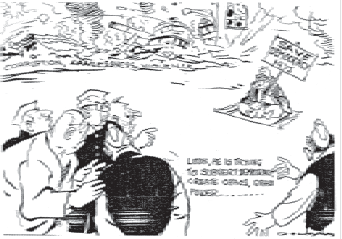
Study the cartoon given below carefully and answer the following questions:
  1. Identify and name the person holding in his hand, the placard 'Save Democracy'.
  2. In your opinion, the group of five persons belongs to which political party?
  3. According to the group of five, what is the intention of the person sitting on 'Dharna'?
  4. Which issues are responsible for the downfall of democracy and highlighted in the cartoon.