MCQ
$\angle \,FAsF$ bond angle in $AsF_3Cl_2$ molecule is
  • $90^o$ and $180^o$
  • B
    $120^o$
  • C
    $90^o$
  • D
    $180^o$

Answer

Correct option: A.
$90^o$ and $180^o$
a
The answer is $90$ and $180$ because axial positions prefer high electronegative atoms so $2$ fluorines on axial and one on eguitorial axial positions prefer high electronegative atoms due to bents rule as they repulsion is more for electronegative aoms

Need a full question paper?

Generate a complete, print-ready paper with questions like this in minutes — across 16+ boards, with answer keys.

Start Generating Free

Similar questions

Consider the reaction at $300\, K$  $H_2(g) + Cl_2(g) \to 2HCl(g); \Delta H^o = -185\, kJ$ If $2\, mole$ of $H_2$ completely react with $2\, mole$ of $Cl_2$ to form $HCl$ . What is $\Delta U^o$ for this reaction ?.....$kJ$
The pair of compounds having metals in their highest oxidation state is
Coordinate covalent compounds are formed by
For the following reaction, the equilibrium constant $K _{ c }$ at $298 K$ is $1.6 \times 10^{17}$.

$Fe ^{2+}( aq )+ S ^{2-}( aq ) \rightleftharpoons FeS ( s )$

When equal volumes of $0.06 M Fe ^{2+}( aq )$ and $0.2 M S ^{2-}( aq )$ solutions are mixed, the equilibrium concentration of $Fe ^{2+}$ (aq) is found to be $Y \times 10^{-17} M$. The value of $Y$ is. . . . .

Methylation of $10\, \mathrm{~g}$ of benzene gave $9.2\, \mathrm{~g}$ of toluene. Calculate the percentage yield of toluene $......$. (Nearest integer)
Given below are two statements :-

Statement $I$ :- Methyl orange is a weak acid.

Statement $II$ :- The benzenoid form of methyl orange is more intense/deeply coloured than the quinonoid form.

In the light of the above statement, choose the most appropriate answer from the options given below :-
For the reaction $2H_{(g)} \to H_{2(g)}$ sign of $\Delta H$ and $\Delta S$ are :-
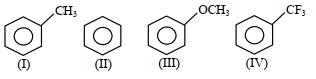
The correct arrangement for decreasing order of electrophilic substitution for above compounds
The successive Ionisation energies of an element $(A)$ is given as $IE_1 = 20\,ev\,, IE_2  = 45\,ev, IE_3 = 150\,ev, IE_4 = 900\,ev, IE_5 = 1800\, ev$ Formula of halide of $(A)$ is
Two equilibria, $AB \rightleftharpoons {A^ + } + {B^ - }$ and $AB + {B^ - } \rightleftharpoons AB_2^ - $ are simultaneously maintained in a solution with equilibrium constants, $K_1$ and $K_2$ respectively. The ratio of $[A^+]$ to $[AB_2^-]$ in the solution is