Question
Aniline is less basic than ammonia. Explain.

Answer

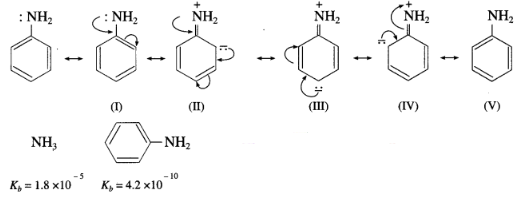
The less basic character of aniline can be explained on the basis of resonance shown by aniline.
Image

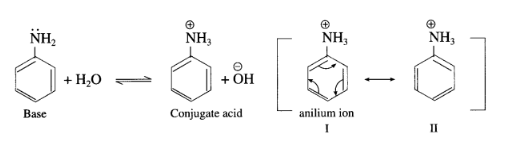
Due to resonance, the nitrogen atom of amino group in aniline acquires a positive charge, hence, lone pair of electrons is less available for protonation as compared to that of ammonia. Aniline is resonance stabilized by five resonance structures. On the other hand, aniline in aqueous medium, accepts a proton does not have lone pair of electrons on nitrogen to produce a very low concentration of anilium ion and anilium ion shows only two resonance structures and therefore less stabilized than anline.
Image

Thus, aniline is more stable than anilium ion. Hence aniline accepts proton less readily or less basic in nature than ammonia.

Need a full question paper?

Generate a complete, print-ready paper with questions like this in minutes — across 16+ boards, with answer keys.

Start Generating Free

Similar questions

Explain cross Cannizzaro reaction with example.###Write the reaction for the action of $50 \%$ NaOH on a mixture of formaldehyde and benzaldehyde.
Explain the reactivity of group 16 elements towards halogens.
Derive a relation between relative lowering of vapour pressure and molar mass of non-volatile solute.
Explain Gibbs free energy and spontaneity of the process.
Give one example of the reaction where order and molecularity are the same.
Mention any two factors that influence the rate of chemical reaction.
If for the reaction A → products, a straight line graph passing through origin is obtained between the rate of reaction against concentration of A, what would be the order of reaction? Why?
Write chemical reactions for the following conversions:
(i) Ethyl bromide to ethyl methyl ether (ii) Ethyl bromide to ethene (iii) Bromobenzene to toluene. (iv) Chlorobenzene to biphenyl.
The density of iridium is $22.4\ g/cm3$. The unit cell of iridium is fcc. Calculate the radius of iridium atom. Molar mass of iridium is $192.2\ g/mol$.
How are the following compounds obtained from alcohol:
$(1)$ Methanal
$(2)$ Propanal
$(3)$ BuLanal
$(4) \ 3-$Methylpentanal?
Predict whether the following
reactions would occur spontaneously
under standard state conditions.
a. $Ca_{(s)} + Cd^{2+}_{(aq)} \rightarrow Ca^{2+}_{(aq)} + Cd_{(s)}$
b. $2 Br-_{(s)} + Sn^{2+}(aq) \rightarrow Br_2_{(l)} + Sn_{(s)}$
c. $2Ag_{(s)} + Ni^{2+}_{(aq)} \rightarrow 2 Ag^+_{(aq)} + Ni_{(s)}$​​​​​​​
Define degree of dissociation. Derive Ostwald’s dilution law for the $CH_3COOH$.