MCQ
Answer the following by appropriately matching the lists based on the information given in the paragraph.

In a thermodynamics process on an ideal monatomic gas, the infinitesimal heat absorbed by the gas is given by $T \Delta X$, where $T$ is temperature of the system and $\Delta X$ is the infinitesimal change in a thermodynamic quantity $X$ of the system. For a mole of monatomic ideal gas

$X=\frac{3}{2} R \ln \left(\frac{T}{T_A}\right)+R \ln \left(\frac{V}{V_A}\right)$. Here, $R$ is gas constant, $V$ is volume of gas, $T_A$ and $V_A$ are constants.

The $List-I$ below gives some quantities involved in a process and $List-II$ gives some possible values of these quantities.

List-$I$ List-$II$
$(I)$ Work done by the system in process $1 \rightarrow 2 \rightarrow 3$ $(P)$ $\frac{1}{3} R T_0 \ln 2$
$(II)$ Change in internal energy in process $1 \rightarrow 2 \rightarrow 3$ $(Q)$ $\frac{1}{3} RT _0$
$(III)$ Heat absorbed by the system in process $1 \rightarrow 2 \rightarrow 3$ $(R)$ $R T _0$
$(IV)$ Heat absorbed by the system in process $1 \rightarrow 2$ $(S)$ $\frac{4}{3} RT _0$
  $(T)$ $\frac{1}{3} RT _0(3+\ln 2)$
  $(U)$ $\frac{5}{6} RT _0$

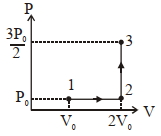
If the process carried out on one mole of monatomic ideal gas is as shown in figure in the PV-diagram with $P _0 V _0=\frac{1}{3} RT _0$, the correct match is,

$(1)$$I \rightarrow Q, II \rightarrow R , III \rightarrow P , IV \rightarrow U$

$(2)$ $I \rightarrow S , II \rightarrow R , III \rightarrow Q , IV \rightarrow T$

$(3)$ $I \rightarrow Q , II \rightarrow R , III \rightarrow S , IV \rightarrow U$

$(4)$ $I \rightarrow Q , II \rightarrow S , III \rightarrow R , IV \rightarrow U$

($2$) If the process on one mole of monatomic ideal gas is an shown is as shown in the $TV$-diagram with $P _0 V _0=\frac{1}{3} RT _0$, the correct match is

$(1)$ $I \rightarrow S, II \rightarrow T, III \rightarrow Q , IV \rightarrow U$

$(2)$ $I \rightarrow P , II \rightarrow R, III \rightarrow T , IV \rightarrow S$

$(3)$ $I \rightarrow P, II \rightarrow, III \rightarrow Q, IV \rightarrow T$

$(4)$ $I \rightarrow P, II \rightarrow R, III \rightarrow T, IV \rightarrow P$

Give the answer or quetion $(1)$ and $(2)$
  • $3,4$
  • B
    $2,4$
  • C
    $1,4$
  • D
    $2,3$

Answer

Correct option: A.
$3,4$
a
$(I)$ Degree of freedom $f=3$

Work done in any proces $5$ Area under P-V graph $\Rightarrow$ Work dooe in $1 \rightarrow 2 \rightarrow 3= P _1 V$,

$=\frac{ RI _0}{3} \Rightarrow(Q)$

$(II)$ Change in intemal energy $1 \rightarrow 2 \rightarrow 3$

$\Delta U =\Delta C \Delta T$

$=\frac{f}{2} n R A T$

$=\frac{f}{2}\left(P_t V_t-P_2 V_i\right)$

$=\frac{3}{2}\left(\frac{3 P_0}{2} 2 V _4- P _0 V _0\right)$

$=3 P _0 V _0$

$\Delta U = RT _{ b } \Rightarrow( R )$

$(III)$ Heat absorbed in $1 \rightarrow 2 \rightarrow 3$

for any process, $I^4$ law of thermodymmics

$\Delta Q =\Delta W +\infty$

$\Delta Q = RT _4+\frac{R T_3}{3}$

$\Delta Q =\frac{4 RT }{3} \Rightarrow( s )$

$(IV)$ Heat absorbed in process $1 \rightarrow 2$

$\Delta Q=\Delta U+W$

$=\frac{f}{2}\left(P_t V_f-P_V V_0\right)+W$

$=\frac{3}{2}\left(P_a 2 V_0-P_0 V_0\right)+P_a V_0$

$=\frac{5}{2} P_0 V_a$

$=\frac{5}{2}\left(\frac{R I_0}{3}\right)$

$\Delta Q-\frac{5 R I_0}{6} \Rightarrow(U)$

($2$) Process $1 \rightarrow 2$ is isothermal (temmerature constaut)

Process $2 \rightarrow 3$ is isochoric (volme constant)

$(I)$ Work done in $1 \rightarrow 2 \rightarrow 3$

$W = W _{1 \rightarrow 2}+ W _{2 \rightarrow 1}$

$=n R T \ln \left(\frac{V_t}{V_i}\right)+ W _{2 \rightarrow 1}$

$=\frac{R I_0}{3} \ln \left(\frac{2 V_4}{V_0}\right)+0$

$W =\frac{R T_1}{3} \ln 2 \Rightarrow \text { (P) }$

$\text { (II) } \Delta U \text { in } 1 \rightarrow 2 \rightarrow 3$

$\Delta U=\frac{f}{2} n R\left(T_4-T_i\right)$

$=\frac{3}{2} R\left( T _0-\frac{T_4}{5}\right)$

$=\frac{3}{2} R\left(\frac{2 T_0}{3}\right)$

$\Delta U=R_0 \quad(R)$

$(III)$ For any system first law of thermodynamics for $1 \rightarrow 2 \rightarrow 3$

$\Delta Q=\Delta U+W$

$\Delta Q=R T_0+\frac{R T_1}{3} \ln 2$

$\Delta Q=\frac{R I_0}{3}(3+\ln 2) \Rightarrow \text { (T) }$

$(IV)$ For process $1 \rightarrow 2$ (isothermal)

$\Delta Q =\Delta U + W$

$=\frac{ f }{2} RR \left( I _e- T _{ i }\right)+ RRT \ln \left( V _e / V _{ i }\right)$

$=0+ R \left(\frac{ T _{ e }}{3}\right) \ln \left(\frac{2 v _{ e }}{ V _{ a }}\right)$

$\Delta Q =\frac{R T_4}{3} \ln 2 \Rightarrow( P )$

Need a full question paper?

Generate a complete, print-ready paper with questions like this in minutes — across 16+ boards, with answer keys.

Start Generating Free

Similar questions

A research satellite of mass $200 \,kg$ circles the earth in an orbit of average radius $3\,R/2$ where $ R$ is the radius of the earth. Assuming the gravitational pull on a mass of $1 \,kg$ on the earth’s surface to be $10 \,N$, the pull on the satellite will be ........ $N$. 
A $npn$ transistor is connected in common emitter configuration in a given amplifier. A load resistance of $800 \,\,\Omega$ is connected in the collector circuit and the voltage drop across it is $0.8\,\, V.$ If the current amplification factor is $0.96$ and the input resistance of the circuit is $192 \,\,\Omega$, the voltage gain and the power gain of the amplifier will respectively be
Three circuit connection of a $PNP-$ transistor are given below  Which of the following represents the Common - Emitter Configuration
In the figure a container is shown to have a movable (without friction) piston on top. The container and the piston are all made of perfectly insulating material allowing no heat transfer between outside and inside the container. The container is divided into two compartments by a rigid partition made of a thermally conducting material that allows slow transfer of heat. The lower compartment of the container is filled with $2$ moles of an ideal monatomic gas at $700 \ K$ and the upper compartment is filled with $2$ moles of an ideal diatomic gas at $400$

K. The heat capacities per mole of an ideal monatomic gas are $C_v=\frac{3}{2} \ R, C_p=\frac{5}{2} R$, and those for an ideal diatomic gas are $C _{ v }=\frac{5}{2} \ R , C _{ P }=\frac{7}{2} R$.

$1.$ Consider the partition to be rigidly fixed so that it does not move. When equilibrium is achieved, the final temperature of the gases will be :

$(A)$ $550 \ K$ $(B)$ $525 \ K$ $(C)$ $513 \ K$ $(D)$ $490 \ K$

$2.$ Now consider the partition to be free to move without friction so that the pressure of gases in both compartments is the same. Then total work done by the gases till the time they achieve equilibrium will be:

$(A)$ $250 \ R$ $(B)$ $200 \ R$ $(C)$ $100 \ R$ $(D)$ $-100 \ R$

Give the answer question $1$ and $2.$

A refrigerator consumes an average $35\, {W}$ power to operate between temperature $-10^{\circ} {C}$ to $25^{\circ} {C}$. If there is no loss of energy then how much average heat per second does it transfer? (in ${J} / {s}$)
A galvanometer of resistance, $G,$ is connected in a circuit. Now a resistance $R$ is connected in series of galvanometer. To keep the main current in the circuit unchanged, the resistance to be put in parallel with the series combination of $G$ and $R$ is
Which of the following graphs is correct between kinetic energy $ (E), $ potential energy $(U)$  and height $(h)$ from the ground of the particle
An insulated container of gas has two chambers separated by an insulating partition. One of the chambers has volume $V_1$ and contains ideal gas at pressure $P_1$ and temperature $T_1$ . The other chamber has volume $V_2$ and contains ideal gas at pressure $P_2$ and temperature $T_2$. If the partition is removed without doing any work on the gas, the final equilibrium temperature of the gas in the container will be
An $ L-$ shaped glass tube is just immersed in flowing water such that its opening is pointing against flowing water. If the speed of water current is $v$, then
The $X-$ ray wavelength of ${L_\alpha }$ line of platinum $(Z=78)$ is $1.30\,{Å}.$ The $X -$ ray wavelength of ${L_\alpha }$ line of Molybdenum $(Z=42)$ is .............. $\mathop {\rm{A}}\limits^o $