MCQ
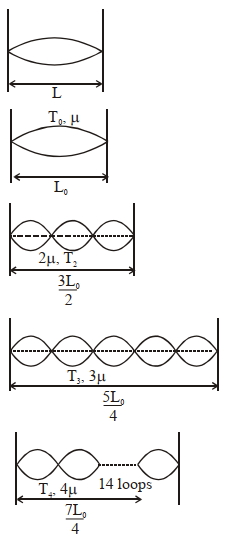
Answer the following by appropriately matching the lists based on the information given in the paragraph. A musical instrument is made using four different metal strings, $1,2,3$ and $4$ with mass per unit length $\mu, 2 \mu, 3 \mu$ and $4 \mu$ respectively. The instrument is played by vibrating the strings by varying the free length in between the range $L _0$ and $2 L _0$. It is found that in string$-1(\mu)$ at free length $L _0$ and tension $T _0$ the fundamental mode frequency is $f _0$.
List$-I$ gives the above four strings while List$-II$ lists the magnitude of some quantity.
$(1)$ If the tension in each string is $T _0$, the correct match for the highest fundamental frequency in $f _0$ units will be,
$(1)\ I \rightarrow P , II \rightarrow R , III \rightarrow S , IV \rightarrow Q$
$(2)\ I \rightarrow P , II \rightarrow Q , III \rightarrow T , IV \rightarrow S$
$(3)\ I \rightarrow Q , II \rightarrow S , III \rightarrow R , IV \rightarrow P$
$(4)\ I \rightarrow Q , II \rightarrow P , III \rightarrow R, IV \rightarrow T$
$(2)$ The length of the string $1,2,3$ and $4$ are kept fixed at $L _0, \frac{3 L _0}{2}, \frac{5 L _0}{4}$ and $\frac{7 L _0}{4}$, respectively. Strings $1,2,3$ and $4$ are vibrated at their $1^{\text {tt }}, 3^{\text {rd }}, 5^{\text {m }}$ and $14^{\star}$ harmonics, respectively such that all the strings have same frequency. The correct match for the tension in the four strings in the units of $T _0$ will be.
$(1)\ I \rightarrow P , II \rightarrow Q , III \rightarrow T , IV \rightarrow U$
$(2\ I \rightarrow T , II \rightarrow Q , III \rightarrow R, IV \rightarrow U$
$(3)\ I \rightarrow P , II \rightarrow Q , III \rightarrow R , IV \rightarrow T$
$(4) \ I \rightarrow P , II \rightarrow R , III \rightarrow T , IV \rightarrow U$
List$-I$ gives the above four strings while List$-II$ lists the magnitude of some quantity.
| List$-I$ | List$-II$ |
| $(I)$ String$-1( \mu$ ) | $(P) 1$ |
| $(II)$ String$-2 (2 \mu)$ | $(Q)1 / 2$ |
| $(III)$ String$-3 (3 \mu)$ | $(R)1 / \sqrt{2}$ |
| $(IV)$ String$-4 (4 \mu)$ | $(S)1 / \sqrt{3}$ |
| $(T)3 / 16$ | |
| $(U)1 / 16$ |
$(1)\ I \rightarrow P , II \rightarrow R , III \rightarrow S , IV \rightarrow Q$
$(2)\ I \rightarrow P , II \rightarrow Q , III \rightarrow T , IV \rightarrow S$
$(3)\ I \rightarrow Q , II \rightarrow S , III \rightarrow R , IV \rightarrow P$
$(4)\ I \rightarrow Q , II \rightarrow P , III \rightarrow R, IV \rightarrow T$
$(2)$ The length of the string $1,2,3$ and $4$ are kept fixed at $L _0, \frac{3 L _0}{2}, \frac{5 L _0}{4}$ and $\frac{7 L _0}{4}$, respectively. Strings $1,2,3$ and $4$ are vibrated at their $1^{\text {tt }}, 3^{\text {rd }}, 5^{\text {m }}$ and $14^{\star}$ harmonics, respectively such that all the strings have same frequency. The correct match for the tension in the four strings in the units of $T _0$ will be.
$(1)\ I \rightarrow P , II \rightarrow Q , III \rightarrow T , IV \rightarrow U$
$(2\ I \rightarrow T , II \rightarrow Q , III \rightarrow R, IV \rightarrow U$
$(3)\ I \rightarrow P , II \rightarrow Q , III \rightarrow R , IV \rightarrow T$
$(4) \ I \rightarrow P , II \rightarrow R , III \rightarrow T , IV \rightarrow U$
- A$1,2$
- B$1,3$
- C$1,1$
- D$1,4$