Question
Answer the following questions:
A low voltage supply from which one needs high currents must have very low internal resistance. Why?

Answer

According to Ohm's law, the relation for the potential is V = IR
Voltage (V) is directly proportional to current (I).
R is the internal resistance of the source.
$\text{I}=\frac{\text{V}}{\text{R}}$
If V is low, then R must be very low, so that high current can be drawn from the source.

Need a full question paper?

Generate a complete, print-ready paper with questions like this in minutes — across 16+ boards, with answer keys.
Start Generating Free

Similar questions

Draw a labelled ray diagram of a reflecting telescope. Mention its two advantages over the refracting telescope.
A heavy box is kept on a smooth inclined plane and is pushed up by a force F acting parallel to the plane. Does the work done by the force F as the box goes from A to B depend on how fast the box was moving at A and B? Does the work by the force of gravity depend on this?
Two transparent slabs having equal thickness but different refractive indices $\mu_1$ and $\mu_2$ are pasted side by side to form a composite slab. This slab is placed just after the double slit in a Young's experiment so that the light from one slit goes through one material and the light from the other slit goes through the other material. What should be the minimum thickness of the slab so that there is a minimum at the point $P_0$ which is equidistant from the slits?
Can you hear your own words if you are standing in a perfect vacuum? Can you hear your friend in the same conditions?
A parallel plate capacitor made of circular plates each of radius $R = 6.0 \ cm$ has a capacitance $C = 100 pF$. The capacitor is connected to a $230 V$ ac supply with a $($angular$)$ frequency of $300 \ \text{rad s}_{^{-1}}.$
  1. What is the rms value of the conduction current?
  2. Is the conduction current equal to the displacement current?
  3. Determine the amplitude of $B$ at a point $3.0 \ cm$ from the axis between the plates.
Write down the difference between forward bias and reverse bias of $p-n$ junction diode.
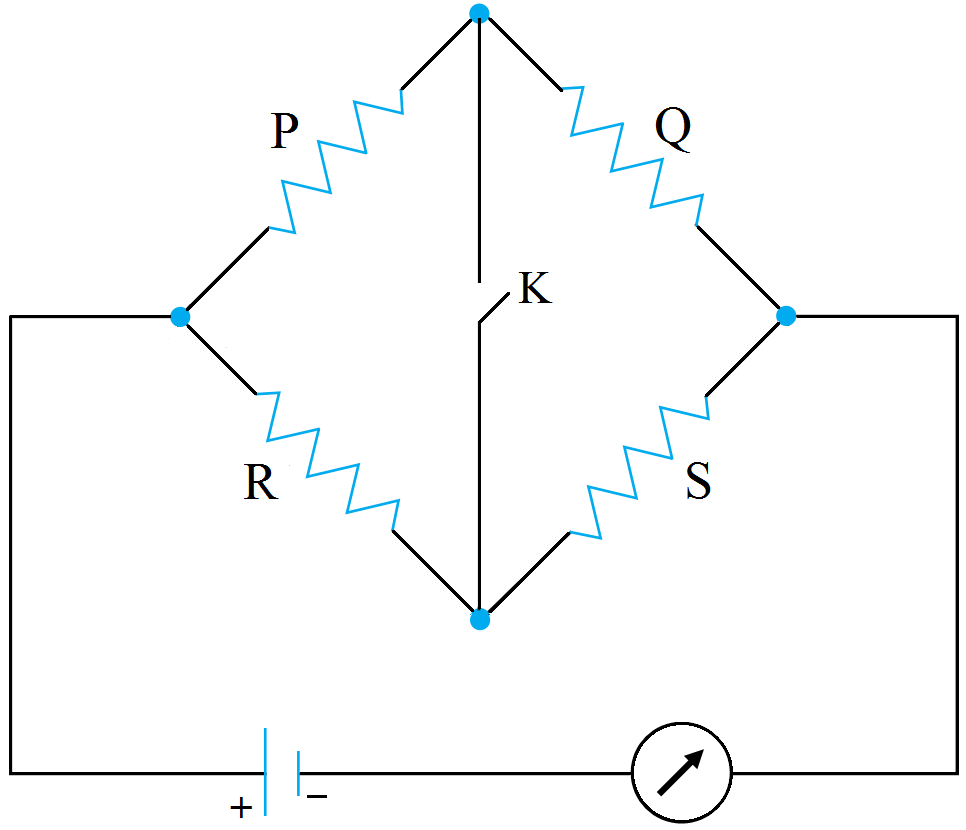
In a Wheatstone’s bridge experiment, a student by mistake, connects key (K) in place of galvanometer and galvanometer (G) in place of key (K). What will be the test for the balance of the bridge?
An aeroplane travels over a rectangular field 100m × 50m, parallel to its length. What should be the speed of the plane so that the field becomes square in the plane frame?
What is nucleus? Give a general introduction.
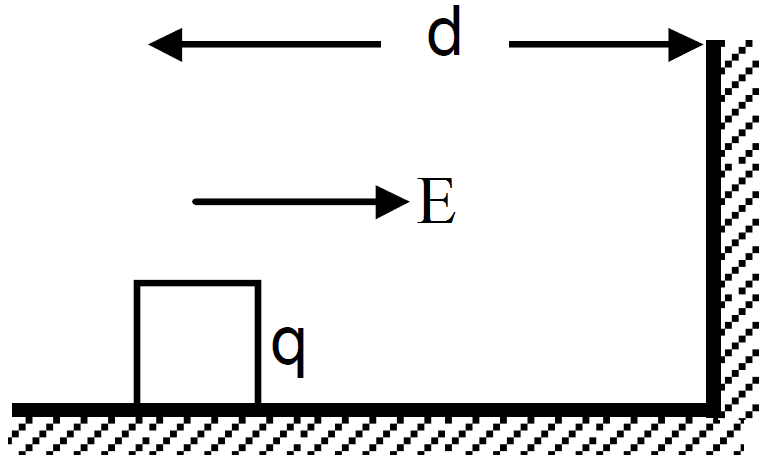
A block of mass m containing a net positive charge q is placed on a smooth horizontal table which terminates in a vertical wall as shown in figure. The distance of the block from the wall is d. A horizontal electric field E towards right is switched on. Assuming elastic collisions (if any) find the time period of the resulting oscillatory motion. Is it a simple harmonic motion?