Questions

1 Marks Question

Take a timed test

78 questions · self-marked practice — reveal the answer and mark yourself.

Question 11 Mark
Answer the following : The triple-point of water is a standard fixed point in modern thermometry. Why? What is wrong in taking the melting point of ice and the boiling point of water as standard fixed points (as was originally done in the Celsius scale)?
Answer
Melting and boiling points of water aren’t considered as the standard fixed points because they vary with change in pressure, the temperature of triple point of water is unique and it does not vary with pressure.
View full question & answer
Question 21 Mark
Answer the following : There were two fixed points in the original Celsius scale as mentioned above which were assigned the number 0°C and 100°C respectively. On the absolute scale, one of the fixed points is the triple-point of water, which on the Kelvin absolute scale is assigned the number 273.16 K. What is the other fixed point on this (Kelvin) scale?
Answer
On the Kelvin’s scale there is only a lower fixed point which is 273.16K, the upper fixed point is not there.
View full question & answer
Question 31 Mark
Answer the following: The absolute temperature (Kelvin scale) T is related to the temperature tc on the Celsius scale by tc = T – 273.15.
Answer
The relation is such because 273.15K on the Kelvin’s scale corresponds to the melting point of ice while 273.16K is the triple point of water.
View full question & answer
Question 41 Mark
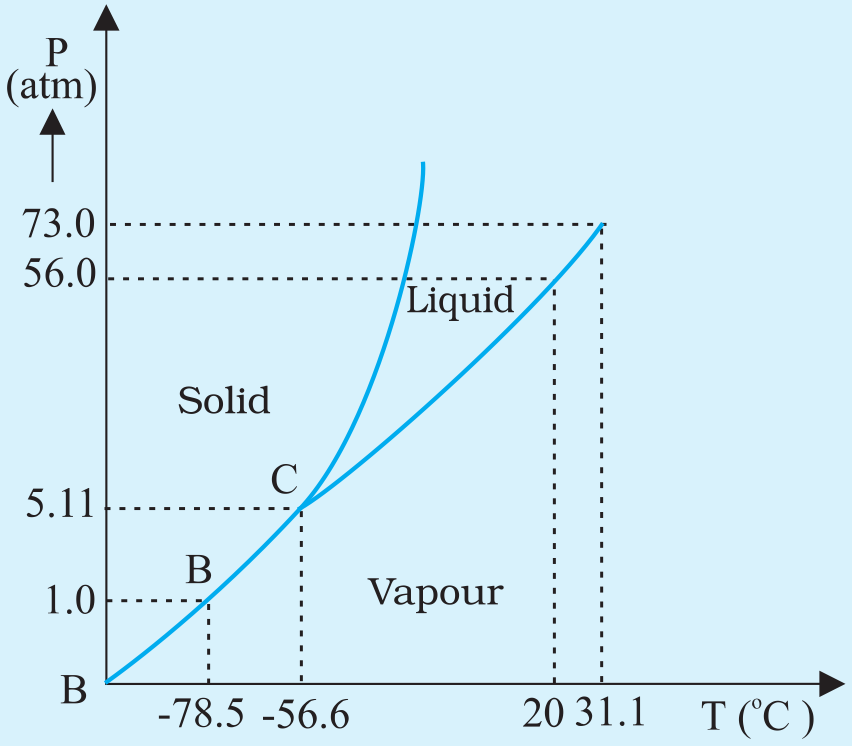
Answer the following questions based on the P-T phase diagram of carbon dioxide
a. At what temperature and pressure can the solid, liquid and vapour phases of $\mathrm{CO}_2$ co-exist in equilibrium ?
b. What is the effect of decrease of pressure on the fusion and boiling point of $\mathrm{CO}_2$ ?
c. What are the critical temperature and pressure for $\mathrm{CO}_2$ ? What is their significance?
d. Is $\mathrm{CO}_2$ solid, liquid or gas at (a) $-70^{\circ} \mathrm{C}$ under 1 atm , (b) $-60^{\circ} \mathrm{C}$ under $10 \mathrm{~atm}, 15^{\circ} \mathrm{C}$ under 56 atm ?
Answer
The P–T phase diagram for $CO_2$ is shown in the following figure:

The solid, liquid and vapour phase of carbon dioxide exist in equilibrium at the triple point, i.e., temprature $=-$ $56.6^{\circ} \mathrm{C}$ and pressure $=5.11 \mathrm{~atm}$. With the decrease in pressure, both the fusion and boiling point of carbon dioxide will decrease. For carbon dioxide, the critical temperature is $31.1^{\circ} \mathrm{C}$ and critical pressure is 73.0 atm . If the temprature of carbon dioxide is more than $31.1^{\circ} \mathrm{C}$, it can not be liquified, however large pressure we may apply. Carbon dioxide will be (a) a vapour, at $=70^{\circ} \mathrm{C}$ under 1atm. (b) a solid, at $-6^{\circ} \mathrm{C}$ under 10 atm (c) a liquid, at $15^{\circ} \mathrm{C}$ under 56 atm .
View full question & answer
Question 51 Mark
Answer the following : The triple-point of water is a standard fixed point in modern thermometry. Why? What is wrong in taking the melting point of ice and the boiling point of water as standard fixed points (as was originally done in the Celsius scale)?
Answer
Melting and boiling points of water aren’t considered as the standard fixed points because they vary with change in pressure, the temperature of triple point of water is unique and it does not vary with pressure.
View full question & answer
Question 71 Mark
Solar pond is a device for collecting solar heat. The pond is about one metre deep, filled with saturated salt solution and protected from air current and other disturbances. When exposed to sun, the temperature at the bottom can go as high as 80°C or more. Why is this possible?
Answer
It is due to the fact that the thermal conductivity of salt is very high.
View full question & answer
Question 81 Mark
Why birds are often seen to swell their feathers in winter?
Answer
When the birds swell their feathers, they are able to enclose air in the feathers. Air, being a poor conductor of heat, so it prevents the loss of heat from the bodies of the birds to the surroundings and as such they do not feel cold in winter.
View full question & answer
Question 91 Mark
A black metal foil is warmed by radiation from a sphere at temperature T at a distance d. If the power received is P, find the power received when both the temperature and distance are doubled.
Answer
Power radiated $\propto\frac{\text{T}^4}{\text{d}^2}$ $\frac{\text{P}'}{\text{P}}=\frac{2^4\text{T}^4}{2^2\text{d}^2}$ $\text{P}'=\text{P}.$
View full question & answer
Question 101 Mark
Can we boil water inside in the earth satellite?
Answer
No, the process of transfer of heat by convection is based on the fact that a liquid becomes lighter on becoming hot and rise up. In condition of weightlessness, this is not possible. So, transfer of heat by convection is not possible in the earth satellite.
View full question & answer
Question 111 Mark
Tea gets cooled when sugar is added to it. Why?
Answer
The sugar absorbs heat energy from the tea and hence temperature of the tea decreases.
View full question & answer
Question 121 Mark
Answer the following : There were two fixed points in the original Celsius scale as mentioned above which were assigned the number 0°C and 100°C respectively. On the absolute scale, one of the fixed points is the triple-point of water, which on the Kelvin absolute scale is assigned the number 273.16 K. What is the other fixed point on this (Kelvin) scale?
Answer
On the Kelvin’s scale there is only a lower fixed point which is 273.16K, the upper fixed point is not there.
View full question & answer
Question 131 Mark
Answer the following: The absolute temperature (Kelvin scale) T is related to the temperature tc on the Celsius scale by tc = T – 273.15.
Answer
The relation is such because 273.15K on the Kelvin’s scale corresponds to the melting point of ice while 273.16K is the triple point of water.
View full question & answer
Question 141 Mark
Each side of a cube increases by 0.01% on heating. How much is the area of its faces and volume increased?
Answer
The area of the faces will increased by 0.02% and the volume by 0.03%.
View full question & answer
Question 151 Mark
What is the condition for the difference between the length of a certain brass rod and that of a steel rod to be constant at all temperature?
Answer
The condition is that the lengths of the rods are inversely proportional to the coefficients of linear expansion of the materials of the rods.
View full question & answer
Question 161 Mark
Does the boiling point of water change with pressure?
Answer
The boiling point of water increases with the increase in pressure (and vice-versa).
View full question & answer
Question 181 Mark
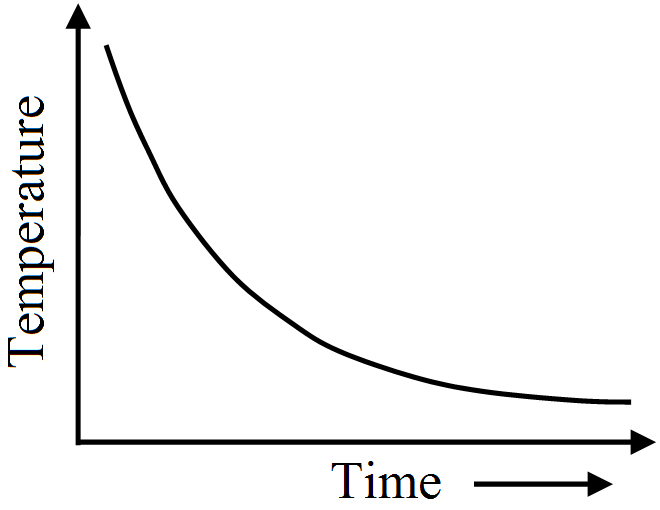
Show graphically the temperature variation with time associated with a cooling hot body.
Answer
The rate of loss reduces as the temperature difference with surrounding is reduced.
View full question & answer
Question 191 Mark
Black body radiation is white. Comment.
Answer
The statement is true. A black body absorbs radiations of all wavelengths. When heated to a suitable temperature, it emits radiations of all wavelengths. Hence, a black body radiation is white.
View full question & answer
Question 201 Mark
Give the relation between celsius, Fahrenheit and reaumur scale temperature.
Answer
$\frac{\text{C}-0}{100-0}=\frac{\text{F}-32}{212-32}\approx\frac{\text{R}-0}{8-0}$
View full question & answer
Question 211 Mark
What is the shift in the colour of light when the temperature increases?
Answer
As temperature increases, the wavelength decreases and frequency increases.
View full question & answer
Question 221 Mark
How does density of a solid change as it is heated?
Answer
Density of a solid decreases as it is heated i.e., as its temperature rises) as per following. $\rho'=\rho(1-\gamma\Delta\text{T}),$ where $\rho=$ density of given solid at temperature T and $\rho'=$ density given solid at temperature $(\text{T}+\Delta\text{T}).$
View full question & answer
Question 241 Mark
Why do two layers of a cloth of equal thickness provide warmer covering than a single layer of cloth of double the thickness?
Answer
The air enclosed between two layers of cloths prevents the transmission of heat from our body to outside.
View full question & answer
Question 261 Mark
Which substance has maximum value of specific heat?
Answer
Out of solids and liquids water has maximum value of specific heat $\left(4186 \mathrm{~J} / \mathrm{kg}^{-1} \mathrm{~K}^{-1}\right)$. In gases, hydrogen gas has maximum value of specific heat, which is even more than that of water.
View full question & answer
Question 271 Mark
What is the relation between the coefficient of linear expansion and coefficient of volume expansion?
Answer
Coefficient of volume expansion = 3 × coefficient of linear expansion.
View full question & answer
Question 281 Mark
Is the value of temperature coefficient of expansion always positive?
Answer
Generally, the value of temperature coefficient of expansion is positive. But in certain cases e.g., water between 0°C and 4°C, the expansion coefficient is negative.
View full question & answer
Question 291 Mark
Is it possible to convert water into vapour form without increasing its temperature, if temperature and pressure of water are 30°C and 1 atm respectively?
Answer
Yes, water at 30°C can be converted into vapour by reducing its pressure until it equals to the vapour pressure of water at 30°C.
View full question & answer
Question 301 Mark
Why two layers of cloth of equal thickness provide warmer covering than a single layer of cloth of double thickness?
Answer
This is because the air enclosed between the two layers of cloth acts as a good heat insulator.
View full question & answer
Question 311 Mark
Why does a piece of red glass when heated and taken out glow with green light?
Answer
At low temperature, red glass absorbs green colour strongly. Therefore, at higher temperatures, it emits green colour strongly and appears green.
View full question & answer
Question 321 Mark
Why do birds swell their feathers in winter?
Answer
They swell their feathers and maintain a column of air, which is an insulator, to avoid loss of heat from body to the surrounding (cold).
View full question & answer
Question 331 Mark
Birds swell their feathers in winter. Why?
Answer
Birds swell their feathers and maintain a column of air, which is an insulator, to avoid the loss of heat from the body to the surrounding (cold).
View full question & answer
Question 341 Mark
A slab consists of two parallel layers of two different materials of the same thickness, having thermal conductivities $\text{K}_1$ and $\text{K}_2$. What is the equivalent thermal conductivity of the slab?
Answer
$\frac{2\text{K}_1\text{K}_2}{\text{K}_1+\text{K}_2}$
View full question & answer
Question 351 Mark
If all the objects radiate electromagnetic energy, why do not the objects around us in everyday life become colder and colder?
Answer
According to the Principal of heat exchange, all the objects (above 0K) not only radiate electromagnetic energy but also absorb at the same rate from their surroundings. Thus, they do not become colder.
View full question & answer
Question 361 Mark
Place a safety pin on a sheet of paper. Hold the sheet over a burning candle, until the paper becomes yellow and charr. On removing the pin, its white trace is observed on the paper. Why?
Answer
The safety pin is made of steel which is good conductor of heat. So, the safety pin takes heat from the paper under it and transfer it away to the surroundings. The portion of the paper under the safety pin remains comparatively colder than the remaining part.
View full question & answer
Question 371 Mark
Why is it cooler at the top of mountains?
Answer
Atmosphere is less dense at higher altitudes. So, the radiated energy from surface of earth escapes at higher altitudes. So, it is comparatively cooler at high mountains.
View full question & answer
Question 381 Mark
Why the temperature above 1200°C cannot be measured accurately by a platinum resistance thermometer?
Answer
This is because platinum begins to evaporate above 1200°C.
View full question & answer
Question 391 Mark
The temperature gradient in a rod 0.5m long is 80°C per metre. The temperature of the hotter end is 30°C. What is the temperature of the colder end?
Answer
30 - 0.5 × 80 = -10°C.
View full question & answer
Question 401 Mark
Why an ice box is constructed with a double wall?
Answer
An ice box is made of double wall and the space in between the walls is filled with some non-conducting material to provide heat insulation, so that the loss of heat can be minimised.
View full question & answer
Question 411 Mark
A wooden charcoal and a metal piece of the same dimension are heated in the same oven to the same temperature and then removed in the dark. Which one would shine more and why?
Answer
Charcoal will shine more as it is a good absorber and good emitter, so it will emit more energy.
View full question & answer
Question 421 Mark
Why should a thermometer bulb have a small heat capacity?
Answer
The thermometer bulb having small heat capacity will absorb less heat from the body whose temperature is to be measured. Hence, the temperature of that body will practically remain unchanged.
View full question & answer
Question 431 Mark
Name three factors affecting the energy radiated by a hot body.
Answer
  1. Nature of surface $($emissivity$)$.
  2. Temperature.
  3. Surface area.
View full question & answer
Question 441 Mark
When we step barefoot into an office with a marble floor, we feel cold. Why?
Answer
This is because marble is a better conductor of heat than concrete. When we walk barefooted on a marble floor, heat flows our body through the feet and we feel cold.
View full question & answer
Question 451 Mark
Why is a gap left between the ends of two railway lines in a railway track?
Answer
It is done to accommodate the linear expansion of railway line during summer. If the gap is not left in summer, the lines will bend causing a threat of derailment.
View full question & answer
Question 461 Mark
“All black surfaces are not good radiators.” Comment.
Answer
The statement is wrong. All black bodies or surfaces are good absorbers and radiators.
View full question & answer
Question 471 Mark
Two bodies at different temperatures $\text{T}_1$ and $\text{T}_2$, if brought in thermal contact do not necessarily settle at the mean temperature $\frac{(\text{T}_1+\text{T}_2)}{2}.$ Why?
Answer
The two bodies may have different masses and different materials i.e. they may have different thermal capacities. In case the two bodies have equal thermal capacities, they would settle at the mean temperature $\frac{\text{T}_1+\text{T}_2}{2}.$
View full question & answer
Question 481 Mark
A substance absorbs heat $\text{Q}_1$ in going from one state to another and releases $\text{Q}_2$ in coming from the second state to the first state. How much work is done by the substance and what is the change in the internal energy of the substance?
Answer
Work done $\text{W}$ = $\text{Q}_1$ - $\text{Q}_2$, $\Delta \text{U}=0.$
View full question & answer
Question 491 Mark
Good reflectors are poor emitters of thermal radiation. Explain.
Answer
A body with good reflectivity is a poor absorber of heat and the poor absorbers of heat are poor emitters of thermal radiations.
View full question & answer
Question 501 Mark
What is specific heat of a gas in an isothermal process?
Answer
Infinite, because $\Delta\text{T}=0;$ use $\text{C}=\frac{\Delta\text{Q}}{\text{m}\Delta\text{T}}.$
View full question & answer
Question 511 Mark
A metal disc has a hole on it. What happens to the size of hole when the disc is heated?
Answer
When the disc is heated, along with its dimensions the size of hole also increases.
View full question & answer
Question 531 Mark
How many fixed points are taken in absolute (kelvin) scale of temperature and what is their value?
Answer
On kelvin scale we select only one fixed point, namely, the triple-point of pure water. Its value of $\mathrm{T}_{\mathrm{tr}}=273.16 \mathrm{~K}=$ $0.01^{\circ} \mathrm{C}$.
View full question & answer
Question 541 Mark
What is sublimation?
Answer
On heating a substance, the change from solid state to vapour state without passing through the liquid state is called sublimation.
View full question & answer
Question 551 Mark
Stainless steel cooking pans are preferred with extra copper bottom. Why?
Answer
The thermal conductivity of copper is much larger than that of steel. The copper bottom allows more heat to flow into the pan and hence helps in cooking the food faster.
View full question & answer
Question 561 Mark
Why can water in a metallic pot be boiled quickly if the bottom of the pot is made black and rough than highly polished?
Answer
The black and rough surface is a better absorber of heat than a highly polished surface.
View full question & answer
Question 571 Mark
Is it correct to call heat as the energy in transit?
Answer
Yes, it is perfect correct to call heat as the energy in transit because it is continuously flowing on account of temperature difference between bodies or parts of a system.
View full question & answer
Question 581 Mark
What happens to the phase of water at its critical point?
Answer
At the critical point, water and water vapours are equally dense.
View full question & answer
Question 591 Mark
Usually a good conductor of heat is a good conductor of electricity also. Give reason.
Answer
Electrons contribute largely both towards the flow of electricity and the flow of heat. A good conductor contains a large number of free electrons. So, it is both a good conductor of heat and electricity.
View full question & answer
Question 601 Mark
Why water is used as an coolant in the radiator of cars?
Answer
Because, specific heat of water is very high due to this it absorbs a large amount of heat. This helps in maintaining the temperature of the engine low.
View full question & answer
Question 611 Mark
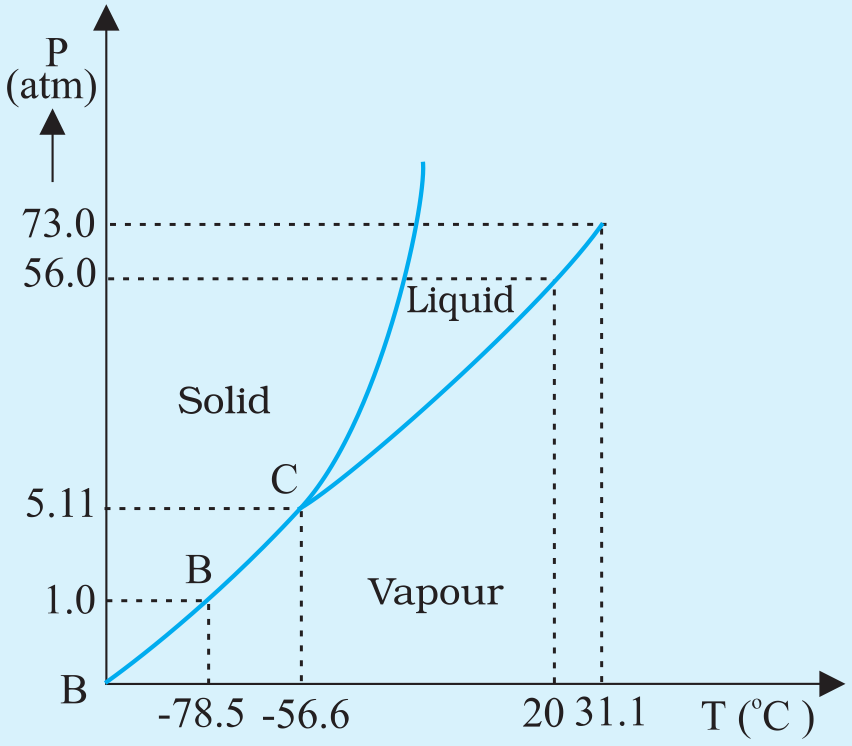
Answer the following questions based on the P-T phase diagram of carbon dioxide
a. At what temperature and pressure can the solid, liquid and vapour phases of $\mathrm{CO}_2$ co-exist in equilibrium ?
b. What is the effect of decrease of pressure on the fusion and boiling point of $\mathrm{CO}_2$ ?
c. What are the critical temperature and pressure for $\mathrm{CO}_2$ ? What is their significance?
d. Is $\mathrm{CO}_2$ solid, liquid or gas at (a) $-70^{\circ} \mathrm{C}$ under 1 atm , (b) $-60^{\circ} \mathrm{C}$ under $10 \mathrm{~atm}, 15^{\circ} \mathrm{C}$ under 56 atm ?
Answer
The P–T phase diagram for $CO_2$ is shown in the following figure:

 The solid, liquid and vapour phase of carbon dioxide exist in equilibrium at the triple point, i.e., temprature $=-$ $56.6^{\circ} \mathrm{C}$ and pressure $=5.11 \mathrm{~atm}$. With the decrease in pressure, both the fusion and boiling point of carbon dioxide will decrease. For carbon dioxide, the critical temperature is $31.1^{\circ} \mathrm{C}$ and critical pressure is 73.0 atm . If the temprature of carbon dioxide is more than $31.1^{\circ} \mathrm{C}$, it can not be liquified, however large pressure we may apply. Carbon dioxide will be (a) a vapour, at $=70^{\circ} \mathrm{C}$ under 1 atm . (b) a solid, at $-6^{\circ} \mathrm{C}$ under 10 atm (c) a liquid, at $15^{\circ} \mathrm{C}$ under 56 atm .
View full question & answer
Question 621 Mark
Relate emissivity 'e', absorptivity ‘a' and reflectivity ‘r’.
Answer
e + a + r = 1, based on the concept of energy conservation.
View full question & answer
Question 631 Mark
Does specific heat of water remain constant throughout?
Answer
No, the specific heat of water changes with temperature range.
View full question & answer
Question 641 Mark
Calorimeters are made of metals not glass. Why?
Answer
This is because metals are good conductors of heat and have low specific heat capacity.
View full question & answer
Question 651 Mark
Which object will cool faster when kept in open air, the one at 300°C or the one of 100°C? Why?
Answer
The object at 300°C will cool faster than the object at 100°C. This is in accordance with Newton's law of cooling. As we know, rate cooling of an object o temperature between the object and its surroundings.
View full question & answer
Question 661 Mark
What are the three modes of transmission of heat energy from one point to another point?
Answer
Conduction, Convection and Radiation.
View full question & answer
Question 671 Mark
If the earth did not have an atmosphere it would become intolerable cold. Why?
Answer
The lower layer of earth's atmosphere reflects infra-red radiations from earth back to the surface of the earth. So the heat radiation received by the earth from the sun during day time are trapped by the atmosphere. Therefore, if the earth did not have atmosphere, its surface would become too cold to tolerate.
View full question & answer
Question 681 Mark
Give dimensions of Solar Constant and Water Equivalent.
Answer
Solar constant $=\left[\mathrm{MT}^{-3}\right]$ Water equivalent $=\left[\mathrm{ML}^2 \mathrm{~T}^{-2} \mathrm{~K}^{-1}\right]$
View full question & answer
Question 691 Mark
Can temperature on celsius scale and Kelvin scale related?
Answer
t(ºC) = T(k) - 273.15 or T(K) = t(ºC) + 273.15
View full question & answer
Question 701 Mark
If a drop of water falls on a hot plate, it takes long time to evaporate. Why?
Answer
The vapour formed at the instant of landing of the drop acts as an insulator and prevents the heat being passed on to the water above. So it takes time to evaporate.
View full question & answer
Question 711 Mark
On winter nights, we feel warmer when clouds cover the sky than when the sky is clear. Why?
Answer
Clouds are bad conductors. So, heat of the Earth's atmosphere is not conducted out.
View full question & answer
Question 721 Mark
White clothes are more comfortable in summer while colourful clothes are more comfortable in winter. Why?
Answer
White clothes absorb very little heat radiation and hence they are comfortable in summer. Coloured clothes absorb almost whole of the incident radiation and keep the body warm in winter.
View full question & answer
Question 731 Mark
What are the S.I. and C.G.S. units of heat? How are they related?
Answer
SI unit of heat is joule and C.G.S. unit of heat is calorie. 1 calorie = 4.18 Joule.
View full question & answer
Question 741 Mark
A thermos flask containing tea is shaken vigorously considering tea as a system.
  1. Has heat been added to tea?
  2. Has work been done on it?
  3. Has its internal energy changed?
  4. Does its temperature rise?
Answer
  1. No, heat is not transferred as the flask is insulated from the surrounding.
  1. $\therefore\text{dQ}=0$
  2. Yes, work is done in shaking $($against the viscous force$)$, i.e., $\text{DW}$ is negative.
  3. Yes, internal energy of tea increases. As $dU = dQ - dW = 0 - dW$, and $W$ is negative, therefore $dU$ is positive.
  4. Yes, the temperature of tea rises because of increase in internal energy.
View full question & answer
Question 751 Mark
What is the value of latent heat of ice?
Answer
Latent heat of ice has a value $3.33 \times 10^5 \mathrm{~J} / \mathrm{kg}$ or $80 \mathrm{kcal} / \mathrm{kg}$.
View full question & answer
Question 761 Mark
Write one application of Kirchhoff's law.
Answer
Kirchhoff's law helps us to study the atmosphere of the sun.
View full question & answer
Question 771 Mark
What is temperature gradient?
Answer
The fall in temperature of a body per unit distance is called the temperature gradient.
View full question & answer
Question 781 Mark
A blacksmith fixes iron ring on the rim of the wooden wheel of a horse cart. The diameter of the rim and the iron ring are $5.243 m$ and $5.231 m$, respectively at $27 ^\circ C$. To what temperature should the ring be heated so as to fit the rim of the wheel?
Answer
Given,
$T_1=27^{\circ} C$
$L_{ T 1}=5.231 m$
$L_{ T 2}=5.243 m$
So,
$L_{T2}=L_{T1}\left[1+\alpha_1\left(T_2-T_1\right)\right]$
$5.243 m =5.231 m \left[1+1.2010^{-5} K ^{-1}\left(T_2-27^{\circ} C \right)\right]$
$\text { or } T_2=218^{\circ} C .$
View full question & answer