Question
Are the given numbers $1, 3, 9, 27, ........$  forms an $AP$? If It forms an $AP$, then find the common difference d and write the next three terms.
Answer

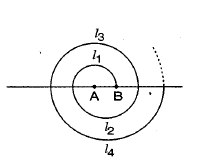
According to question we are given that a spiral is made up of successive semi-circles, with centres alternately at A and B, starting with centre at A, of radii 0.5 cm, 1.0 cm, 1.5 cm, 2.0 cm, ....as shown in Fig.Let $l_1, l_2, l_3, l_4,..l_{13}$ be the lengths (circumferences) of semi-circles of radii $r_1= 0.5 cm, r_2 =1.0 cm, r_3 = 1.5 cm, r_4 = 2.0 cm, r_5 = 2.5 cm,...$ respectively.

Now, Semi-perimeter of circle = $\pi\cdot r $
Therefore,
$l _ { 1 } = \pi r _ { 1 } = \pi \times 0.5 = \frac { \pi } { 2 } \mathrm { cm }$
$l _ { 2 } = \pi r _ { 2 } = \pi \times 1 = 2 \left( \frac { \pi } { 2 } \right) \mathrm { cm }$
$l _ { 3 } = \pi r _ { 3 } = \pi \times \frac { 3 } { 2 } = 3 \left( \frac { \pi } { 2 } \right) \mathrm { cm }$
$l _ { 4 } = \pi r _ { 4 } = \pi \times 2 = 4 \left( \frac { \pi } { 2 } \right) \mathrm { cm }$
and
$l _ { 13 } = \pi r _ { 13 } = \pi \times \frac { 13 } { 2 } \mathrm { cm } = 13 \left( \frac { \pi } { 2 } \right) \mathrm { cm }$
Therefore total length of the spiral $= l_1 + l_2 + l_3 +...+ l_{13}$
$\bf= \left\{ \frac { \pi } { 2 } + 2 \left( \frac { \pi } { 2 } \right) + 3 \left( \frac { \pi } { 2 } \right) + \dots + 13 \left( \frac { \pi } { 2 } \right) \right\} $
$\bf= \frac { \pi } { 2 } ( 1 + 2 + 3 + \cdots + 13 ) $
$\bf= \frac { \pi } { 2 } \times \frac { 13 } { 2 } ( 1 + 13 ) \quad \left[ \text { Using } S _ { n } = \frac { n } { 2 } ( a + l ) \right]$
$\bf= \frac { \pi } { 2 } \times \frac { 13 } { 2 } \times 14$ = $\bf\frac { 1 } { 2 } \times \frac { 22 } { 7 } \times 13 \times 7$ = $\bf {143 cm}$
which is required length of the spiral made up of thirteen consecutive semi-circles.

Need a full question paper?

Generate a complete, print-ready paper with questions like this in minutes — across 16+ boards, with answer keys.
Start Generating Free