MCQ
Area under a speed $-$ time graph gives:
  • A
    The time taken by a moving object.
  • The distance travelled by a moving object.
  • C
    The acceleration of a moving object.
  • D
    The retardation of a moving object.

Answer

Correct option: B.
The distance travelled by a moving object.
The area under the velocity $-$ time graph gives the distance traveled by a moving object during that time interval.
While the area under the velocity$-$time graph gives displacement of the particle.

Need a full question paper?

Generate a complete, print-ready paper with questions like this in minutes — across 16+ boards, with answer keys.
Start Generating Free

Similar questions

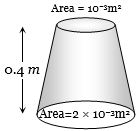
A uniformly tapering vessel is filled with a liquid of density $900 kg/m^3.$  The force that acts on the base of the vessel due to the liquid is ......... $N$. $(g = 10\,m{s^{ - 2}})$
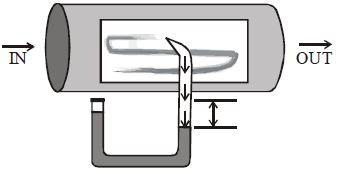
The Pitot tube shown in the figure is used to measure fluid flow velocity in a pipe of cross sectional area $S$. It was invented by a French engineer Henri Pitot in the early $18^{th}$ century. The volume of the gas flowing across the section of the pipe per unit time is (The difference in the liquid columns is $\Delta h,  \rho_0$ and  $\rho$  are the densities of liquid and the gas respectively) :-
The second overtone of an open organ pipe $A$ and a closed pipe $B$ have the same frequency at a given temperature. It follows that the ratio of the
A projectile thrown with a speed $v$ at an angle $\theta $ has a range $R$ on the surface of earth. For same $v$ and $\theta $, its range on the surface of moon will be
A metre scale is moving with uniform velocity. This implies:
At extreme position, velocity of the particle executing $\text{SHM}$ that has amplitude $A$ is:
A block of mass $m = 0.1\,kg$ is connected to a spring of unknown spring constant $k.$ It is compressed to a distance $x$ from its equilibrium. position and released from rest . After approaching half the distance $(\frac {x}{2})$ from equilibrium position, it hits another block and comes to rest momentarily, while the other block moves with a velocity $3\,ms^{-1}.$ The total initial energy of the spring is ................ $\mathrm{J}$
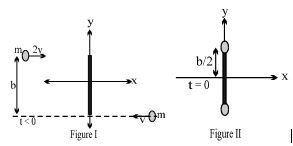
One ice skater of mass $m$ moves with speed $2v$ to the right, while another of the same mass $m$ moves with speed $v$ toward the left, as shown in figure $I$. Their paths are separated by $a$ distance $b$. At $t = 0$, when they are both at $x = 0$, they grasp a pole of length $b$ and negligible mass. For $t > 0$, consider the system as a rigid body of two masses $m$ separated by distance $b$, as shown in figure $II$. Which of the following is the correct formula for the motion after $t = 0$ of the skater initially at $y = b/2?$
If an electric heater is rated at $1000\, W$, then the time required to heat one litre of water from $20\,^oC$ to $60\,^oC$ is
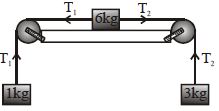
Three masses of $1\, kg$, $6\, kg$ and $3\, kg$ are connected to each other with threads and are placed on a tabel as shown in figure. ....... $ms^{-2}$ is the acceleration with which the block is moving. (Take $g = 10\, ms^2$)