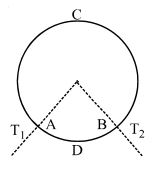
Aring consisting of two parts $ADB$ and $ACB$ of same conductivity $k$ carries an amount of heat $H$. The $ADB$ part is now replaced with another metal keeping the temperatures $T_1$ and $T_2$ constant. The heat carried increases to $2H$. What $ACB$ should be the conductivity of the new$ADB$ part? Given $\frac{{ACB}}{{ADB}}= 3$
Diffcult
Download our app for free and get started
$H_{1}+H_{2}=\frac{K A\left(T_{1}-T_{2}\right)}{3 l}+\frac{K A\left(T_{1}-T_{2}\right)}{l}=\frac{4}{3 l} K A\left(T_{1}-T_{2}\right)$
Now, $H_{2}=2 H-H_{1}=\frac{7 K A\left(T_{1}-T_{2}\right)}{3 l}=\frac{K^{\prime} A\left(T_{1}-T_{2}\right)}{l}$
$\therefore \quad K^{\prime}=\frac{7}{3} K$

Download our appand get started for free
Experience the future of education. Simply download our apps or reach out to us for more information. Let's shape the future of learning together!No signup needed.*
Similar Questions
- 1A cylindrical rod with one end in a steam chamber and the other end in ice results in melting of $0.1$ gm of ice per second. If the rod is replaced by another with half the length and double the radius of the first and if the thermal conductivity of material of second rod is $\frac{1}{4}$ that of first, the rate at which ice melts in $gm/\sec $will beView Solution
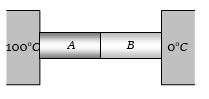
- 2Two metal cubes $A$ and $B$ of same size are arranged as shown in the figure. The extreme ends of the combination are maintained at the indicated temperatures. The arrangement is thermally insulated. The coefficients of thermal conductivity of $A$ and $B$ are $300\;W/m{\;^o}C$ and $200\;W/m{\;^o}C$, respectively. After steady state is reached, the temperature of the interface will be...... $^oC$View Solution
- 3View SolutionOn increasing the temperature of a substance gradually, which of the following colours will be noticed by you
- 4Surface of the lake is at $2°C$ . Find the temperature of the bottom of the lake..... $^oC$View Solution
- 5An ice cube of dimensions $60\,cm \times 50\,cm \times 20\,cm$ is placed in an insulation box of wall thickness $1\,cm$. The box keeping the ice cube at $0^{\circ}\,C$ of temperature is brought to a room of temperature $40^{\circ}\,C$. The rate of melting of ice is approximately. (Latent heat of fusion of ice is $3.4 \times 10^{5}\,J\,kg ^{-1}$ and thermal conducting of insulation wall is $0.05\,Wm ^{-10} C ^{-1}$ )View Solution
- 6The lengths and radii of two rods made of same material are in the ratios $1 : 2$ and $2 : 3$ respectively. If the temperature difference between the ends for the two rods be the same, then in the steady state, the amount of heat flowing per second through them will be in the ratioView Solution
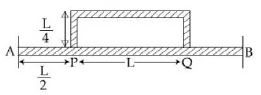
- 7Temperature difference of $120\,^oC$ is maintained between two ends of a uniform rod $AB$ of length $2L$. Another bent rod $PQ$, of same cross-section as $AB$ and length $\frac{{3L}}{2}$, is connected across $AB$ (See figure). In steady state, temperature difference between $P$ and $Q$ will be close to .......... $^oC$View Solution
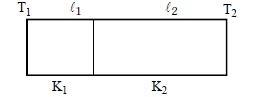
- 8One end of a thermally insulated rod is kept at a temperature $T_1$ and the other at $T_2$. The rod is composed of two sections of lengths $l_1$ and $l_2$ and thermal conductivities $K_1$ and $K_2$ respectively. The temperature at the interface of the two sections isView Solution
- 9A certain stellar body has radius $50 \,R_{s}$ and temperature $2 \,T_{s}$ and is at a distance of $2 \times 10^{10} \,AU$ from the earth. Here, $AU$ refers to the earth-sun distance and $R_{s}$ and $T_{s}$ refer to the sun's radius and temperature, respectively. Take, both star and sun to be ideal black bodies. The ratio of the power received on earth from the stellar body as compared to that received from the sun is close toView Solution
- 10The rate of loss of heat from a body cooling under conditions of forced convection is proportional to its $(A)$ heat capacity $(B)$ surface area $(C)$ absolute temperature $(D)$ excess of temperature over that of surrounding : state ifView Solution