As a wave propagates
IIT 1999, Medium
Download our app for free and get started
(d) For a travelling wave, the intensity of wave remainsconstant if it is a plane wave.
Intensity of wave is inversely proportional to the square of the distance from the source if the wave is spherical
$\left( {I = \frac{P}{{4\pi {r^2}}}} \right)$
Intensity of spherical wave on the spherical surface centred at source always remains same. Here total intensity means power $P$.
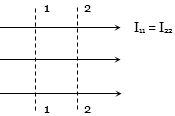
Intensity of wave is inversely proportional to the square of the distance from the source if the wave is spherical
$\left( {I = \frac{P}{{4\pi {r^2}}}} \right)$
Intensity of spherical wave on the spherical surface centred at source always remains same. Here total intensity means power $P$.

Download our appand get started for free
Experience the future of education. Simply download our apps or reach out to us for more information. Let's shape the future of learning together!No signup needed.*
Similar Questions
- 1A stone thrown into still water, creates a circular wave pattern moving radially outwards. If $r$ is the distance measured from the centre of the pattern. the amplitude of the wave aries asView Solution
- 2View SolutionWhich of the following graphs is/are correct.
- 3Two trains are moving towards each other at speeds of $20 m/s$ and $15 m/s$ relative to the ground. The first train sounds a whistle of frequency $600 Hz.$ the frequency of the whistle heard by a passenger in the second train before the train meets is ...... $Hz$ (the speed of sound in air is $340\, m/s$)View Solution
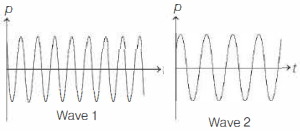
- 4View SolutionThe figure below shows pressure variation in two different sound waves in air with time at a given position. Both the figures are drawn to the same scale. Which of the following statements is true?
- 5A string is stretched between fixed points separated by $75.0\,\, cm.$ It is observed to have resonant frequencies of $420\,\, Hz$ and $315\,\, Hz$. There are no other resonant frequencies between these two. The lowest resonant frequency for this string is .... $Hz$View Solution
- 6For a certain organ pipe, three successive resonance frequencies are observed at $425,595,$ and $765 \,Hz$ respectively, Taking the speed of sound in air to be $340 \,m / s$ the fundamental frequency of the pipe (in $Hz$ ) is .........View Solution
- 7The minimum distance of reflector surface from the source for listening the echo of sound is ..... $m$View Solution
- 8View SolutionA musical scale is constructed by providing intermediate frequencies between a note and its octave which
- 9A table is revolving on its axis at $5$ revolutions per second. A sound source of frequency $1000 Hz$ is fixed on the table at $70 cm$ from the axis. The minimum frequency heard by a listener standing at a distance from the table will be .... $Hz$ (speed of sound $= 352 m/s$)View Solution
- 10The fundamental frequency of a sonometer wire increases by $6$ $Hz$ if its tension is increased by $44\%$ keeping the length constant. The change in the fundamental frequency of the sonometer wire in $Hz$ when the length of the wire is increased by $20\%$, keeping the original tension in the wire will be :-View Solution