Two trains are moving towards each other at speeds of $20 m/s$ and $15 m/s$ relative to the ground. The first train sounds a whistle of frequency $600 Hz.$ the frequency of the whistle heard by a passenger in the second train before the train meets is ...... $Hz$ (the speed of sound in air is $340\, m/s$)
Medium
Download our app for free and get started
(d) The frequency of whistle heard by passenger in the train $B$, is
$n' = n\,\left( {\frac{{v + {v_0}}}{{v - {v_s}}}} \right) = 600\,\left( {\frac{{340 + 15}}{{340 - 20}}} \right) \approx 666\;Hz$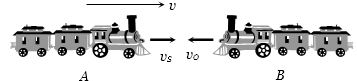

Download our appand get started for free
Experience the future of education. Simply download our apps or reach out to us for more information. Let's shape the future of learning together!No signup needed.*
Similar Questions
- 1A tube closed at one end and containing air is excited. It produces the fundamental note of frequency $512 Hz$. If the same tube is open at both the ends the fundamental frequency that can be produced is .... $Hz$View Solution
- 2A person feels $2.5\%$ difference of frequency of a motor-car horn. If the motor-car is moving to the person and the velocity of sound is $320\, m/sec,$ then the velocity of car will beView Solution
- 3View SolutionIf the temperature increases, then what happens to the frequency of the sound produced by the organ pipe
- 4A simple harmonic progressive wave is represented by the equation : $y = 8\sin 2\pi (0.1x - 2t)$ where $x$ and $y$ are in $cm$ and $t$ is in seconds. At any instant the phase difference between two particles separated by $2.0 \,cm$ in the $x-$direction is ..... $^o$View Solution
- 5View SolutionVelocity of sound measured in hydrogen and oxygen gas at a given temperature will be in the ratio
- 6View SolutionQuality of a musical note depends on
- 7In an experiment with sonometer a tuning fork of frequency $256 Hz$ resonates with a length of $25 cm$ and another tuning fork resonates with a length of $16 cm$. Tension of the string remaining constant the frequency of the second tuning fork is .... $Hz$View Solution
- 8For the stationary wave $y = 4\sin \,\left( {\frac{{\pi x}}{{15}}} \right)\cos (96\,\pi t)$, the distance between a node and the next antinode isView Solution
- 9A string of length $1 \mathrm{~m}$ and mass $2 \times 10^{-5} \mathrm{~kg}$ is under tension $\mathrm{T}$. when the string vibrates, two successive harmonics are found to occur at frequencies $750 \mathrm{~Hz}$ and $1000 \mathrm{~Hz}$. The value of tension $\mathrm{T}$ is. . . . . . .Newton.View Solution
- 10A tuning fork sounded together with a tuning fork of frequency $256$ emits two beats. On loading the tuning fork of frequency $256,$ the number of beats heard are $1$ per second. The frequency of tuning fork isView Solution