The fundamental frequency of a sonometer wire increases by $6$ $Hz$ if its tension is increased by $44\%$ keeping the length constant. The change in the fundamental frequency of the sonometer wire in $Hz$ when the length of the wire is increased by $20\%$, keeping the original tension in the wire will be :-
Diffcult
Download our app for free and get started
Fundamental frequency of sonometer
${\rm{n}} = \frac{1}{{2l}}\sqrt {\frac{{\rm{T}}}{{\rm{m}}}} $
when tension is increased by $44 \%$ then $n^{\prime}=n+6$
$ \Rightarrow {\rm{n}} + 6 = \frac{1}{{2l}}\sqrt {\frac{{1.44{\rm{T}}}}{{\rm{m}}}} = 1.2{\rm{n}} \Rightarrow {\rm{n}} = 30\,{\rm{Hz}}$
When length of the wire is increased by $20 \%$ then
${{\rm{n}}^\prime } = \frac{1}{{2{l^\prime }}}\sqrt {\frac{{\rm{T}}}{{\rm{m}}}} = \frac{1}{{2(1.2l)}}\sqrt {\frac{{\rm{T}}}{{\rm{m}}}} = \left( {\frac{1}{{1.2}}} \right)(30) = 25\,{\rm{Hz}}$
Change in frequency $=30-25=5 \mathrm{\,Hz}$

Download our appand get started for free
Experience the future of education. Simply download our apps or reach out to us for more information. Let's shape the future of learning together!No signup needed.*
Similar Questions
- 1Tube $A$ has both ends open while tube $B$ has one end closed, otherwise they are identical. The ratio of fundamental frequency of tube $A$ and $B$ isView Solution
- 2Two open organ pipes of length $60 \mathrm{~cm}$ and $90 \mathrm{~cm}$ resonate at $6^{\text {th }}$ and $5^{\text {th }}$ harmonics respectively. The difference of frequencies for the given modes is . . . . . $\mathrm{Hz}$.View Solution
(Velocity of sound in air $=333 \mathrm{~m} / \mathrm{s}$ )
- 3A tuning fork of frequency $100$ when sounded together with another tuning fork of unknown frequency produces $2$ beats per second. On loading the tuning fork whose frequency is not known and sounded together with a tuning fork of frequency $100$ produces one beat, then the frequency of the other tuning fork isView Solution
- 4Two engines pass each other moving in opposite directions with uniform speed of $30\,m/s$ . One of them is blowing a whistle of frequency $540\,Hz.$ Calculate the frequency heard by driver of second engine before they pass each other ... $Hz$. Speed of sound is $330\,m/sec$View Solution
- 5It takes $2.0$ seconds for a sound wave to travel between two fixed points when the day temperature is ${10^o}C.$ If the temperature rise to ${30^o}C$ the sound wave travels between the same fixed parts in ...... $sec$View Solution
- 6The equation of progressive wave is $y = 0.2\sin 2\pi \left[ {\frac{t}{{0.01}} - \frac{x}{{0.3}}} \right]$, where $x$ and $y$ are in metre and $t$ is in second. The velocity of propagation of the wave is .... $m/s$View Solution
- 7When two sound waves with a phase difference of $\pi /2$, and each having amplitude $A$ and frequency $\omega $, are superimposed on each other, then the maximum amplitude and frequency of resultant wave isView Solution
- 8A stationary source is emitting sound at a fixed frequency $\mathrm{f}_0$, which is reflected by two cars approaching the source. The difference between the frequencies of sound reflected from the cars is $1.2 \%$ of $f_0$. What is the difference in the speeds of the cars (in $\mathrm{km}$ per hour) to the nearest integer? The cars are moving at constant speeds much smaller than the speed of sound which is $330 \mathrm{~ms}^{-1}$.View Solution
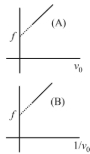
- 9A source of sound emits sound waves at frequency $f_0$. It is moving towards an observer with fixed speed $v_s$ ($v_s < v$, where $v$ is the speed of sound in air). If the observer were to move towards the source with speed $v_0$, one of the following two graphs ($A$ and $B$) will given the correct variation of the frequency $f$ heard by the observer as $v_0$ is changed The variation of $f$ with $v_0$ is given correctly byView Solution
- 10A string fixed at both ends is in resonance in its $2^{nd}$ harmonic with a tuning fork of frequency $f_1$. Now its one end becomes free. If the frequency of the tuning fork is increased slowly from $f_1$ then again a resonance is obtained when the frequency is $f_2$. If in this case the string vibrates in $n^{th}$ harmonic thenView Solution