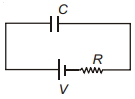
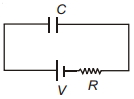
As in the figure, if a capacitor of capacitance $C$ is charged by connecting it with resistance $R$, then energy given by the battery will be
Easy


Download our appand get started for free
Experience the future of education. Simply download our apps or reach out to us for more information. Let's shape the future of learning together!No signup needed.*
Similar Questions
- 1A condenser of $2\,\mu F$ capacitance is charged steadily from $0$ to $5\,C$. Which of the following graph represents correctly the variation of potential difference $(V)$ across it's plates with respect to the charge $(Q)$ on the condenser?View Solution
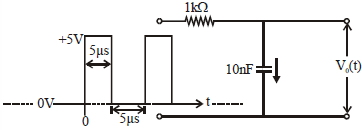
- 2For the given input voltage waveform $V_{\text {in }}( t )$, the output voltage waveform $V _{ D }( t ),$ across the capacitor is correctly depicted by:View Solution
- 3A cathode ray tube contains a pair of parallel metal plates $1.0\, cm$ apart and $3.0\, cm$ long. A narrow horizontal beam of electron with a velocity $3 \times 10^7\, m/s$ passed down the tube midway between the plates. When a potential difference of $550\, V$ is maintained across the plates, it is found that the electron beam is so deflected that it just strikes the end of one of the plates. Then the specific charge of the electron in $C/kg$ isView Solution
- 4A point charge $Q$ is placed in uniform electric field $\vec E = E_1 \hat i + E_2\hat j$ at position $(a, b)$. Find work done in moving it to position $(c, d)$View Solution
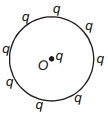
- 5A point charge $q$ is surrounded by eight identical charges at distance $r$ as shown in figure. How much work is done by the forces of electrostatic repulsion when the point charge at the centre is removed to infinity?View Solution
- 6A capacitor of capacity $C$ is connected with a battery of potential $V$ in parallel. The distance between its plates is reduced to half at once, assuming that the charge remains the same. Then to charge the capacitance upto the potential $V$ again, the energy given by the battery will beView Solution
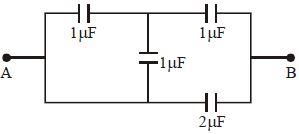
- 7The equivalent capacitance between points $A$ and $B$ of the circuit shown will beView Solution
- 8Two charges of magnitude $5\, nC$ and $-2\, nC$, one placed at points $(2\, cm, 0, 0)$ and $(x\, cm, 0, 0)$ in a region of space, where there is no other external field. If the electrostatic potential energy of the system is $ - 0.5\,\mu J$. The value of $x$ is.....$cm$View Solution
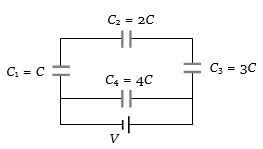
- 9A network of four capacitors of capacity equal to ${C_1} = C,\,\,{C_2} = 2C,\,{C_3} = 3C$ and ${C_4} = 4C$ are conducted in a battery as shown in the figure. The ratio of the charges on ${C_2}$ and ${C_4}$ isView Solution
- 10Two charged particles of masses $m$ and $2m$ have charges $+2q$ and $+q$ respectively. They are kept in uniform electric field and allowed to move for some time. The ratio of their kinetic energies will beView Solution