A condenser of $2\,\mu F$ capacitance is charged steadily from $0$ to $5\,C$. Which of the following graph represents correctly the variation of potential difference $(V)$ across it's plates with respect to the charge $(Q)$ on the condenser?
JEE MAIN 2022, Medium
Download our app for free and get started
$Q=C V$
$V=\frac{1}{C} Q$
Straight line with slope $=\frac{1}{C}$
Slope $=\frac{1}{C}=\frac{1}{2 \times 10^{-6}}=5 \times 10^{5}$

Download our appand get started for free
Experience the future of education. Simply download our apps or reach out to us for more information. Let's shape the future of learning together!No signup needed.*
Similar Questions
- 1The plates of a parallel plate condenser are pulled apart with a velocity $v$. If at any instant their mutual distance of separation is $d$, then the magnitude of the time of rate of change of capacity depends on $d$ as followsView Solution
- 2The capacitance of an air filled parallel plate capacitor is $10\,p F$. The separation between the plates is doubled and the space between the plates is then filled with wax giving the capacitance a new value of $40 \times {10^{ - 12}}farads$. The dielectric constant of wax isView Solution
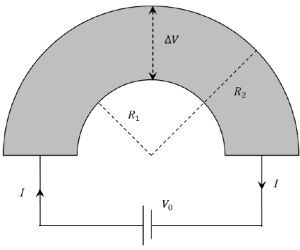
- 3Shown in the figure is a semicircular metallic strip that has thickness $t$ and resistivity $\rho$. Its inner radius is $R_1$ and outer radius is $R_2$. If a voltage $V_0$ is applied between its two ends, a current $I$ flows in it. In addition, it is observed that a transverse voltage $\Delta V$ develops between its inner and outer surfaces due to purely kinetic effects of moving electrons (ignore any role of the magnetic field due to the current). Then (figure is schematic and not drawn to scale)-View Solution
$(A)$ $I =\frac{V_0 t}{\pi \rho} \ln \left(\frac{R_2}{R_1}\right)$
$(B)$ the outer surface is at a higher voltage than the inner surface
$(C)$ the outer surface is at a lower voltage than the inner surface
$(D)$ $\Delta V \propto I ^2$
- 4When a charge of $3\, coulomb$ is placed in a uniform electric field, it experiences a force of $3000\, Newton$. Within this field, potential difference between two points separated by a distance of $1\, cm$ is........$volts$View Solution
- 5Eight small drops, each of radius $r$ and having same charge $q$ are combined to form a big drop. The ratio between the potentials of the bigger drop and the smaller drop isView Solution
- 6Two capacitors of capacitances $3\,\mu \,F$ and $6\,\mu F$ are charged to a potential of $12 \,V$ each. They are now connected to each other, with the positive plate of each joined to the negative plate of the other. The potential difference across each will be......$volt$View Solution
- 7There is an electric field $E$ in $X$-direction. If the work done on moving a charge $0.2\,C$ through a distance of $2\,m$ along a line making an angle $60^\circ $ with the $X$-axis is $4.0\;J$, what is the value of $E$........ $N/C$View Solution
- 8An electric dipole of dipole moment is $6.0 \times 10^{-6}\,Cm$ placed in a uniform electric field of $1.5 \times 10^3\,NC ^{-1}$ in such a way that dipole moment is along electric field. The work done in rotating dipole by $180^{\circ}$ in this field will be $.........\,mJ$View Solution
- 9View SolutionAssertion: Electron move away from a region of higher potential to a region of lower potential.
Reason: An electron has a negative charge.
- 10A parallel plate capacitor is made of two square parallel plates of area $A$ , and separated by a distance $d < < \sqrt A $ . The capacitor is connected to a battery with potential $V$ and allowed to fully charge. The battery is then disconnected. A square metal conducting slab also with area $A$ but thickness $\frac {d}{2}$ is then fully inserted between the plates, so that it is always parallel to the plates. How much work has been done on the metal slab by external agent while it is being inserted?View Solution