Question
As oscillating pendulum stops after some time. Is this a violation of the law of conservation of mechanical energy?

Answer

There is mutual conversion between the kinetic energy and potential energy of an oscillating pendulum. But the total energy of the object remains constant and the law of conservation of mechanical energy is followed. But this situation is possible only when friction force is not present but in reality there is some friction force in the oscillating pendulum due to which the pendulum stops after some time.

Need a full question paper?

Generate a complete, print-ready paper with questions like this in minutes — across 16+ boards, with answer keys.

Start Generating Free

Similar questions

Find the area bounded under the curve $y = 3x^2 + 6x + 7$ and the X-axis with the ordinates at x = 5 and x = 10.
Define heat conduction and coefficient of thermal conductivity.
A mass $M_1$ revolves around another mass $M_2$ in a path of radius r, what is the angular momentum associated with $M_1$?
What is the speed of an aircraft if the pilot remains in contact with the seat, even while looping in vertical plane?
Find the maximum potential difference which may be applied across an X-ray tube with tungsten target without emitting any characteristic K or L X-ray. The energy levels of the tungsten atom with an electron knocked out are as follows.
Cell containing vacancy
K
L
M
Energy in keV
69.5
11.3
2.3
Find the increase in mass when 1kg of water is heated from $0^\circ c$ to $100^\circ C$. Specific heat capacity of water = 4200J/kg-K.
Although velocity of air molecules is very fast but fragnance of a perfume spreads at a much slower rate, explain?
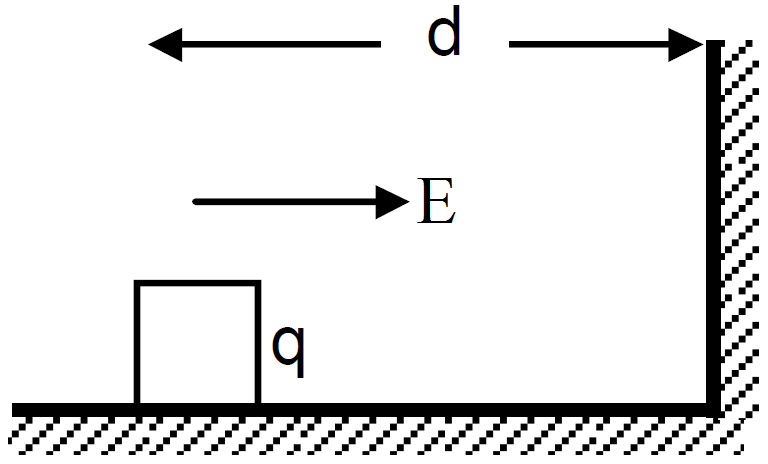
A block of mass m containing a net positive charge q is placed on a smooth horizontal table which terminates in a vertical wall as shown in figure. The distance of the block from the wall is d. A horizontal electric field E towards right is switched on. Assuming elastic collisions (if any) find the time period of the resulting oscillatory motion. Is it a simple harmonic motion?
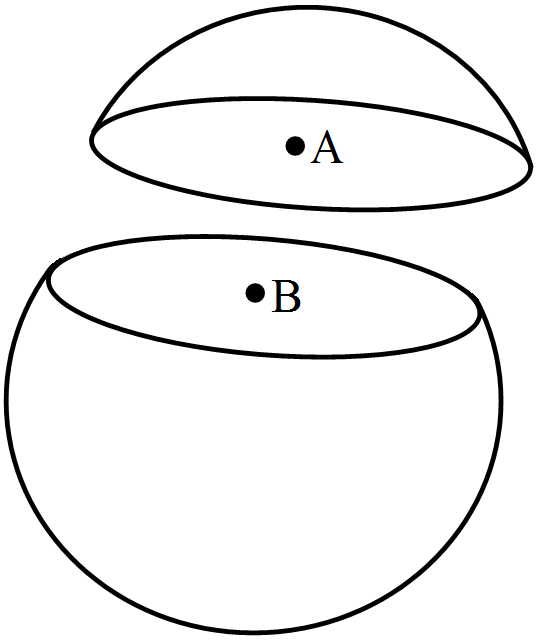
A thin spherical shell having uniform density is cut in two parts by a plane and kept separated as shown in figure (11-E3). The point A is the centre of the plane section of the first part and B is the centre of the plane section of the second part. Show that the gravitational field at A due to the first part is equal in magnitude to the gravitational field at B due to the second part.
A steel girder can bear a load of 25 tonnes. If the depth of the girdes is doubled, how much load can it bear?