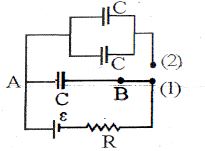
If capacitor connected across $AB$ is charged to $Q$ and then switch is shifted to $2$ . The heat released after that
Diffcult


Download our appand get started for free
Experience the future of education. Simply download our apps or reach out to us for more information. Let's shape the future of learning together!No signup needed.*
Similar Questions
- 1In free space, a particle $A$ of charge $1\,\mu C$ is held fixed at a point $P.$ Another particle $B$ of the same charge and mass $4\,\mu g$ is kept at a distance of $1\,mm$ from $P$. If $B$ is released, then its velocity at a distance of $9\,mm$ from $P$ is [ Take $\frac{1}{{4\pi {\varepsilon _0}}} = 9 \times {10^9}\,N{m^2}{C^{ - 2}}$ ]View Solution
- 2View SolutionDimension of Capacitance is
- 3A $60\; pF$ capacitor is fully charged by a $20\; \mathrm{V}$ supply. It is then disconnected from the supply and is connected to another uncharged $60 \;pF$ capactior is parallel. The electrostatic energy that is lost in this process by the time the charge is redistributed between them is (in $nJ$)View Solution
- 4For a charged spherical ball, electrostatic potential inside the ball varies with $r$ as $V =2 ar ^2+ b$. Here, $a$ and $b$ are constant and $r$ is the distance from the center. The volume charge density inside the ball is $-\lambda a \varepsilon$. The value of $\lambda$ is $...........$. $\varepsilon=$ permittivity of medium.View Solution
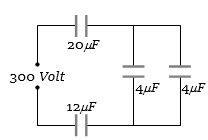
- 5In the adjoining figure, four capacitors are shown with their respective capacities and the $P.D.$ applied. The charge and the $P.D.$ across the $4\,\mu F$ capacitor will beView Solution
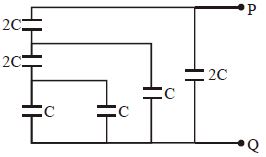
- 6The value of equivalent capacitance of the combination shown in figure, between points $P$ and $Q$ isView Solution
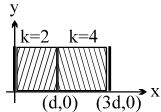
- 7A parallel plate capacitor has two layers of dielectric as shown in figure. This capacitor is connected across a battery. The graph which shows the variation of electric field $(E)$ and distance $(x)$ from left plate.View Solution
- 8A parallel plate capacitor has capacitance $C$. If it is equally filled with parallel layers of materials of dielectric constants $K_1$ and $K_2$ its capacity becomes $C_1$. The ratio of $C_1$ to $C$ isView Solution
- 9A thin spherical insulating shell of radius $R$ carries a uniformly distributed charge such that the potential at its surface is $V _0$. A hole with a small area $\alpha 4 \pi R ^2(\alpha<<1)$ is made on the shell without affecting the rest of the shell. Which one of the following statements is correct?View Solution
- 10Consider a spherical shell of radius $R$ with a total charge $+ Q$ uniformly spread on its surface (centre of the shell lies at the origin $x=0$ ). Two point charges $+q$ and $-q$ are brought, one after the other from far away and placed at $x=-a / 2$ and $x=+a / 2( < R)$, respectively. Magnitude of the work done in this process isView Solution