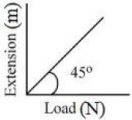
As shown in the figure, in an experiment to determine Young's modulus of a wire, the extension-load curve is plotted. The curve is a straight line passing through the origin and makes an angle of $45^{\circ}$ with the load axis. The length of wire is $62.8\,cm$ and its diameter is $4\,mm$. The Young's modulus is found to be $x \times$ $10^4\,Nm ^{-2}$. The value of $x$ is
JEE MAIN 2023, Easy


Download our appand get started for free
Experience the future of education. Simply download our apps or reach out to us for more information. Let's shape the future of learning together!No signup needed.*
Similar Questions
- 1View SolutionThe only elastic modulus that applies to fluids is
- 2The mass and length of a wire are $M$ and $L$ respectively. The density of the material of the wire is $d$. On applying the force $F$ on the wire, the increase in length is $l$, then the Young's modulus of the material of the wire will beView Solution
- 3The diameter of a brass rod is 4 mm and Young's modulus of brass is $9 \times {10^{10}}\,N/{m^2}$. The force required to stretch by $0.1\%$ of its length isView Solution
- 4The Young's modulus of a wire is $y$. If the energy per unit volume is $E$, then the strain will beView Solution
- 5View SolutionIf Young's modulus for a material is zero, then the state of material should be
- 6The length of metallic wire is $\ell_{1}$ when tension in it is $T _{1}$. It is $\ell_{2}$ when the tension is $T _{2}$. The original length of the wire will be ...... .View Solution
- 7On increasing the length by $0.5\, mm$ in a steel wire of length $2\, m$ and area of cross-section $2\,m{m^2}$, the force required is $[Y$ for steel$ = 2.2 \times {10^{11}}\,N/{m^2}]$View Solution
- 8View SolutionWith rise in temperature, the Young's modulus of elasticity
- 9If a spring extends by $x$ on loading, then the energy stored by the spring is (if $T$ is tension in the spring and $k$ is spring constant)View Solution
- 10The elastic limit of brass is $3.5 \times 10^{10}\,N / m ^2$. Find the maximum load that can be applied to a brass wire of $0.75\,mm$ diameter without exceeding the elastic limit$.......\times 10^4\,N$View Solution