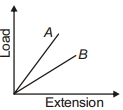
The Young's modulus of a wire is $y$. If the energy per unit volume is $E$, then the strain will be
Easy


Download our appand get started for free
Experience the future of education. Simply download our apps or reach out to us for more information. Let's shape the future of learning together!No signup needed.*
Similar Questions
- 1The elongation of a wire on the surface of the earth is $10^{-4} \; m$. The same wire of same dimensions is elongated by $6 \times 10^{-5} \; m$ on another planet. The acceleration due to gravity on the planet will be $\dots \; ms ^{-2}$. (Take acceleration due to gravity on the surface of earth $=10 \; m / s ^{-2}$ )View Solution
- 2When a certain weight is suspended from a long uniform wire, its length increases by one $cm$. If the same weight is suspended from another wire of the same material and length but having a diameter half of the first one, the increase in length will be ......... $cm$View Solution
- 3View SolutionWhich of the following relations is true
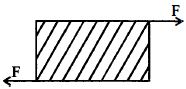
- 4As shown in the figure, forces of $10^5\,N$ each are applied in opposite directions, on the upper and lower faces of a cube of side $10\,cm$, shifting the upper face parallel to itself by $0.5\,cm$ . If the side of another cube of the same material is, $20\,cm$ then under similar conditions as above, the displacement will be......... $cm$View Solution
- 5On increasing the length by $0.5\, mm$ in a steel wire of length $2\, m$ and area of cross-section $2\,m{m^2}$, the force required is $[Y$ for steel$ = 2.2 \times {10^{11}}\,N/{m^2}]$View Solution
- 6A metal wire of length $0.5 m$ and cross-sectional area $10^{-4}\; m ^{2}$ has breaking stress $5 \times 10^{8}\; Nm ^{-2}$. A block of $10\; kg$ is attached at one end of the string and is rotating in a horizontal circle. The maximum linear velocity of block will be $ms ^{-1}$.View Solution
- 7Young's moduli of the material of wires $A$ and $B$ are in the ratio of $1: 4$, while its area of cross sections are in the ratio of $1: 3$. If the same amount of load is applied to both the wires, the amount of elongation produced in the wires $A$ and $B$ will be in the ratio ofView Solution
[Assume length of wires $A$ and $B$ are same]
- 8View SolutionIn which case there is maximum extension in the wire, if same force is applied on each wire
- 9The stress versus strain graphs for wires of two materials $A$ and $B$ are as shown in the figure. If ${Y_A}$ and ${Y_B}$ are the Young ‘s modulii of the materials, thenView Solution
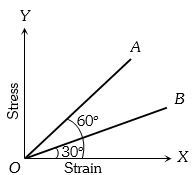
- 10In the given figure, if the dimensions of the two wires are same but materials are different, then Young's modulus is $........$View Solution