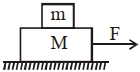
Two blocks $( m =0.5\, kg$ and $M =4.5\, kg$ ) are arranged on a horizontal frictionless table as shown in figure. The coefficient of static friction between the two blocks is $\frac{3}{7} .$ Then the maximum horizontal force that can be applied on the larger block so that the blocks move together is ......... $N.$ (Round off to the Nearest Integer) [Take g as $9.8\, ms ^{-2}$ ]
JEE MAIN 2021, Medium


Download our appand get started for free
Experience the future of education. Simply download our apps or reach out to us for more information. Let's shape the future of learning together!No signup needed.*
Similar Questions
- 1A uniform rod of length $l$ is being rotated in a horizontal plane with a constant angular speed about an axis passing through one of its ends. If the tension generated in the rod due to rotation is $T(x)$ at a distance $x$ from the axis, then which of the following graphs depicts it most closely?View Solution
- 2A block of mass $m$ rests on a rough inclined plane. The coefficient of friction between the surface and the block is $\mu$. At what angle of inclination $\theta$ of the plane to the horizontal will the block just start to slide down the plane?View Solution
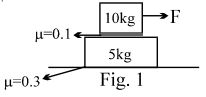
- 3When $F = 2N$, the frictional force between $10 kg$ block and $5 kg$ block is ...... $N$View Solution
- 4A train is moving with a speed of $12 \mathrm{~m} / \mathrm{s}$ on rails which are $1.5 \mathrm{~m}$ apart. To negotiate a curve radius $400 \mathrm{~m}$, the height by which the outer rail should be raised with respect to the inner rail is (Given, $g=$ $10 \mathrm{~m} / \mathrm{s}^2$ ) :View Solution
- 5A heavy uniform chain lies on a horizontal table-top. If the coefficient of friction between the chain and table surface is $0.25$, then the maximum fraction of length of the chain, that can hang over one edge of the table is ...... $\%$View Solution
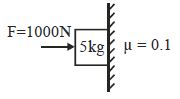
- 6A horizontal force of $40\,N$ is applied to a $5\, kg$ block which is at rest on the horizontal surface. If the coefficient of kinetic friction is $0.4$, then the acceleration of the block is ........ $m/s^2$ $(g = 10 \,m/s^2)$View Solution
- 7A body of mass $10\,kg$ is moving with an initial speed of $20\,m / s$. The body stops after $5\,s$ due to friction between body and the floor. The value of the coefficient of friction is (Take acceleration due to gravity $g =10\; ms ^{-2}$)View Solution
- 8A hemispherical bowl of radius $R$ is rotated about its axis of symmetry which is kept vertical with angular velocity $\omega $ . A small block is kept in the bowl. It remains stationary relative to the bowl surface at a position where the radius makes an angle $\theta $ with the vertical. The friction is absent. The value of $\theta $ isView Solution
- 9A horizontal force of $129.4 \,N $ is applied on a $10\, kg$ block which rests on a horizontal surface. If the coefficient of friction is $0.3$, the acceleration should be ....... $m/s^2$View Solution
- 10For the given figure, if block remains in equilibrium position then find frictional force between block and wall ........ $N$View Solution