$Assertion :$ It is hotter over the top of a fire than at the same distance of the sides.
$Reason :$ Air surrounding the fire conducts more heat upwards.
AIIMS 2003, Easy


Download our appand get started for free
Experience the future of education. Simply download our apps or reach out to us for more information. Let's shape the future of learning together!No signup needed.*
Similar Questions
- 1Two spheres of different materials one with double the radius and one-fourth wall thickness of the other, are filled with ice. If the time taken for complete melting ice in the large radius one is $25$ minutes and that for smaller one is $16$ minutes, the ratio of thermal conductivities of the materials of larger sphere to the smaller sphere isView Solution
- 2A beaker full of hot water is kept in a room. If it cools from $80^{\circ} C$ to $75^{\circ} C$ in $t_1$, minutes, from $75^{\circ} C$ to $70^{\circ} C$ in $t_2$ minutes and from $70^{\circ} C$ to $65^{\circ} C$ in $t_3$ minutes, thenView Solution
- 3If the temperature of the body is increased by $10\% $ , the percentage increase in the emitted radiation will be ....... $\%$View Solution
- 4View SolutionThe energy supply being cut-off, an electric heater element cools down to the temperature of its surroundings, but it will not cool further because
- 5View SolutionWhich of the following statements is wrong
- 6Which of the following graphs correctly represents the relation between ln $E$ and ln $T$ where $E$ is the amount of radiation emitted per unit time from unit area of a body and $T$ is the absolute temperatureView Solution
- 7View SolutionThe quantity of heat which crosses unit area of a metal plate during conduction depends upon
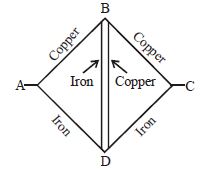
- 8Six wire each of cross-sectional area $A$ and length $l$ are combined as shown in the figure. The thermal conductivities of copper and iron are $K_1$ and $K_2$ respectively. The equivalent thermal resistance between points $A$ and $C$ is :-View Solution
- 9The maximum wavelength of radiation emitted at $2000\;K$is $4\mu m$. What will be the maximum wavelength of radiation emitted at $2400\,K$ is ...... $\mu m$View Solution
- 10Two circular discs $A$ and $B$ with equal radii and equal mass are blackened. They are heated to same temperature and are cooled under identical conditions.What inference do you draw from their cooling curves ?View Solution