Question

As we know a tree or a plant needs both soil and water along with sunlight to
grow. It will have the necessary nourishment in both water and sun to make its
leaves green and fruit to grow. A rural Indian school Gardner planted some
trees on his school at certain distances from the water body following a sequence.
There are 25 trees at equal distances of 5 meters in a line with a well, the
distance of the well from the nearest tree being 10 meters. A gardener waters
all the trees separately starting from the well and he returns to the well after
watering each tree to get water for the next.
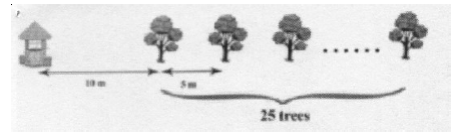
(i) Distance travelled to water nearest tree and back to the well is:
(ii) Progression so formed in the above condition is
(iii) Distance travelled to water 25th tree.
OR
The total distance the gardener will cover in order to water all the trees.

Answer

(i) 20m
(ii) 20, 30, 40, 50 .....
(iii) 260m OR 3500m

Need a full question paper?

Generate a complete, print-ready paper with questions like this in minutes — across 16+ boards, with answer keys.

Start Generating Free

Similar questions

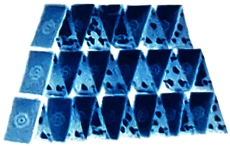
Figure, shows playing cards stacked together in a following manner: 56 cards are stacked in this manner. 14 cards are in the bottom row, 12 in the next row, 10 in the row next to it and so on. Based on this information answer the following questions
Image
(i) The total number of rows in which the cards are stacked is
(a) 7 $\qquad$ $\qquad$ (b) 6 $\qquad$ (c) 8 $\qquad$ (d) 9
(ii) The number of cards in the top row is
(a) 4 $\qquad$ (b) 6 $\qquad$ (c) 1 $\qquad$ (d) 2
(iii) The mathematical concept applied in solving the above problem is
(a) Linear equations $\qquad$ (b) Probability
(c) Arithmetic progression $\qquad$ (d) Coordinate geometry
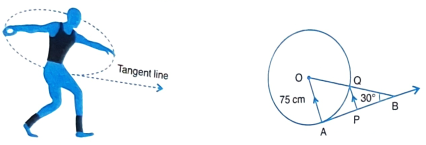
The discus throw is an event in which an athlete attempts to throw a discus. The athlete spins anti-clockwise around one and a half times through a circle, then releases the throw. When released the discus travels along tangent to the circular spin orbit.
Image
In the given figure, $A B$ is one such tangent to a circle of radius 75 cm . Point $O$ is centre of the circle and $\angle A B O=30^{\circ}$. $P Q$ is parallel to $O A$.
Based on above information find the lengths of:
(i) $A B$ $\qquad$ (ii) $O B$ $\qquad$ (iii) $A P$ $\qquad$ (iv) $P Q$
A group of students conducted a survey to find out about the preferred mode of transportation to school among their classmates. They surveyed 200 students from their school. The results of the survey are as follows:
120 students preferred to walk to school.
25% of the students preferred to use bicycles.
10% of the students preferred to take the bus.
Remaining students preferred to be dropped off by car.
Based on the above information, answer the following questions:
(i) What is the probability that a randomly selected student does not prefer to walk to school?
(ii) Find the probability of a randomly selected student who prefers to walk or use a bicycle.
(iii)(A) One day 50% of walking students decided to come by bicycle. What is the probability that a randomly selected student comes to school using a bicycle on that day?
OR
(B) What is the probability that a randomly selected student prefers to be dropped off by car?

Smita always finds it confusing with the concepts of tangent and secant of a circle. But this time she has determined herself to get concepts easier. So, she started listing down the differences between tangent and secant of a circle, along with their relation. Here, some points in question form are listed by Smita in her notes. Try answering them to clear your concepts also.
  1. A line that intersects a circle exactly at two points is called:
  2. Number of tangents that can be drawn on a circle is:
  3. Number of tangents that can be drawn to a circle from a point not on it, is:
    Or
    Number of secants that can be drawn to a circle from a point on it is:

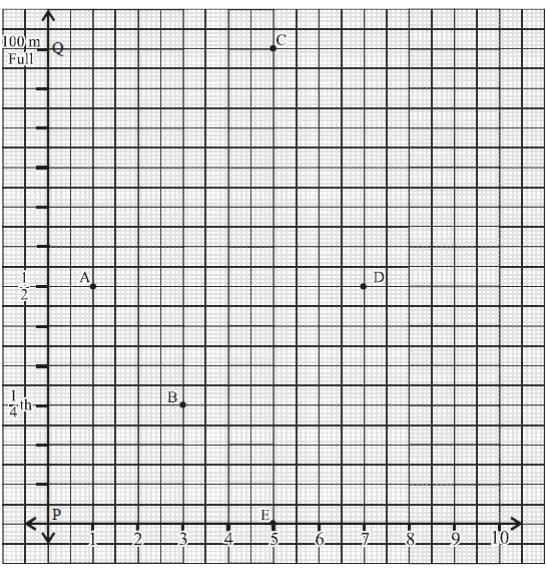
RPVV, Suraj Mal organised Sports Day in which one of the event is 100 m race. Participants
have to run in the rows which are marked at a distance of 1 metre as shown in the figure. At
one time the participants are at position A, B, C, D. A has covered half the distance PQ, B has
covered 1/4th distance PQ, C has covered the distance PQ, D has covered half the distance
PQ. Considering P as origin, answer the questions given below the diagram.

Based on the above information, answer the following questions.
(i) On joing A, B, C, D which figure you will get?
(ii) What area is enclosed by ABCD ?
(iii) If another participant at E could not run due to some shoe problem, what are the co-odinates of E
OR
In what ratio B divides AE?
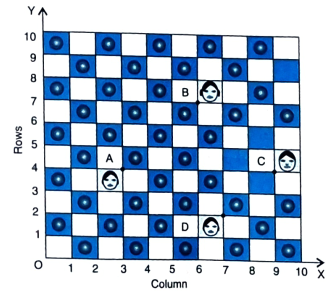
Four persons John, Saurabh, Salim and Ratan are sitting in a courtyard at points $A, B, C$ and $D$ respectively as shown in Fig. 6.19. The Courtyard has been divided into small squares by drawing equality spaced horizontal and vertical lines. Taking $O X$ and $O Y$ as the coordinate axes, answer the following questions:
Image
(i) The coordinates of points $A$ are
(a) $(4,3)$ $\qquad$ $\qquad$ (b) $(3,4)$ $\qquad$ (c) $(3,3)$ $\qquad$ (d) $(4,4)$
(ii) By joining $A$ to $B, B$ to $C, C$ to $D$ and $D$ to $A$, the figure formed is not a
(a) rhombus $\qquad$ (b) square $\qquad$ (c) parallelogram $\qquad$ (d) trapezium
(iii) The distance between the mid-points of $A C$ and $B D$ is
(a) 2 $\qquad$ (b) 3 $\qquad$ (c) 0 $\qquad$ (d) 1
(iv) Area of $\triangle A B C$ is
(a) 18 sq. units $\qquad$ (b) 9 sq. units $\qquad$ (c) 12 sq. units $\qquad$ (d) 16 sq. units
The angle of elevation of the top of a chimney from the top of a tower is 60º and the angle of depression of the foot of the chimney from the top of the tower is 30º. If the height of the tower is 40m, find the height of the chimney. According to pollution control norms, the minimum height of a smoke emitting chimney should be 100m. State if the height of the above mentioned chimney meets the pollution norms. What value is discussed in this question?
A moving boat is observed from the top of a 150m high cliff moving away from the cliff. The angle of depression of the boat changes from 60° to 45° in 2 minutes. Find the speed of the boat in m/h.