Questions

Case study (4 Marks)

Take a timed test

30 questions · self-marked practice — reveal the answer and mark yourself.

Question 14 Marks
On Diwali occasion two rocket crackers were launched at the same time from two different places opposite to each other and the path followed by them are along the lines 3x – 2y = 6 and x + y =12.
Use the above figure to answer the questions that follow:
(i) What is the point of start i.e. the point of intersection of the first line with x -axis.
(ii) At what point the second line intersect y-axis.
(iii) What is the point of intersection of the two rockets,
OR
If both are launched from x-axis,at what height they cross each other,
Answer
(i) (2,0)
(ii) (0,12)
(iii) (6,6) or 6 units from x-axis
View full question & answer
Question 24 Marks
In a class the teacher asks every student to write an example of A.P. Two friends Geeta and Madhuri writes their progressions as -5, -2, 1, 4, ... and 187, 184, 181,.... respectively. Now, the teacher asks various students of the class the following questions on these two rogressions. Help students to find the answers of the questions.
(i) Find the 34th term of the progression written by Madhuri.
(ii) Find the sum of common difference of the two progressions.
(iii) Find the 19th term of the progression written by Geeta.
OR
Find the sum of first 10 terms of the progression written by Geeta.
Answer
(i) 88
(ii) 0
(iii) 49 OR 85
View full question & answer
Question 34 Marks
Jack is much worried about his upcoming assessment on A.P. He was vigorously practicing for the exam but unable to solve some questions. One of these questions is as shown below. If the 3rd and the 9th terms of an A.P. are 4 and - 8 respectively, then help Jack in solving the problem(i) What is the common difference?
(ii) What is the first term?
(iii) Which term of the A.P. is-160?
OR
Which of the following is not a term of the given A.P.?
Answer
(i) -2
(ii) 8
(iii) 85th OR -123
View full question & answer
Question 44 Marks


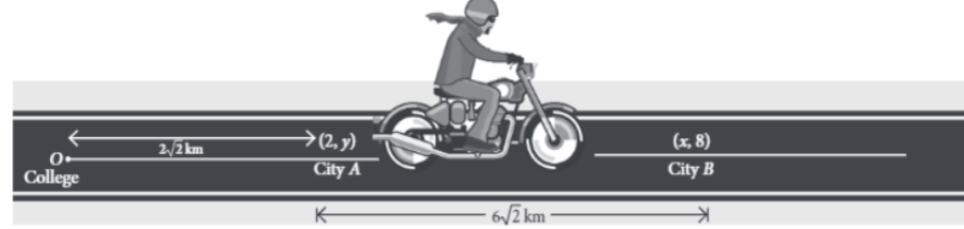
A person is riding his bike on a straight road towards East from his college to city A and then to city B. At some point in between city A and city B, he suddenly realises that there is not enough petrolfor the journey. Also, there is no petrol pump on the road between these two cities. Based on the above information, answer the following questions.
(i) Find the value of y.
(ii) Find the value of x.
(iii) If M is any point exactly in between city A and city B, then coordinates of M are
OR
The ratio in which A divides the line segment joining the points O and Mis
Answer
(i) 2
(ii) 8
(iii) (5,5) or 2:3
View full question & answer
Question 54 Marks

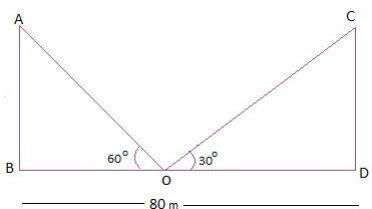
Abhi sees the two poles of equal heights are standing opposite each other on either side of the road, which is 80 m wide. From a point between them on the road, the angles of elevation of the top of the poles are 60° and 30°, respectively. Read the above information and answer the below questions.

(i) What is the length of CD?
(ii) What is the length of 0D?
OR
What is the distance from the point of elevation from 60°?
(iii) What is the length of OC?
Answer
i)20√3 m
ii)60 m or 20 m
iii) $\frac{60}{\sqrt{3}}$
View full question & answer
Question 64 Marks

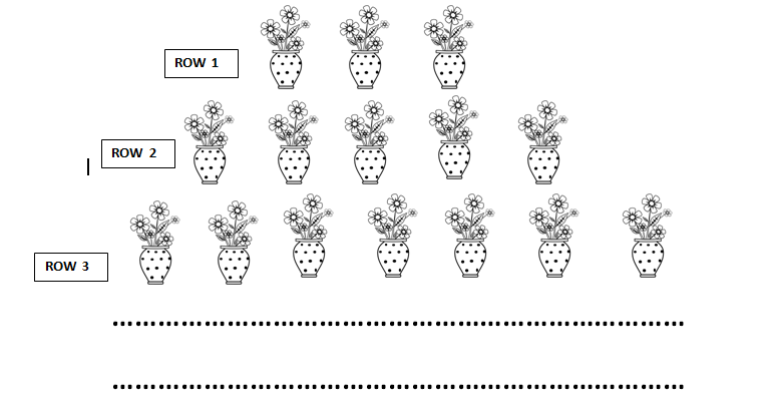
Siya being a plant lover came up with an idea of opening a nursery during the lockdown and she
bought a few plants with pots. She wants to place pots in such a way that number of pots in row one is 3, pots in row second is 5 and in third is 7 and so on.

Use the above figure to answer the questions that follow:
(i) What is the difference in number of pots increasing per row?
(ii) What will be the number of pots in row 5?
(iii) If Siya wants to place 120 pots, how many rows will it require?
OR
(iii)Find the difference in number of pots placed in fourth and tenth row.
Answer
(i) 2
(ii) 11 pots
(iii) 11 rows or 12
View full question & answer
Question 74 Marks

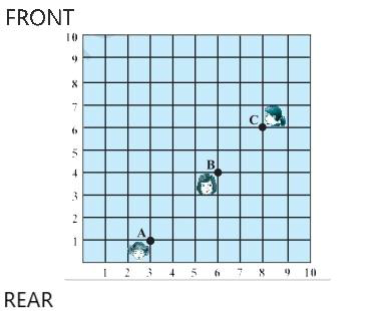
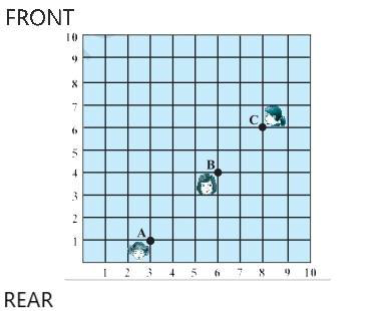
In a theatre, seats are marked positions as shown in the above image. People from town alpha prefer
the front row seats, people from town beta prefer the middle row seats and people from town gamma
prefer back row seats.

i) Give the location of the seat for town alpha's woman.
ii)Name the girl who came from town gamma.
iii)Distance between A and C is.....
Or
Can you say that all the members from the town are seated in collinear position ? Give reason for
your answer.
Answer
i) (8,6)
ii) A
iii) 7.071 units or Yes and Find the area of the three points to prove it
View full question & answer
Question 84 Marks

In a school, students decided to plant trees in and around the school to reduce air pollution. It was decided that the number of trees, that each section of each class will plant, will be double of the class in which they are studying. If there are 1 to 12 classes in the school and each class has two sections. Answer the following questions using the given information.

(i) State the arithmatic progression formed in the case that whole class is counted as one.
(ii) State the class which planted 40 trees.
(iii) State the number of trees planted by class 12
OR
What is the total number of trees planted by the class?
Answer
i) 4, 8, 12 and so on
ii)48 trees or 312 trees
iii) Class 10
View full question & answer
Question 94 Marks

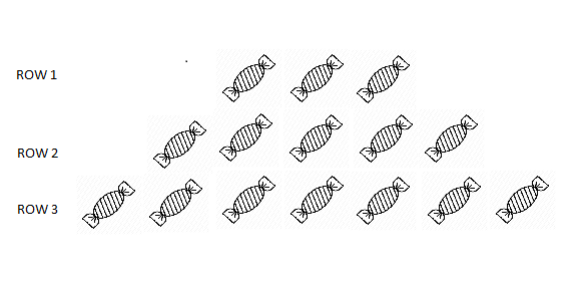
Raj's mother gave him a packet of toffees and candies. The packet he had was having 120
toffees and candies. He started arranging toffees and candies in such a way that there were 3
in row 1, 5 in row 2, 7 in row 3 and so on. Answer the following questions using the above passage

(i) What is the total number of rows formed by the number of candies he had?
(ii)How many candies are there in the last row?
(iii) How many candies would Raj require more, if he wishes to add two more rows to
his pattern?
OR
What is the difference of the candies between row 4th and row 8th?
Answer
(i)10 rows
(ii) 21 candies
(iii)48 candies or 8 candies
View full question & answer
Question 104 Marks
Jack is much worried about his upcoming assessment on A.P. He was vigorously practicing
for the exam but unable to solve some questions. One of these questions is as shown below.
If the 3rd and the 9th terms of an A.P. are 4 and - 8 respectively, then help Jack in solving
the problem.
(i) What is the common difference?
(ii) What is the first term?
(iii) Which term of the A.P. is-160?
OR
Which of the following is not a term of the given A.P.?
Answer
(i) -2
(ii) 8
(iii) 85th OR -123
View full question & answer
Question 114 Marks

As we know a tree or a plant needs both soil and water along with sunlight to
grow. It will have the necessary nourishment in both water and sun to make its
leaves green and fruit to grow. A rural Indian school Gardner planted some
trees on his school at certain distances from the water body following a sequence.
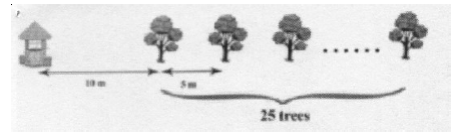
There are 25 trees at equal distances of 5 meters in a line with a well, the
distance of the well from the nearest tree being 10 meters. A gardener waters
all the trees separately starting from the well and he returns to the well after
watering each tree to get water for the next.

(i) Distance travelled to water nearest tree and back to the well is:
(ii) Progression so formed in the above condition is
(iii) Distance travelled to water 25th tree.
OR
The total distance the gardener will cover in order to water all the trees.
Answer
(i) 20m
(ii) 20, 30, 40, 50 .....
(iii) 260m OR 3500m
View full question & answer
Question 124 Marks
A construction company will be penalized each day of delay in the construction
of the bridge. The penalty will be ` 4000 for the first day and will increase by 1000 for each following day. Based on its budget, the company can afford to pay a maximum of ` 165000 toward penalty.
(i) The penalty amount paid by the construction company from the first day as a sequence
(ii) First-term and difference respectively of the above series is
(iii) Find the maximum number of days by which the completion of work can be delayed (take Sn = 165000)
OR
The penalty will be charged on the tenth day
Answer
(i) 4000, 5000, 6000
(ii) 4000 and 1000
(iii) 15 days OR 13000
View full question & answer
Question 134 Marks
Do you know, we can find A.P. In many situations in our day-to-day life. One such example
is a tissue paper roll, in which the first term is the diameter of the core of the roll and twice
the thickness of the paper is the common difference. If the sum of first n rolls of tissue on a
roll is S,, = 0.1 m² +7.9n, then answer the following questions.
(i) Find Sn-1
(ii) Find the radius of the core.
(iii) What is the diameter of roll when one tissue sheet is rolled over it?
OR
Find the thickness of each tissue sheet.
Answer
(i) 0.1n²+7.7n-7.8
(ii) 4 cm
(iii) 8.2cm OR 1mm
View full question & answer
Question 144 Marks
In a theatre, seats are marked positions as shown in the above image. People from town alpha
prefer the front row seats, people from town beta prefer the middle row seats and people from town gamma prefer back row seats.

i) Give the location of the seat for town alpha's woman.
ii)Name the girl who came from town gamma.
iii)Distance between A and C is.
Or
Can you say that all the members from the town are seated in collinear position ? Give reason for
Answer
(i) (8,6) (ii) A (iii) 7.071 units or Yes and Find the area of the three points to prove it
View full question & answer
Question 154 Marks
In a class the teacher asks every student to write an example of A.P. Two friends Geeta and
Madhuri writes their progressions as -5, -2, 1, 4, ... and 187, 184, 181,.... respectively. Now,
the teacher asks various students of the class the following questions on these two
progressions. Help students to find the answers of the questions
(i) Find the 34th term of the progression written by Madhuri.
(ii) Find the sum of common difference of the two progressions.
(iii) Find the sum of first 10 terms of the progression written by Geeta.
OR
Which term of the two progressions will have the same value?
Answer
(i) 88, (ii) 0, (iii) 85 OR 33
View full question & answer
Question 164 Marks
In a class the teacher asks every student to write an example of A.P. Two friends Geeta and
Madhuri writes their progressions as -5, -2, 1, 4, ... and 187, 184, 181,.... respectively. Now,
the teacher asks various students of the class the following questions on these two
progressions. Help students to find the answers of the questions.
(i) Find the 34th term of the progression written by Madhuri.
(ii) Find the sum of common difference of the two progressions.
(iii) Find the 19th term of the progression written by Geeta.
OR
Find the sum of first 10 terms of the progression written by Geeta.
Answer
(i) 88
(ii) 0
(iii) 49 OR 85
View full question & answer
Question 174 Marks
In a class the teacher asks every student to write an example of A.P. Two friends Geeta and
Madhuri writes their progressions as -5, -2, 1, 4, ... and 187, 184, 181,.... respectively. Now,
the teacher asks various students of the class the following questions on these two progressions. Help students to find the answers of the questions
(i) Find the 34th term of the progression written by Madhuri.
(ii) Find the sum of common difference of the two progressions.
(iii) Find the sum of first 10 terms of the progression written by Geeta.
OR
Which term of the two progressions will have the same value?
Answer
(i) 88
(ii) 0
(iii) 85 OR 33
View full question & answer
Question 184 Marks
In a board game, the number of sea shells in various cells forms an A.P. If the number of sea
shells in the 3rd and 11th cell together is 68 and number of shells in 11th cell is 24 more
than that of 3rd cell, then answer the following questions based on this data.
(i) What is the difference between the number of sea shells in the 19th and 20th cells?
(ii) How many Sea shells are there in first cell?
(iii) Altogether, how many sea shells are there in the first 5 cells?
OR
What is the sum of number of sea shells in the 7th and 9th cell?
Answer
(i) 3
(ii) 16
(iii) 110 OR 74
View full question & answer
Question 194 Marks
Elena had a test on monday in her school of maths subject. So, she was solving her maths guide on weekend and found a sequence of numbers in a topic whose general term was T(n) = 4n + 5. Using this information, calculate the answers for the questions given below..
(i) What is the fifth term in the sequence ?
(ii) Calculate the n when the value of the term is 97.
(iii) Find the sum between the fourth and ninth term.
OR
Find the sum between the fifth and 11th term
Answer
(i) 25
(ii) 23
(iii) 62 or 180
View full question & answer
Question 204 Marks
The houses of a row are numbered consecutively from 1 to 49. Show that there is a value of x such that the sum of the numbers of the houses preceding the house numbered x is equal to the sum of the numbers of the houses following it. Find this value of x.
[Hint : $S_{x–1} = S_{49} – S_x]$
Answer
Here a = 1 and d = 1
$\therefore\ \text{S}_{\text{x-1}}=\frac{\text{x}-1}{2}[2\times1+(\text{x}-1-1)\times1]$
$=\frac{\text{x}-1}{2}(2+\text{x}-2)$
$\frac{(\text{x}-1)\text{x}}{2}=\frac{\text{x}^2-\text{x}}{2}$
$\text{S}_\text{x}=\frac{\text{x}}{2}[2\times1+(\text{x}-1)\times1]$
$=\frac{\text{x}}{2}(\text{x}+1)=\frac{\text{x}^2+\text{x}}{2}$
$\text{S}_\text{49}=\frac{49}{2}[2\times1+(49-1)\times1]$
$=\frac{49}{2}(2+48)=49\times25$
According to question,
$\text{S}_\text{x-1}=\text{S}_{49}-\text{S}_\text{x}$
$\Rightarrow\ \frac{\text{x}^2-\text{x}}{2}=49\times25-\frac{\text{x}^2+\text{x}}{2}$
$\Rightarrow\ \frac{\text{x}^2-\text{x}}{2}+\frac{\text{x}^2+\text{x}}{2}=49\times25$
$\Rightarrow\ \frac{\text{x}^2-\text{x}+\text{x}^2+\text{x}}{2}=49\times25$
$\Rightarrow x^2 = 49 \times 25$
$\Rightarrow\ \text{x}=\pm35$
Since, x is a counting number, so negative value will be neglected.
$\therefore\ \text{x}=35$
View full question & answer
Question 214 Marks
Amit was playing a number card game. In the game, some number cards (having both + ve or -ve numbers) are arranged in a row such that they are following an arithmetic progression. On his first turn, Amit picks up $6^{\text {th }}$ and $14^{\text {th }}$ card and finds their sum to be -76 . On the second turn he picks up $8^{\text {th }}$ and $16^{\text {th }}$ card and finds their sum to be -96 . Based on the above information, answer the following questions:
  1. What is the difference between the numbers on any two consecutive cards?
  1. 7
  2. -5
  3. 11
  4. -3
  1. The number on first card is,
  1. 12
  2. 3
  3. 5
  4. 7
  1. What is the number on the $19^{th}$ card?
  1. -88
  2. -83
  3. -92
  4. -102
  1. What is the number on the $23^{rd}$ card?
  1. -103
  2. -122
  3. -108
  4. -117
  1. The sum of numbers on the first 15 cards is:
  1. -840
  2. -945
  3. -427
  4. -420
Answer
Let the numbers on the cards be a, a + d, a + 2d, ... According to question, We have (a + 5d) + (a + 13d) = -76
$\Rightarrow 2a + 18d = -76$
$\Rightarrow a + 9d = -38 And (a + 7d) + (a + 15d) = -96$
$\Rightarrow 2a + 22d = -96$
$\Rightarrow a + 11d = -48 From (1) and (2), we get 2d = -10$
$\Rightarrow d = -5 From (1), a + 9(-5) = -38$
$\Rightarrow a = 7$
  1. (b) -5
Solution:

The difference between the numbers on any two consecutive cards = common difference of the A.P. = -5
  1. (d) 7
Solution:

Number on first card = a = 7
  1. (b) -83
Solution:

Number on $19^{th}$​​​​​​​ card = a + 18d = 7 + 18(-5) = -83
  1. (a) -103
Solution:

Number on $23^{rd}​​​​​​​$ card = a + 22d = 7 + 22(-5) = -103
  1. (d) -420
Solution:

$\text{S}_{15}=\frac{15}{2}\big[2(7)+14(-5)\big]=-420$
View full question & answer
Question 224 Marks
A sequence is an ordered list of numbers. A sequence of numbers such that the difference between the consecutive terms is constant is said to be an arithmetic progression (A.P.). On the basis of above information, answer the following questions.
  1. Which of the following sequence is an A.P.?
  1. 10, 24, 39, 52,....
  2. 11, 24, 39, 52, ...
  3. 10, 24, 38, 52, ...
  4. 10, 38, 52, 66, ....
  1. If x, y and z are in A.P., then.
  1. x + z = y
  2. x - z = y
  3. x + z = 2y
  4. None of these
  1. If $a_1, a_2 ..... a_3$ are in A.P. then which of the following is true?
  1. $a_1 + k, a_2 + k, a_3 + k.....,a_n$ k are in A.P., where k is a constant.
  2. $k - a_1, k - a_{2,} k - a_3......,k - a_n​​​​​​​$ are in A.P., where k is a constant.
  3. $ka_1, ka_2, ka_3........,ka_n​​​​​​​$ are in A.P., where k is a constant.
  4. All of these
  1. If the $n^{th}​​​​​​​$​​​​​​​ term (n > 1) of an A.P. is smaller than the first term, then nature of its common difference (d) is.
  1. d > 0
  2. d < 0
  3. d = 0
  4. Can't be determined
  1. Which of the following is incorrect about A.P.?
  1. All the terms of constant A.P. are same.
  2. Some terms of an A.P. can be negative.
  3. All the terms of an A.P. can never be negative.
  4. None of these.
Answer
  1. (c) 10, 24, 38, 52,....
  2. (c) x + z = 2y
  3. (d) All of these
  4. (b) x - z = y
  5. (c) All the terms of an A.P. can never be negative.
View full question & answer
Question 234 Marks
ln a pathology lab, a culture test has been conducted. ln the test, the number of bacteria taken into consideration in various samples is all 3-digit numbers that are divisible by 7, taken in order.

On the basis of above information, answer the following questions
  1. How many bacteria are considered in the fifth sample?
  1. 126
  2. 140
  3. 133
  4. 149
  1. How many samples should be taken into consideration?
  1. 129
  2. 128
  3. 130
  4. 127
  1. Find the total number of bacteria in the first 10 samples.
  1. 1365
  2. 1335
  3. 1302
  4. 1540
  1. How many bacteria are there in the $7^{th}$ sample from the last?
  1. 952
  2. 945
  3. 959
  4. 966
  1. The number of bacteria in $50^{th}​​​​​​​$​​​​​​​ sample is?
  1. 546
  2. 553
  3. 448
  4. 496
Answer
Here the smallest 3-digit number divisible by 7 is 105. So, the number of bacteria taken into consideration is 105, 112, 119, .... 994 So, first term (a) = 105, d = 7 and last term = 994.
  1. (c) 133
Solution:

$t_5 = a + 4d = 105 + 28 = 133$​​​​​​​
  1. (b) 128
Solution:

Let n samples be taken under consideration

$\because$ Last term = 994

⇒ a + (n - d)d = 994

⇒ 105 + (n - 1)7 = 994

⇒ n = 128
  1. (a) 1365
Solution:

Total number of bacteria in first 10 samples $=\text{S}_{10}=\frac{10}{2}[2(105)+9(7)]=1365$
  1. (a) 952
Solution:

$t_7​​​​​​​$​​​​​​​ from end = (128 - 7 + 1) term from beginning $= 122^{th} term = 105 + 121(7) = 952​​​​​​​$​​​​​​​
  1. (c) 448
Solution:

$t_{50} = 105 + 49 \times 7 = 448$
View full question & answer
Question 244 Marks
Meena's mother start a new shoe shop. To display the shoes, she put 3 pairs of shoes in $1^{\text {st }}$ row, 5 pairs in $2^{\text {nd }}$ row, 7 pairs in $3^{\text {rd }}$ row and so on.

On the basis of above information, answer the following questions.
  1. If she puts a total of 120 pairs of shoes, then the number of rows required are:
  1. 5
  2. 6
  3. 7
  4. 10
  1. Difference of pairs of shoes in $17^{th}$ row and $10^{th}$ row is:
  1. 7
  2. 14
  3. 21
  4. 28
  1. On next day, she arranges x pairs of shoes in 15 rows, then x =
  1. 21
  2. 26
  3. 31
  4. 42
  1. Find the pairs of shoes in $30^{th}$ row:
  1. 61
  2. 67
  3. 56
  4. 59
  1. The total number of pairs of shoes in $5^{th}$ and $8^{th}​​​​​​​$ row is:
  1. 7
  2. 14
  3. 28
  4. 56
Answer
Number of pairs of shoes in $1^{\text {st }} 2^{\text {nd }} 3^{\text {rd }}$ row $\ldots$ are $3,5,7 \ldots \ldots .$. So, it forms an A.P. with first term $a=3, d=5-3=2$
  1. (d) 10
Solution:

Let n be the number of rows required.

$\therefore$ $S_n = 120$

$\Rightarrow\frac{\text{n}}{2}[(3)+(\text{n - 1)2}]=120$

$\Rightarrow n^2 + 2n - 120 = 0$

$\Rightarrow n^2 + 12n - 10n - 120 = 0$

$\Rightarrow (n + 12) (n - 10) = 0$

$\Rightarrow n = 10$

So, 10 rows required to put 120 pairs
  1. (b) 14
Solution:

No. of pairs in $17^{th}$ row $= t_{17} = 3 + 16(2) = 35$

No. of pairs in $10^{th}$ row $= t_{10} = 3 + 9(2) = 21$

$\therefore$ Required difference = 35 - 21 = 14
  1. (c) 31
Solution:

Here n = 15

$\therefore$ $t_{15} = 3 + 14(2) = 3 + 28 = 31$​​​​​​​
  1. (a) 61
Solution:

No. of pairs in $30^{th}$ row $= t_{30} = 3 + 29(2) = 61​​​​​​​$​​​​​​​
  1. (c) 28
Solution:

No. of pairs in $5^{th}$ row $= t_5 = 3 + 4(2) = 11$

No. of pairs in $8^{th}$ row $= t_8 = 3 + 7(2) = 17$

$\therefore$ Required sum $= 11 + 17 = 28$
View full question & answer
Question 254 Marks
Anuj gets pocket money from his father everyday. Out of the pocket money, he saves ₹ 2.75 on first day,₹ 3 on second day,₹ 3.25 on third day and so on.

On the basis of above information, answer the following questions.
  1. What is the amount saved by Anuj on $14^{th}$ day?
  1. ₹ 6.25
  2. ₹ 6
  3. ₹ 6.50
  4. ₹ 6.75
  1. What is the total amount saved by Anuj in 8 days?
  1. ₹ 18
  2. ₹ 33
  3. ₹ 24
  4. ₹ 29
  1. What is the amount saved by Anuj on 30th day?
  1. ₹ 10
  2. ₹ 12.75
  3. ₹ 10.25
  4. ₹ 9.75
  1. What is the total amount saved by him in the month of June, if he starts savings from 1st June?
  1. ₹ 191
  2. ₹ 191.25
  3. ₹ 192
  4. ₹ 192.5
  1. On which day, he save tens times as much as he saved on day-1?
  1. $9^{th}$
  2. $99^{th}$
  3. $10^{th}$
  4. $100^{th}$
Answer
Here the savings form an A.P. i.e., ₹ 2.75, ₹ 3, ₹ 3.25,... So, a = 2.75, d = 3 - 2.75 = 0.25
  1. (b) ₹ 6
Solution:

Amount saved by Anuj on 14th day $= t_{14} = a + 13d = 2.75 + 13(0.25) = ₹ 6$​​​​​​​
  1. (d) ₹ 29
Solution:

Total amount saved by Anuj in 8 days

$=\text{S}_8=\frac{8}{2}\big[2(2.75)+7(0.25)\big]= ₹\ 29$
  1. (a) ₹ 10
Solution:

Amount saved by Anuj on 30th day $= t_{30} = a + 29d = 2.75 + 29(0.25) = ₹ 10​​​​​​​$
  1. (b) ₹ 191.25
Solution:

Number of days in June = 30

$\therefore\text{S}_{30}=\frac{30}{2}\big[2(2.75)+29(0.25)\big]=₹\ 191.25$
  1. (d) $100^{th}​​​​​​​$​​​​​​​
Solution:

Let on n$^{th}$ day, he saves 10 times as he saves on $1^{st}$ day .

$t^n = 10(2.75)$

$\Rightarrow a + (n - 1)d = 27.5$

$\Rightarrow n = 100$
View full question & answer
Question 264 Marks
While playing a treasure hunt game, some clues (numbers) are hidden in various spots collectively forms an A.P. lf the number on the $n^{th}$ spot is 20 + 4n, then answer the following questions to help the player in spotting the clues.
  1. Which number is on the first spot?.
  1. 20
  2. 24
  3. 16
  4. 28
  1. Which number is on the $(n - 2)^{th}$ spot?
  1. 16 + 4n
  2. 24 + 4n
  3. 12 + 4n
  4. 28 + 4n
  1. Which number is on the $34^{th}$​​​​​​​ spot?
  1. 156
  2. 116
  3. 120
  4. 160
  1. What is the sum of all the numbers on the first 10 spots?
  1. 410
  2. 420
  3. 480
  4. 410
  1. Which spot is numbered as 116?
  1. $5^{th}$
  2. $8^{th}$
  3. $9^{th}$
  4. $4^{th}$
Answer
Number on $n^{th}$ spot $= 20 + 4n i.e., t_n = 20 + 4n$
  1. (b) 24
Solution:

Number on $1^{th}$ spot $= t_1 = 20 + 4(1) = 24​​​​​​​$​​​​​​​
  1. (c) 12 + 4n
Solution:

Number on $(n - 2)^{th}$ spot $= t_{n - 2}​​​​​​​$​​​​​​​

= 20 + 4 (n - 2)

= 20 + 4n - 8 = 12 + 4n
  1. (a) 156
Solution:

Number on $34^{th}$ spot $= t_{34}​​​​​​​$​​​​​​​

= 20 + 4(34) = 156
  1. (b) 420
Solution:

Here a $= t_1 = 24$ Now,$ t_2 = 20 + 4 (2) = 20 + 8 = 28$

$d = t_2 - t_1= 4$

So, required sum $=\text{S}_{10}=\frac{10}{2}\big[2(24)+9(4)\big]=420$
  1. (d) $4^{th}​​​​​​​$​​​​​​​
Solution:

Let $n^{th}​​​​​​​$​​​​​​​ spot is numbered as 116.

$\therefore$ $t_n = 11$

$\Rightarrow 20 + 4n = 116$

$\Rightarrow 4n = 96$

$\Rightarrow n = 24$
View full question & answer
Question 274 Marks
Jack is much worried about his upcoming assessment on A.P. He was vigorously practicing for the exam but unable to solve some questions. One of these questions is as shown below. If the $3^{rd}$​​​​​​​ and the $9^{th}​​​​​​​$​​​​​​​ terms of an A.P. are 4 and - 8 respectively, then help Jack in solving the problem.
  1. What is the common difference?
  1. 2
  2. -1
  3. -2
  4. 4
  1. What is the first term?
  1. 6
  2. 2
  3. -2
  4. 8
  1. Which term of the A.P. is -160?
  1. $80^{th}$
  2. $85^{th}$
  3. $81^{th}$
  4. $84^{th}$
  1. Which of the following is not a term of the given A.P.?
  1. -123
  2. -100
  3. 0
  4. -200
  1. What is the $75^{lh}​​​​​​​$​​​​​​​ term of the A.P.?
  1. -140
  2. -102
  3. -150
  4. -158
Answer
We have, $3^{\text {rd }}$ term $=4$ and $9^{\text {th }}$ term $=-8$ i.e., $a+2 d=4$ and $a+8 d=-8$ Solving (1) and (2), we get $d=-2, a=8$
  1. (c) -2
  2. (d) 8
  3. (b) $85^{th}$​​​​​​​
Solution:
Let $t_n= -160$
$\Rightarrow a + (n - 1) d = -160$
$\Rightarrow 8 + (n - 1)(-2) = -160$
$\Rightarrow (n - 1)(-2) = -168$
$\Rightarrow n - 1 = 84$
$\Rightarrow n = 85$
So, $t_{85} = -160​​​​​​​$​​​​​​​
  1. (a) -123
  2. (a) -140
Solution:
$t_{75} = a + 74d = 8 + 74(-2) = -140$
View full question & answer
Question 284 Marks
ln a class the teacher asks every student to write an example of A.P. Two friends Geeta and Madhuri writes their progressions as -5, -2, 1, 4,..... and 187, 184, 181, .... respectively. Now, the teacher asks various students of the class the following questions on these two progressions. Help students to find the answers of the questions.
  1. Find the $34^{th}$ term of the progression written by Madhuri.
  1. 86
  2. 88
  3. -99
  4. 190
  1. Find the sum of common difference of the two progressions.
  1. 6
  2. -6
  3. 1
  4. 0
  1. Find the $19^{th}$ tenn of the progression written by Geeta.
  1. 49
  2. 59
  3. 52
  4. 62
  1. Find the sum of first 10 terms of the progression written by Geeta.
  1. 85
  2. 95
  3. 110
  4. 200
  1. Which term of the two progressions will have the same value?
  1. 31
  2. 33
  3. 32
  4. 30
Answer
Geeta's A.P. is $-5,-2,1,4, \ldots$ Here, first term $\left(a_1\right)=-5$ and conunon difference $\left(d_1\right)=-2+5=3$ Similarly, Madhuri's A.P. is 187 , $184,181, \ldots$ Here first term $\left(a_2\right)=187$ and common difference $\left( d _2\right)=184-187=-3$
  1. (b) 88
Solution:

$t_{34} = a_2 + 33d_2 = 187 + 33(-3) = 88$
  1. (d) 0
Solution:

Required sum = 3 + (-3) = 0
  1. (a) 49
Solution:

$t_{19} = a_1 + 18d_1 = (-5) + 18(3) = 49​​​​​​​$
  1. (a) 85
Solution:

$\text{S}_{10}=\frac{\text{n}}{2}[2\text{a}_1+(\text{n-1})\text{d}_1]=\frac{10}{2}[2(-5)+9(3)]=85$
  1. (b) 33
Solution:

Let $n^{th}​​​​​​​$ terms of the two A.P s be equal.

$\because$ -5 + (n - 1)3 = 187 + (n - 1)(-3)

⇒ 6(n - 1) = 192

⇒ n = 33
View full question & answer
Question 294 Marks
In a board game, the number of sea shells in various cells forms an A.P. If the number of sea shells in the $3^{\text {rd }}$ and $11^{\text {th }}$ cell together is 68 and number of shells in $11^{\text {th }}$ cell is 24 more than th at of $3^{\text {rd }}$ cell, th en answer the following questions based on this data.
  1. What is the difference between the number of sea shells in the $19^{th}$ and $20^{th}$ cells?
  1. 2
  2. 3
  3. 8
  4. 7
  1. How many sea shells are there in the first cell?
  1. 52
  2. 18
  3. 16
  4. 54
  1. How many total sea shells are there in first 13 cells?
  1. 442
  2. 221
  3. 204
  4. Can't be determined
  1. Altogether, how many sea shells are there in the first 5 cells?
  1. 220
  2. 125
  3. 96
  4. 110
  1. What is the sum of number of sea shells in the $7^{th}$ and $9^{th}​​​​​​​$ cell?
  1. 42
  2. 32
  3. 74
  4. 80
Answer
Let the number of sea shells in the cells be of the form a, a + d, a + 2d, ... According to question, we have (a + 2d) + (a + 10d) = 68
⇒ 2a + 12d = 68
⇒ a + 6d = 34 ...
Also,(a + 10d) - (a + 2d) = 24
⇒ d = 3 From (1), we get a + 6(3) = 34
⇒ a = 16
  1. (b) 3
Solution:

Required difference, d = 3
  1. (c) 16
Solution:

Number of sea shells in the first cell (a) = 16
  1. (a) 442
Solution:

Total number of sea shells in 13 cells $= S_{13}$

$=\frac{13}{2}\big[2(16)+12(3)\big]=6.5(68)=442$
  1. (d) 110
Solution:

$\text{S}_{13}=\frac{5}{2}\big[2(16)+4(3)\big]=110$
  1. (c) 74
Solution:

Required sum $= t_7 + t_9 = (a + 6d) + (a + 8d) = 2(16) + 14(3) = 74$
View full question & answer
Question 304 Marks
Do you know, we can find A.P. in many situations in our day-to-day life. One such example is a tissue paper roll, in which the first term is the diameter of the core of the roll and twice the thickness of the paper is the common difference. If the sum of first n rolls of tissue on a roll is $S_n = 0.1 n^2 + 7$.9n, then answer the following questions.
  1. Find $S_{n - 1$}$
  1. $0.in^2 - 0.2n - 7.8$
  2. $0.in^2 - 7.9n$
  3. $0.in^2 - 7.7n - 7.8$
  4. None of these
  1. Find the radius of the core.
  1. 8cm
  2. 4cm
  3. 16cm
  4. Can't be determined
  1. $S_2 =$
  1. 16.2
  2. 8.2
  3. 2.8
  4. 4.8
  1. What is the diameter of roll when one tissue sheet is rolled over it?
  1. 7.6cm
  2. 7.9cm
  3. 8.1cm
  4. 8.2cm
  1. Find the thickness of each tissue sheet.
  1. 2cm
  2. 1cm
  3. 1mm
  4. 2mm
Answer
Here $S_n.= 0.1 n^2 + 7.9n$
  1. (c) $0.in^2 - 7.7n - 7.8$
Solution:
$S_n 1 = 0.1 (n - 1)^2 + 7.9(n - 1)$
$= 0.1 n^2 + 7.7n - 7.8​​​​​​​$
  1. (b) 4cm
Solution:

$S_1 = t_1 = a = 0.1(1)^2 + 7.9(1) = 8cm =$ Diameter of core

So, radius of the core = 4cm
  1. (a) 16.2
Solution:

$S_2 = 0.1(2)^2 + 7.9(2) = 16.2​​​​​​​$​​​​​​​
  1. (d) 8.2cm
Solution:

Required diameter $= t_2 = S_2 - S_1 = 16.2 - 8 = 8.2cm​​​​​​​$​​​​​​​
  1. (c) 1mm
Solution:

As $d = t_2 - t_1 = 8.2 - 8 = 0.2cm$

So, thickness of tissue = 0.2 + 2 = 0.1cm = 1mm
View full question & answer