Question
Ashish is writing examination. He is reading question paper during reading time. He reads instructions carefully. While reading instructions, he observed that the question paper consists of $15$ questions divided in to two parts part $I$ containing $8$ questions and part $II$ containing $7$ questions.
Image

$i$. If Ashish is required to attempt $8$ questions in all selecting at least $3$ from each part, then in how many ways can he select these questions $(1)$
$ii$. If Ashish is required to attempt $8$ questions in all selecting $3$ from $I$ part, then in how many ways can he select these questions $(1)$
$iii.$ If Ashish is required to attempt $8$ questions in all selecting $4$ from part $I$ and $4$ from part $II,$ then in how many ways can he select these questions $(2)$
OR
If Ashish is required to attempt $8$ questions in all selecting $6$ from one section and remaining from another section, then in how many ways can he select these questions $(2)$
Answer

$i.$ Since, at least $3$ questions from each part have to be selected
Part $I$ Part $II$
$3$ $5$
$4$ $4$
$3$ $5$
So number of ways are
$3 $ questions from part $I$ and $5$ questions from part $II$ can be selected in $n^8 C_3 \times{ }^7 C_5$ ways
$4$ questions from part $I$ and $4$ questions from part $II$ can be selected in ${ }^8 C_4 \times{ }^7 C_4$ ways
$5$ questions from part $I$ and $3$ questions from part $II$ can be selected in ${ }^8 C_5 \times{ }^7 C_3$ ways
So required number of ways are
${ }^8 C_3 \times{ }^7 C_5+{ }^8 C_4 \times{ }^7 C_4+{ }^8 C_5 \times{ }^7 C_3$
$\Rightarrow \frac{8!}{5!\times 3!} \times \frac{7!}{5!\times 2!}+\frac{8!}{4!\times 4!} \times \frac{7!}{4!\times 3!}+\frac{8!}{5!\times 3!} \times \frac{7!}{4!\times 3!}$
$\Rightarrow \frac{8 \times 7 \times 6}{3 \times 2 \times 1} \times \frac{7 \times 6}{2 \times 1}+\frac{8 \times 7 \times 6 \times 5}{4 \times 3 \times 2 \times 1} \times \frac{7 \times 6 \times 5}{3 \times 2 \times 1}+\frac{8 \times 7 \times 6}{3 \times 2 \times 1} \times \frac{7 \times 6 \times 5 \times 4}{4 \times 3 \times 2 \times 1}$
$\Rightarrow 56 \times 21+70 \times 35+56 \times 35$
$\Rightarrow 1176+2450+1960$
$\Rightarrow 5586$
$ii$. Ashish is selecting $3$ questions from part $I$ so he has to select remaining $5$ questions from part $II$
The number of ways of selection is $3$ questions from part $I$ and $5$ questions from part $II$ can be selected in ${ }^8 C_3 \times{ }^7 C_5$ ways
$\Rightarrow{ }^8 C_3 \times{ }^7 C_5$
$\Rightarrow \frac{8!}{5!\times 31} \times \frac{7!}{5!\times 2!}$
$\Rightarrow \frac{8 \times 7 \times 6}{3 \times 2 \times 1} \times \frac{7 \times 6}{2 \times 1}$
$\Rightarrow 56 \times 21$
$\Rightarrow 1176$
$iii.\  4$ questions from part $I$ and $4$ questions from part $II$ can be selected
${ }^8 C_4 \times{ }^7 C_4$
$\Rightarrow \frac{8!}{4 \times 4!} \times \frac{7}{4!3!}$
$\Rightarrow \frac{8 \times 7 \times 6 \times 5}{4 \times 3 \times 2 \times 1} \times \frac{7 \times 6 \times 5}{3 \times 2 \times 1}$
$\Rightarrow 70 \times 35$
$\Rightarrow 2450$
OR
$6$ questions from part $I$ and $2$ questions from part $II$ can be selected or $2$ questions from part $I$ and $6$ questions from part $II$ can be selected
$\Rightarrow{ }^8 C_6 \times{ }^7 C_2+{ }^8 C_2 \times{ }^7 C_6$
$\Rightarrow \frac{8!}{6!\times 2!} \times \frac{7!}{2!\times 5!}+\frac{8!}{6!\times 2!} \times \frac{7!}{1!\times 6!}$
$\Rightarrow \frac{8 \times 7}{2 \times 1} \times \frac{7 \times 6}{2 \times 1}+\frac{8 \times 7}{2 \times 1} \times 7$
$\Rightarrow 28 \times 21+28 \times 7$
$\Rightarrow 588+196=784$

Need a full question paper?

Generate a complete, print-ready paper with questions like this in minutes — across 16+ boards, with answer keys.

Start Generating Free

Similar questions

$24 \ 3 \ 32 \ 1 $ A state cricket authority has to choose a team of $11$ members, to do it so the authority asks $2$ coaches of a government academy to select the team members that have experience as well as the best performers in last $15$ matches. They can make up a team of $11$ cricketers amongst $15$ possible candidates. In how many ways can the final eleven be selected from $15$ cricket players if:
Image

$i$. Two of them being leg spinners, in how many ways can be the final eleven be selected from $15$ cricket players if one and only one leg spinner must be included? $(1)$
$ii$. If there are $6$ bowlers, $3$ wicketkeepers, and $6$ batsmen in all. In how many ways can be the final eleven be selected from $15$ cricket players if $4$ bowlers, $2$ wicketkeepers and $5$ batsmen are included. $(1)$
$iii$. In how many ways can be the final eleven be selected from $15$ cricket players if there is no restriction? $(2)$
OR
In how many ways can be the final eleven be selected from $15$ cricket players if one particular player must be included. $(2)$
Shweta was teaching "method to solve a linear inequality in one variable" to her daughter.
Step I Collect all terms involving the variable (x) on one side and constant terms on other side with the help of above rules and then reduce it in the form $\mathbf{a x}<\mathbf{b}$ or $\mathbf{a x} \leq \mathbf{b}$ or $\mathbf{a x}>\mathbf{b}$ or $\mathbf{a x} \geq \mathbf{b}$.
Step II Divide this inequality by the coefficient of variable (x). This gives the solution set of given inequality.
Step III Write the solution set.

Based on above information, answer the following questions.

(i) The solution set of $\mathbf{2 4 x}<\mathbf{1 0 0}$, when $\mathrm{x}$ is a natural number is
    (a) $\{1,2,3,4\}$     (b) $(1,4)$     (c) $[1,4]$     (d) None of these

(ii) The solution set of $24100 \mathrm{x}<$, when $\mathrm{x}$ is an integer is
    (a) $\{\ldots \ldots-4,-3,-2,-1,0,1,2,3,4\}$     (b) $(-\infty, 4]$     (c) $[4, \infty]$     (d) None of the above

(iii) The solution set of $-\mathbf{5 x}+\mathbf{2 5}>0$ is
    (a) $[5, \infty)$     (b) $(-\infty, 5]$    (c) $(5, \infty)$     (d) $(-\infty, 5)$

(iv) The solution set of $\mathbf{3 x}-\mathbf{5}<\mathbf{x + 7}$ is
    (a) $(6, \infty)$     (b) $[6, \infty)$     (c) $(-\infty, 6)$     (d) $(-\infty, 6]$

(v) The solution set of $x+\frac{x}{2}+\frac{x}{3}<11$ is
    (a) $(-\infty, 6]$     (b) $(-\infty, 6)$     (c) $[6, \infty)$     (d) None of these
To find the limits of trigonometric functions, we use the following theorems
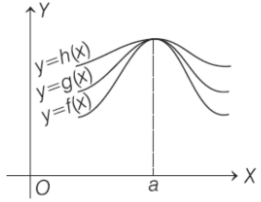
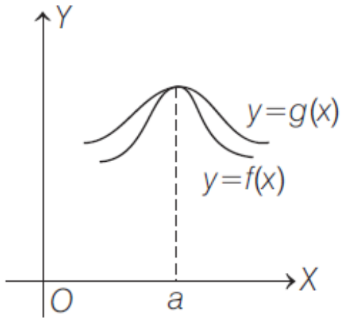
Theorem 1: Let $f$ and $g$ be two real valued functions with the same domain such that $f(x) \leq g(x)$ for all $x$ in the domain of definition. For some real number $a$, if both $\lim _{x \rightarrow a} f(x)$ and $\lim _{x \rightarrow a} g(x)$ exist, then
$
\lim _{x \rightarrow a} f(x) \leq \lim _{x \rightarrow a} g(x) .
$
This is shown in the figure
Image

Theorem 2 (Sandwich theorem) : Let $f, g$ and $h$ be real functions such that $f(x) \leq g(x) \leq h(x)$ for all $x$ in the common domain of definition. For some real number $a$, if $\lim _{x \rightarrow a} f(x)=l=\lim _{x \rightarrow a} h(x)$, then $\lim _{x \rightarrow a} g(x)=l$.

This is shown in the figure
Image

Theorem 3 : Three important limits are
(i) $\lim _{x \rightarrow 0} \frac{\sin x}{x}=1$
(ii) $\lim _{x \rightarrow 0} \frac{\frac{x}{1-\cos x}}{x}=0$
(iii) $\lim _{x \rightarrow 0} \frac{\tan ^x x}{x}=1$

Based on above information, answer the following questions.

(i) $\lim _{x \rightarrow 0} \frac{\sin 3 x}{5 x}$ is equal to
    (a) $\frac{1}{5}$     (b) $\frac{2}{5}$     (c) $\frac{3}{5}$     (d) $\frac{4}{5}$

(ii) $\lim _{\theta \rightarrow b} \frac{\tan (\theta-b)}{\theta-b}$ is equal to
    (a) 0     (b) 1     (c) 2     (d) 3

(iii) $\lim _{x \rightarrow 0} \frac{\tan 2 x-\sin 2 x}{x^3}$ is equal to
    (a) 4     (b) 3     (c) 2     (d) 1

(iv) $\lim _{x \rightarrow 0} \frac{2 \sin x-\sin 2 x}{x^3}$ is equal to
    (a) 0     (b) 1     (c) 2     (d) 3

(v) $\lim _{x \rightarrow \frac{\pi}{4}} \frac{\sin x-\cos x}{x-\frac{\pi}{4}}$ is equal to
    (a) $\sqrt{2}$     (b) 3     (c) 1     (d) $\sqrt{3}$
A manufacturing company produces certain goods. The company manager used to make a data record on daily basis about the cost and revenue of these goods separately. The cost and revenue function of a product are given by $C(x)=20 x+4000$ and $R(x)=60 x+2000$, respectively, where $x$ is the number of goods produced and sold.

Based on above information, answer the following questions.

(i) How many goods must be sold to realise some profit?
(a) $\mathrm{x}<\mathbf{5 0}$
(b) $x>50$
(c) $x \geq 50$
(d) $\mathbf{x} \leq \mathbf{5 0}$

(ii) If the cost and revenue functions of a product are given by $C(x)=3 x+400$ and $R(x)=$ $5 x+20$ respectively, where $x$ is the number of items produced by the manufacturer, then how many items must be sold to realise some profit?
(a) $x \leq 190$
(b) $x \geq 190$
(c) $x<190$
(d) $x>190$

(iii) Let $\mathbf{x}$ and $\mathbf{b}$ are real numbers. If $\mathbf{b} > \mathbf{0}$ and $\mathbf{x}< \mathbf{b}$, then
(a) $x$ is always positive
(b) $\mathbf{X}$ is always negative
(c) $\mathrm{x}$ is real number
(d) None of these

(iv) The solution set of $\mathbf{3}-\mathbf{5}<\mathrm{x}+\mathbf{7}$, when $\mathrm{x}$ is a whole number is given by
(a) $\{0,1,2,3,4,5\}$
(b) $(-\infty, 6)$
(c) $[0,5]$
(d) None of these

(v) Graph of inequality $x>2$ on the number line is represented by
(a) Image
(b)Image 
(c) Image
(d) None of the above
There are $4$ red, $5$ blue and $3$ green marbles in a basket.
$i.$ If two marbles are picked at randomly, find the probability that both red marbles. $(1)$
$ii.$ If three marbles are picked at randomly, find the probability that all green marbles. $(1)$
$iii.$ If two marbles are picked at randomly then find the probability that both are not blue marbles. $(2)$
OR
If three marbles are picked at randomly, then find the probability that atleast one of them is blue. $(2)$
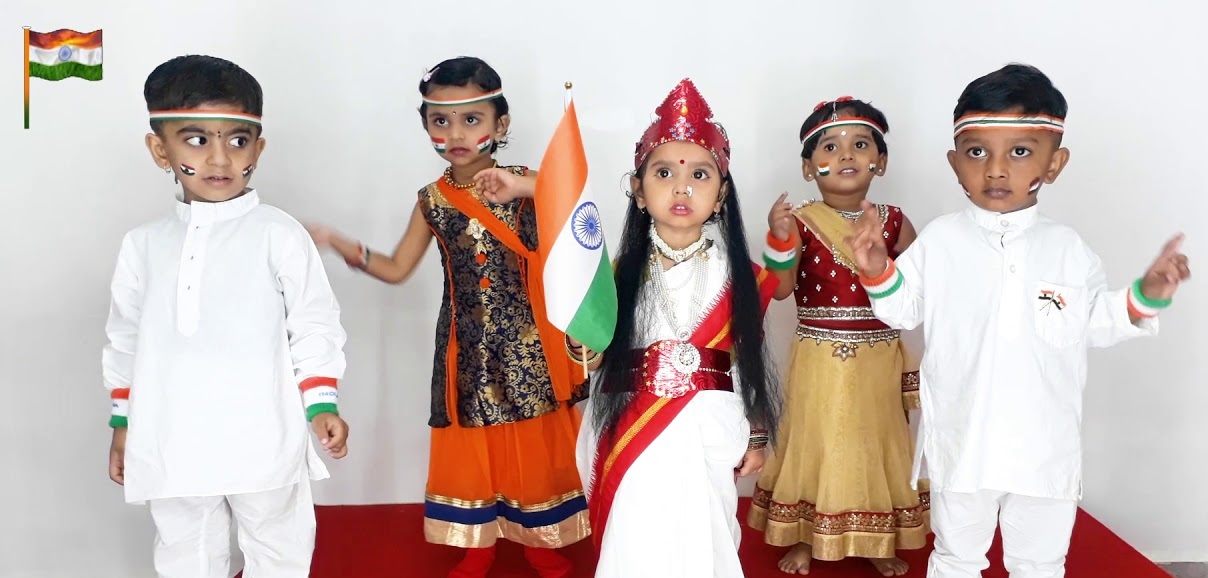
Republic day is a national holiday of India. It honours the date on which the constitution of India came into effect on 26 January 1950 replacing the Government of India Act (1935) as the governing document of India and thus, turning the nation into a newly formed republic.

Answer the following question, which are based on the word "REPUBLIC".


(i) Find the number of arrangements of the letters of the word 'REPUBLIC'.
(a) 40300     (b) 30420    (c) 40320     (d) 40400

(ii) How many arrangements start with a vowel?
(a) 12015     (b) 15120     (c) 12018     (d) 15100

(iii) Which concept is used for finding the arrangements start with a vowel?
(a) Permutation     (b) FPM     (c) Combination     (d) FPA

(iv) If the number of arrangements of the letters of the word 'REPUBLIC' is abcde, the (a + b + $\mathbf{c}+\mathbf{d}+\mathbf{e})$ is
(a) 10     (b) 9     (c) 8     (d) 15

(v) If the number of arrangements start with a vowel is abcde, then $(\mathbf{a}+\mathbf{b})-(\mathbf{d}+\mathbf{e})$ is
(a) 2     (b) 3     (c) 4     (d) 5
The school organised a cultural event for $100$ students. In the event, $15$ students participated in dance, drama and singing. $25$ students participated in dance and drama; $20$ students participated in drama and singing; $30$ students participated in dance and singing. $8$ students participated in dance only; $5$ students in drama only and $12$ students in singing only.

Based on the above information, answer the following questions.
  1. The number of students who participated in dance, is:
  1. $18$
  2. $30$
  3. $40$
  4. $48$
  1. The number of students who participated in drama, is:
  1. $35$
  2. $30$
  3. $25$
  4. $20$
  1. The number of students who participated in singing, is:
  1. $42$
  2. $45$
  3. $47$
  4. $37$
  1. The number of students who participated in dance and drama but not in singing, is:
  1. $20$
  2. $5$
  3. $10$
  4. $15$
  1. The number of students who did not participate in any of the events, is:
  1. $20$
  2. $30$
  3. $25$
  4. $35$
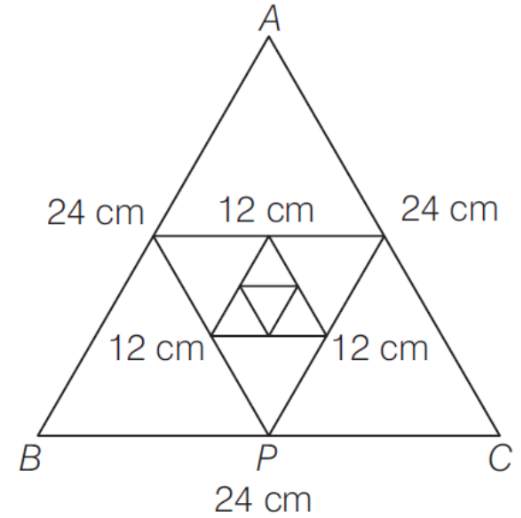
Each side of an equilateral triangle is $24 \mathrm{~cm}$. The mid-point of its sides are joined to form another triangle. This process is going continuously infinite.
Image
Based on above information, answer the following questions.

(i) The side of the 5th triangle is (in $\mathrm{cm}$)
    (a) 3     (b) 6     (c) 1.5     (d) 0.75

(ii) The sum of perimeter of first 6 triangle is (in $\mathrm{cm}$)
    (a) $\frac{569}{4}$     (b) $\frac{567}{4}$     (c) 120     (d) 144

(iii) The area of all the triangle is (in sq $\mathrm{cm}$ )
    (a) 576     (b) $192 \sqrt{3}$     (c) $144 \sqrt{3}$     (d) $169 \sqrt{3}$

(iv) The sum of perimeter of all triangle is (in $\mathrm{cm}$ )
    (a) 144     (b) 169     (c) 400     (d) 625

(v) The perimeter of 7 th triangle is (in $\mathrm{cm}$ )
    (a) $\frac{7}{8}$     (b) $\frac{9}{8}$     (c) $\frac{5}{8}$     (d) $\frac{3}{4}$
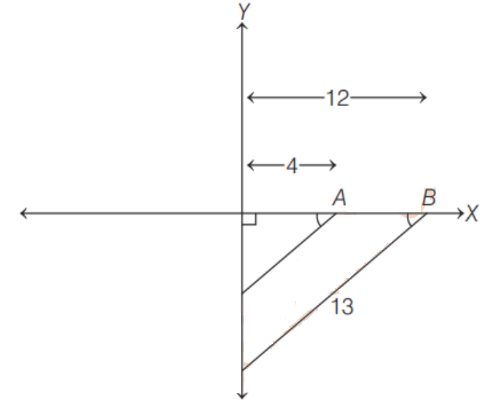
Rajiv constructs two right angled triangles in the fourth quadrant in such a way that the measure of triangle gives $\cos A=\frac{4}{5}$ and $\cos B=\frac{12}{13}$, where $\frac{3 \pi}{2} < A$ and $B > 2 \pi$.
Image
Based on the above information, answer the following questions.
(i) Find the value of $\cos (A+B)$
(ii) Find the value of $\sin (A-B)$
(iii) Find the value of $\tan (\mathbf{A}+\mathbf{B})$
There are $4$ red, $5$ blue and $3$ green marbles in a basket.
$i.$ If two marbles are picked at randomly, find the probability that both red marbles. $(1)$
$ii.$ If three marbles are picked at randomly, find the probability that all green marbles. $(1)$
$iii$. If two marbles are picked at randomly then find the probability that both are not blue marbles. $(2)$
OR
If three marbles are picked at randomly, then find the probability that atleast one of them is blue. $(2)$