$Assertion :$ A brass tumbler feels much colder than a wooden tray on a chilly day.
$Reason :$ The thermal conductivity of brass is more than the thermal conductivity of wood.
AIIMS 2008, Easy
Download our app for free and get started
Brass is a metal and good conductor. On a cold day, when brass tumbler is touched heat transfers from our body to brass, since our body looses heat so the tumbler feels cold. On the other hand, transfer of heat from our body to wood is slow and less, hence wooden tray appears warm.

Download our appand get started for free
Experience the future of education. Simply download our apps or reach out to us for more information. Let's shape the future of learning together!No signup needed.*
Similar Questions
- 1Consider a compound slab consisting of two different materials having equal thickness and thermal conductivities $ K$ and $2K$ respectively. The equivalent thermal conductivity of the slab isView Solution
- 2View SolutionWhen two ends of a rod wrapped with cotton are maintained at different temperatures and after some time every point of the rod attains a constant temperature, then
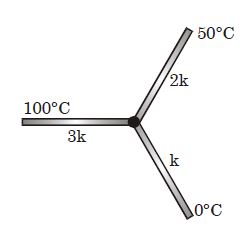
- 3Three rods of the same dimensions have thermal conductivities $3k, 2k$ and $k$. They are arranged as shown, with their ends at $100\,^oC, 50\,^oC$ and $0\,^oC$. The temperature of their junction isView Solution
- 4One end of a metal rod of length $1.0 m$ and area of cross section $100c{m^2}$ is maintained at ${100^o}C.$If the other end of the rod is maintained at ${0^o}C$, the quantity of heat transmitted through the rod per minute is (Coefficient of thermal conductivity of material of rod =$100W/m-K$)View Solution
- 5A rod of length $L$ with sides fully insulated is of a material whose thermal conductivity varies with $\alpha$ temperature as $ K= \frac{\alpha }{T}$, where $\alpha$ is a constant. The ends of the rod are kept at temperature $T_1$ and $T_2$. The temperature $T$ at $x,$ where $x$ is the distance from the end whose temperature is $T_1$ isView Solution
- 6The ends of two rods of different materials with their thermal conductivities, radii of cross-sections and lengths all are in the ratio $1:2$ are maintained at the same temperature difference. If the rate of flow of heat in the larger rod is $4\;cal/\sec $, that in the shorter rod in $cal/\sec $ will beView Solution
- 7The temperatures of two bodies $A$ and $B$ are respectively ${727^o}C$ and ${327^o}C$. The ratio ${H_A}:{H_B}$ of the rates of heat radiated by them isView Solution
- 8If the radius of a star is $R$ and it acts as a black body, what would be the temperature of the star, in which the rate of energy production is $Q$?View Solution
($\sigma$ stands for Stefan's constant)
- 9Column $I$ gives some devices and Column $II$ gives some process on which the functioning of these devices depend. Match the devices in Column $I$ with the processes in Column $II$ and indicate your answer by darkening appropriate bubbles in the $4 \times 4$ matrix given in the $ORS$.View Solution
Column $I$ Column $II$ $(A)$ Bimetallic strip $(p)$ Radiation from a hot body $(B)$ Steam engine $(q)$ Energy conversion $(C)$ Incandescent lamp $(r)$ Melting $(D)$ Electric fuse $(s)$ Thermal expansion of solids - 10A very thin metallic shell of radius $r$ is heated to temperature $T$ and then allowed to cool. The rate of cooling of shell is proportional to ........View Solution