Question
Assertion  :   A charged capacitor is disconnected from a battery. Now if its plate are separated farther, the potential energy will fall.
Reason     : Energy stored in a capacitor is equal to the work done in charging it.(a) If both assertion and reason are true and the reason is the correct explanation of the assertion.(b) If both assertion and reason are true but reason is not the correct explanation of the assertion.(c) If assertion is true but reason is false.(d) If assertion is false but reason is true.


Answer

(d) If assertion is false but reason is true.
Need a full question paper?

Generate a complete, print-ready paper with questions like this in minutes — across 16+ boards, with answer keys.

Start Generating Free

Similar questions

The light reflected by a plane mirror may form a real image(a) If the rays incident on the mirror are diverging(b) If the rays incident on the mirror are converging(c) If the object is placed very close to the mirror (d) Under no circumstances


Which of the following is correct when one cell is wrongly connected in series circuit?
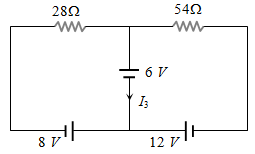
Consider the circuit shown in the figure. The current $I_3$  is equal to          
Three capacitors of capacitances $6\mu\text{F}$ each are available. The minimum and maximum capacitances, which may be obtained are:
An electron moving with a uniform velocity along the positive x-direction enters a magnetic field directed along the positive y-direction. The force on the electron is directed along (a) Positive y-direction (b) Negative y-direction(c) Positive z-direction(d) Negative z-direction
   
   
The current in a simple series circuit is 5.0 amp. When an additional resistance of 2.0 ohms is inserted, the current drops to 4.0 amp. The original resistance of the circuit in ohms was(a) 1.25(b) 8(c) 10       (d) 20
       
A long, straight wire carries a current i. The magnetizing field intensity H is measured at a point P close to the wire. A long, cylindrical iron rod is brought close to the wire so that the point P is at the centre the rod. The value of H at P will:
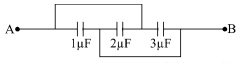
In the attached figure, the value of equivalence between points A and B will be:
Image
Atomic radius of $fcc$ is
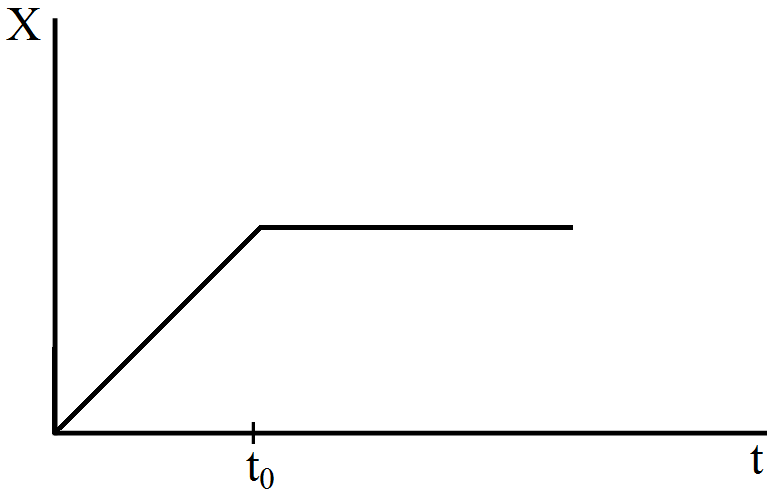
Figure shows the displacement-time graph of a particle moving on the $X-$axis.
  1. The particle is continuously going in positive $x$ direction.
  2. The particle is at rest.
  3. The velocity increases up to a time to, and then becomes constant.
  4. The particle moves at a constant velocity up to a time to, and then stops.