Assertion : A current continues to flow in superconducting coil even after switch is off.
Reason : Superconducting coils show Meissner effect
AIIMS 2007, Easy
Download our app for free and get started
Current continues to flow in a super conducting coil even after switch off because at critical temperature, its resistance is zero so there is no hinderance to current flow.
Meissner effect says that at critical temperature magnetic field inside the conductor is zero i.e, $B = 0$ but this does not explain assertion.

Download our appand get started for free
Experience the future of education. Simply download our apps or reach out to us for more information. Let's shape the future of learning together!No signup needed.*
Similar Questions
- 1View SolutionThe relaxation time in conductors
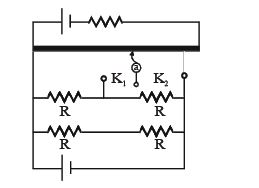
- 2In potentiometer experiment when $K_1$ is closed balance length is $100\,cm$. Then what will be balancing length when $K_2$ is closed ................ $\mathrm{cm}$View Solution
- 3The heat generated through $2 \,ohm$ and $8\, ohm$ resistances separately, when a condenser of $200\,\mu F$ capacity charged to $200\, V$ is discharged one by one, will beView Solution
- 4An ammeter with internal resistance $90\,\Omega $ reads $1.85\, A$ when connected in a circuit containing a battery and two resistors $700\,\Omega $ and $410\,\Omega $ in series. Actual current will beView Solution
- 5View SolutionTwo wires of the same material are given. The first wire is twice as long as the second and has twice the diameter of the second. The resistance of the first will be
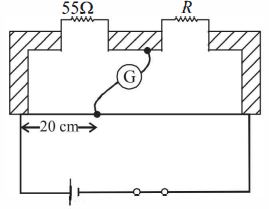
- 6Shown in the figure below is a meter-bridge set up with null deflection in the galvanometer. The value of the unknown resistor $R$ is ............. $\Omega$View Solution
- 7The $e.m.f.$ of a standard cell balances across $150\, cm$ length of a wire of potentiometer. When a resistance of $2\,\Omega $ is connected as a shunt with the cell, the balance point is obtained at $100\,cm$. The internal resistance of the cell is .............. $\Omega $View Solution
- 8What will happen when a $40\, watt$, $220\, volt$ lamp and $100\, watt$, $220\, volt$ lamp are connected in series across $40\, volt$ supplyView Solution
- 9What amount of heat will be generated in a coil of resistance $R$ due to a charge $q$ passing through it if the current in the coil decreases to zero uniformly during a time interval $\Delta t$View Solution
- 10A platinum resistance thermometer has a resistance of $50\,\Omega $ at $20\,^o C$. When dipped in a liquid the resistance becomes $76.8\,\Omega $. The temperature coefficient of resistance for platinum is $\alpha = 3.92 \times {10^{ - 3}}\,^o C$. The temperature of the liquid is .............. $^o C$View Solution