The relaxation time in conductors
Easy
Download our app for free and get started
(b) Because as temperature increases, the resistivity increases and hence the relaxation time decreases for conductors $\left( {\tau \propto \frac{1}{\rho }} \right).$

Download our appand get started for free
Experience the future of education. Simply download our apps or reach out to us for more information. Let's shape the future of learning together!No signup needed.*
Similar Questions
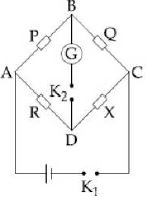
- 1In a Wheatstone bridge (see figure) Resistance $P$ and $Q$ are approximately equal. When $R = 400\,\Omega ,$ the bridge is balanced. On interchanging $P$ and $Q,$ the value of $R,$ for balance is $405\,\Omega .$ The value of $X$ is close to ................. $ohm$View Solution
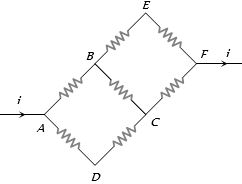
- 2In the adjoining circuit diagram each resistance is of $10$ $\Omega$. The current in the arm $AD$ will beView Solution
- 3For comparing the $e.m.f.$'s of two cells with a potentiometer, a standard cell is used to develop a potential gradient along the wires. Which of the following possibilities would make the experiment unsuccessfulView Solution
- 4In the circuit shown in figure reading of voltmeter is $V_1$ when only $S_1$ is closed, reading of voltmeter is $V_2$ when only $S_2$ is closed. The reading of voltmeter is $V_3$ when both $S_1$ and $S_2$ are closed thenView Solution
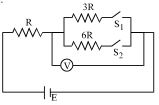
- 5The resistance of hot tungsten filament is about $10$ times the cold resistance. What will be the resistance of $100\, W$ and $200\, V$ lamp when not in use ............. $\Omega $View Solution
- 6At room temperature, copper has free electron density of $8.4 \times {10^{28}}$ per ${m^3}$. The copper conductor has a cross-section of $10^{-6} \,m^2$ and carries a current of $5.4\, A$. The electron drift velocity in copper isView Solution
- 7Resistance of the wire is measured as $2\,\Omega$ and $3\,\Omega$ at $10^{\circ}C$ and $30^{\circ}C$ respectively. Temperature cocoefficient of resistance of the material of the wire is............$^{\circ}C ^{-1}$View Solution
- 8The total momentum of electrons in a straight wire of copper of length $1\, metre$ carrying a current of $16\, A$ isView Solution
- 9The electric field $E$, current density $J$ and conductivity $\sigma$ of a conductor are related asView Solution
- 10In hydrogen atom, the electron makes $6.6 \times {10^{15}}$ revolutions per second around the nucleus in an orbit of radius $0.5 \times {10^{ - 10}}\,m$. It is equivalent to a current nearlyView Solution