Assertion : A helium filled balloon does not rise indefinately in air but halts after a certain height.
Reason : Viscosity opposes the motion of balloon. Choose any one of the following four responses:
Medium


Download our appand get started for free
Experience the future of education. Simply download our apps or reach out to us for more information. Let's shape the future of learning together!No signup needed.*
Similar Questions
- 1Under a constant pressure head, the rate of flow of liquid through a capillary tube is $V$. If the length of the capillary is doubled and the diameter of the bore is halved, the rate of flow would becomeView Solution
- 2If pressure at half the depth of a lake is equal to $2/3$ pressure at the bottom of the lake then what is the depth of the lake ........ $m$View Solution
- 3A cylindrical vessel of height $500 \mathrm{~mm}$ has an orifice (small hole) at its bottom. The orifice is initially closed and water is filled in it up to height $\mathrm{H}$. Now the top is completely sealed with a cap and the orifice at the bottom is opened. Some water comes out from the orifice and the water level in the vessel becomes steady with height of water column being $200 \mathrm{~mm}$. Find the fall in height (in ${m m}$ ) of water level due to opening of the orifice.View Solution
|Take atmospheric pressure $=1.0 \times 10^5 \mathrm{~N} / \mathrm{m}^2$, density of water $=1000 \mathrm{~kg} / \mathrm{m}^3$ and $g=10 \mathrm{~m} / \mathrm{s}^2$. Neglect any effect of surface tension.]
- 4A steel wire is suspended vertically from a rigid support. When loaded with a weight in air, it extends by $l_a$ and when the weight is immersed completely in water, the extension is reduced to $l_w$. Then the relative density of material of the weight isView Solution
- 5View SolutionWater flows out of the hole on the side of a bucket and follows a parabolic path. If the bucket falls freely under gravity, ignoring air resistance, the water flow
- 6A flat plate of area $10\,cm^2$ is separated from a large plate by a layer of glycerine $1\, mm$ thick. If the coefficient of viscosity of glycerine is $20$ poise, the force required to keep the plate moving with a velocity of $1\,cm/sec$ is .......... $dyne$View Solution
- 7Given below are two statements: one is labelled as Assertion $A$ and the other is labelled as Reason $R$View Solution
Assertion $A:$ When you squeeze one end of a tube to get toothpaste out from the other end, Pascal's principle is observed.
Reason $R:$ A change in the pressure applied to an enclosed incompressible fluid is transmitted undiminished to every portion of the fluid and to the walls of its container.
In the light of the above statements, choose the most appropriate answer from the options given below
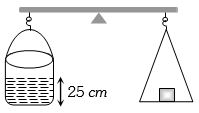
- 8A cylinder containing water up to a height of $25 cm$ has a hole of cross-section $\frac{1}{4}c{m^2}$ in its bottom. It is counterpoised in a balance. What is the initial change in the balancing weight when water begins to flow outView Solution
- 9Fountains usually seen in gardens are generated by a wide pipe with an enclosure at one end having many small holes. Consider one such fountain which is produced by a pipe of internal diameter $2$ $cm$ in which water flows at a rate $3$ $ms^{^{-1}}$. The enclosure has $100$ holes each of diameter $0.05$ $cm$. The velocity of water coming out of the holes ids ( in $ms^{^{-1}}$)View Solution
- 10Eight spherical rain drops of the same mass and radius are falling down with a terminal speed of $6\, cm -s^{-1}$ . If they coalesce to form one big drop, what will be the terminal speed of the bigger drop ? (Neglect the buoyancy of the air) ....... $cm -s^{-1}$View Solution