MCQ
Assertion : A helium filled balloon does not rise indefinately in air but halts after a certain height.

Reason : Viscosity opposes the motion of balloon. Choose any one of the following four responses:

  • A
    if both $(A) $ and $ (R)$ are true and $(R)$ is the correct explanation of $(A)$
  • if both $(A) $ and $ (R) $ are true but $(R)$ is not correct explanation of $(A)$
  • C
    if both $ (a) $ and $(R)$ are true but $(R)$ is not correct explanation of
  • D
    if $(A) $ is true but $(R)$ is false

Answer

Correct option: B.
if both $(A) $ and $ (R) $ are true but $(R)$ is not correct explanation of $(A)$
b

Need a full question paper?

Generate a complete, print-ready paper with questions like this in minutes — across 16+ boards, with answer keys.

Start Generating Free

Similar questions

Two springs have their force constant as $k_1$ and $k_2 (k_1 > k_2)$. when they are  stretched by the same force
One main scale division of a vernier callipers is $a$ $cm$ and $n ^{\text {th }}$ division of the vernier scale coincide with $( n -1)^{\text {th }}$ division of the main scale. The least count of the callipers in $mm$ is
The persistence of sound in a room after the source of sound is turned off is called reverberation. The measure of reverberation time is the time required for sound intensity to decrease by $60 \,dB$. It is given that the intensity of sound falls off as $I_0 \exp \left(-c_1 \alpha\right)$ where $I_0$ is the initial intensity, $c_1$ is a dimensionless constant with value $1 / 4$. Here, $\alpha$ is a positive constant which depends on the speed of sound, volume of the room, reverberation time, and the effective absorbing area $A_e$. The value of $A_e$ is the product of absorbing coefficient (with value between $0$ and $1,1$ being a perfect absorber) and the area of the room. For a concert hall of volume $600 \,m ^3$, the value of $A_e$ (in $m ^2$ ) required to give a reverberation time of $1 s$ is closest to (speed of sound in air $=340 \,m / s$ )
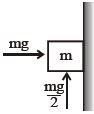
A block pressed against the vertical wall is in equilibrium. The minimum coefficient of  friction is:-
An observer starts moving with uniform acceleration $a$ toward a stationary sound source emitting a whistle of frequency $n.$ As the observer approaches source, the apparent frequency, heard by the observer varies with time as
A simple harmonic oscillator has an amplitude $A$ and time period $6 \pi$ second. Assuming the oscillation starts from its mean position, the time required by it to travel from $x=A$ to $x=\frac{\sqrt{3}}{2} A$ will be $\frac{\pi}{x}$ s, where $x=$__________.
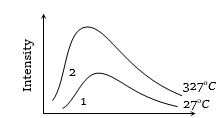
The spectrum of a black body at two temperatures $27^oC$ and $327^oC$ is shown in the figure. Let $A_1$ and $A_2$ be the areas under the two curves respectively. The value of $\frac{{{A_2}}}{{{A_1}}}$ is
The density of a cube is measured by measuring its mass and the length of its sides. If the maximum errors in the measurement of mass and length are 3% and 2% respectively, then the maximum error in the measurement of density is:
Which of the following particles will experience maximum magnetic force circle when projected with the same velocity perpendicular to a magnetic field?
  1. Electron
  2. Proton
  3. He+
  4. Li++
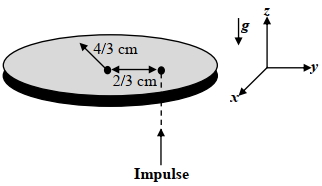
A thin circular coin of mass $5 \mathrm{gm}$ and radius $4 / 3 \mathrm{~cm}$ is initially in a horizontal $x y$-plane. The coin is tossed vertically up ( $+z$ direction) by applying an impulse of $\sqrt{\frac{\pi}{2}} \times 10^{-2} \mathrm{~N}-\mathrm{s}$ at a distance $2 / 3 \mathrm{~cm}$ from its center. The coin spins about its diameter and moves along the $+z$ direction. By the time the coin reaches back to its initial position, it completes $n$ rotations. The value of $n$ is. . . . . [Given: The acceleration due to gravity $\mathrm{g}=10 \mathrm{~ms}^{-2}$ ]