Question
Assertion : A paramagnetic sample display greater magnetisation (for the same magnetic field) when cooled.

Reason : The magnetisation does not depend on temperature.

Answer

A paramagnetic sample display greater magnetisation when cooled, this is because at lower temperature, the tendency to disrupt the alignment of dipoles (due to magnetising field) decreases on account of reduced random thermal motion.

Need a full question paper?

Generate a complete, print-ready paper with questions like this in minutes — across 16+ boards, with answer keys.

Start Generating Free

Similar questions

The upper half of an inclined plane with inclination $\phi$ is perfectly smooth, while the  lower half is rough. $A$ body starting from rest at the top will again come to rest at the  bottom, if the coefficient of friction for the lower half is given by-
Two identical charges $+Q $ are kept fixed some distance apart. A small particle $P $ with charge $q$ is placed midway between them. If $P$  is given a small displacement $\Delta$ , it will undergo simple harmonic motion if
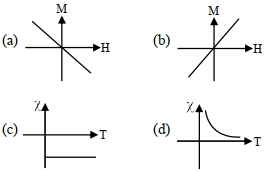
Following plots show Magnetization $(M)$ $vs$ Magnetising field $(H)$ and Magnetic susceptibility $(\chi)$ vs temperature $(T)$ graph :

Which of the following combination will be represented by a diamagnetic material?
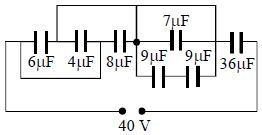
In the following diagram, the charge and potential difference across $8\,\mu F$ capacitance will be nearly
A $4\, \,\mu F$ condenser is charged to $400\, V$ and then its plates are joined through a resistance. The heat produced in the resistance is.......$J$
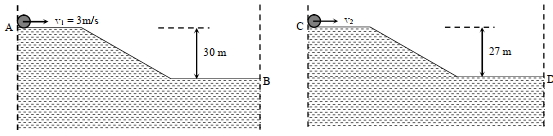
Two identical uniform discs roll without slipping on two different surfaces $AB$ and $CD$ (see figure) starting at $A$ and $C$ with linear speeds $v _1$ and $v _2$, respectively, and always remain in contact with the surfaces. If they reach $B$ and $D$ with the same linear speed and $v_1=3 \ m / s$, then $v_2$ in $m / s$ is $\left(g=10 \ m / s ^2\right)$
In nuclear reactions, we have the conservation of
Photons of energy $7 \,eV$ are incident on two metals $A$ and $B$ with work functions $6 \,eV$ and $3 \,eV$, respectively. The minimum de-Broglie wavelengths of the emitted photoelectrons with maximum energies are $\lambda_A$ and $\lambda_B$ respectively, where $\lambda_A / \lambda_B$ is nearly
In hydrogen atom, the electron is moving round the nucleus with velocity $2.18 \times 10^{6} \;m / s$ in an orbit of radius $0.528\;\mathring A.$ The acceleration of the electron is
Which of the compounds with molecular formula $C_5H_{10}$ yields acetone on ozonolysis