Question

Assertion :   A paramagnetic sample display greater magnetisation (for the same magnetising field) when cooled.

Reason     : The magnetisation does not depend on temperature.

(a) If both assertion and reason are true and the reason is the correct explanation of the assertion.

(b) If both assertion and reason are true but reason is not the correct explanation of the assertion.

(c) If assertion is true but reason is false.

(d) If the assertion and reason both are false.

Answer

(c) If assertion is true but reason is false.

Need a full question paper?

Generate a complete, print-ready paper with questions like this in minutes — across 16+ boards, with answer keys.

Start Generating Free

Similar questions

In a Young’s double slit experiment, the source illuminating the slits is changed from blue to violet. The width of the fringes

(a) Increases

(b) Decreases

(c) Becomes unequal

(d) Remains constant

Nucleus produced due to a-decay of the nucleus   is

(a)  

(b)  

(c)  

(d)  

A charge of Q coulomb is placed on a solid piece of metal of irregular shape. The charge will distribute itself

(a) Uniformly in the metal object

(b) Uniformly on the surface of the object

(c) Such that the potential energy of the system is minimised

(d) Such that the total heat loss is minimised

Calculate the de-Brogile wavelength of an electron travelling at 1% of the speed of light:
What happens to fringe width in the Young's double slit experiment, if it is performed in glycerine instead of air?
Which of the following pairs of physical quantities may be represented in the same unit?
  1. Heat and temperature.
  2. Temperature and mole.
  3. Heat and work.
  4. Specific heat and heat.
A p-type semiconductor is:
  1. Positively charged.
  2. Negatively charged.
  3. Uncharged.
  4. Uncharged at 0K but charged at higher ternperatures.

For a real object, which of the following can produced a real image         

(a) Plane mirror

(b) Concave lens

(c) Convex mirror

(d) Concave mirror

A current flows in a conductor from east to west. The direction of the magnetic field at a points above the conductor is .....

(a) Towards north

(b) Towards south

(c) Towards east

(d) Towards west

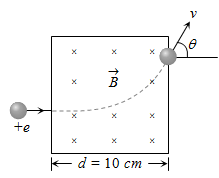
A proton accelerated by a potential difference 500 KV moves though a transverse magnetic field of 0.51T as shown in figure. The angle θ through which the proton deviates from the initial direction of its motion is

(a) 15°

(b) 30°

(c) 45°

(d) 60°