Question
$Assertion :$ A transverse waves are produced in a very long string fixed at one end. Only progressive wave is observed near the free end.
$Reason :$ Energy of reflected wave does not reach the free end.
Answer

Get the step-by-step solution for this question inside the Vidyadip app.

Get the answer in the app

Need a full question paper?

Generate a complete, print-ready paper with questions like this in minutes — across 16+ boards, with answer keys.

Start Generating Free

Similar questions

A solid horizontal surface is covered with a thin layer of oil. A rectangular block of mass $m =0.4 kg$ is at rest on this surface. An impulse of $1.0 N s$ is applied to the block at time $t =0$ so that it starts moving along the $x$-axis with a velocity $v ( t )= v _0^{ e ^{-1 / \tau}}$, where $v_0$ is a constant and $\tau=4 s$. The displacement of the block, in metres, at $t=\tau$ is. . . . . . . Take $e ^{-1}=0.37$
Colour of shining bright star is an indication of its
In the Arctic region, hemispherical houses called Igloos are made of ice. It is possible to maintain a temperature inside an Igloo as high as $20^{\circ} C$ because
A metal wire has mass $(0.8 \pm 0.001) g$, radius $(0.3 \pm 0.002) mm$ and length $(5 \pm 0.04) cm$. The maximum possible percentage error in the measurement of density will nearly be:
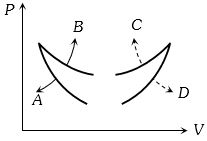
Four curves $A, B, C$ and $D$ are drawn in the adjoining figure for a given amount of gas. The curves which represent adiabatic and isothermal changes are
The $V-i$ graph for a conductor makes an angle $\theta $ with $V-$ axis. Here $ V$ denotes the voltage and $i$ denotes current. The resistance of conductor is given by
The particles $A$ and $B$ of mass $m$ each are separated by a distance $r$. Another particle $C$ of mass $M$ is placed at the midpoint of $A$ and $B$. Find the work done in taking $C$ to a point equidistant $r$ from $A$ and $B$ without acceleration $(G=$ Gravitational constant and only gravitational interaction between $A, B$ and $C$ is considered) 
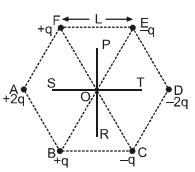
Six point charges are kept at the vertices of a regular hexagon of side $L$ and centre $O$, as shown in the figure. Given that $K=\frac{1}{4 \pi \varepsilon_0} \frac{q}{L^2}$, which of the following statement $(s)$ is (are) correct?

$(A)$ the elecric field at $O$ is $6 K$ along $O D$

$(B)$ The potential at $O$ is zero

$(C)$ The potential at all points on the line $PR$ is same

$(D)$ The potential at all points on the line $ST$ is same.

A bi convex lens of focal length $10\,cm$ is cut in two identical parts along a plane perpendicular to the principal axis. The power of each lens after cut is $...........\,D$.
A wire of length ' $r$ ' and resistance $100 \Omega$ is divided into $10$ equal parts. The first $5$ parts are connected in series while the next $5$ parts are connected in parallel. The two combinations are again connected in series. The resistance of this final combination is: