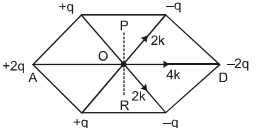
Six point charges are kept at the vertices of a regular hexagon of side $L$ and centre $O$, as shown in the figure. Given that $K=\frac{1}{4 \pi \varepsilon_0} \frac{q}{L^2}$, which of the following statement $(s)$ is (are) correct?
$(A)$ the elecric field at $O$ is $6 K$ along $O D$
$(B)$ The potential at $O$ is zero
$(C)$ The potential at all points on the line $PR$ is same
$(D)$ The potential at all points on the line $ST$ is same.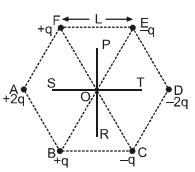
IIT 2012, Diffcult


Download our appand get started for free
Experience the future of education. Simply download our apps or reach out to us for more information. Let's shape the future of learning together!No signup needed.*
Similar Questions
- 1Consider a spherical shell of radius $R$ with a total charge $+ Q$ uniformly spread on its surface (centre of the shell lies at the origin $x=0$ ). Two point charges $+q$ and $-q$ are brought, one after the other from far away and placed at $x=-a / 2$ and $x=+a / 2( < R)$, respectively. Magnitude of the work done in this process isView Solution
- 2A parallel plate capacitor with air between the plates has a capacitance of $9\,pF$. The separation between its plates is $'d'$. The space between the plates is now filled with two dielectrics. One of the dielectrics has dielectric constant $K_1=3$ and thickness $\frac {d}{3}$ while the other one has dielectric constant $K_2 = 6$ and thickness $\frac {2d}{3}$ . Capacitance of the capacitor is now........$pF$View Solution
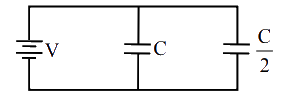
- 3Two condensers, one of capacity $C$ and other of capacity $C/2$ are connected to a $V-$ volt battery, as shown in the figure. The work done in charging fully both the condensers isView Solution
- 4The distance between the circular plates of a parallel plate condenser $40\,mm$ in diameter, in order to have same capacity as a sphere of radius $1\;metre$ is....$mm$View Solution
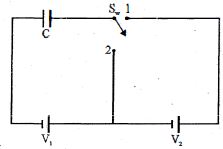
- 5The switch $S_w$ is shifted from position $1$ to position $2$ as shown in the figure. Heat generated in the circuit isView Solution
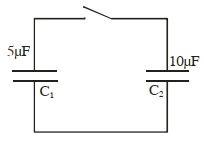
- 6A capacitor $C _{1}$ of capacitance $5\,\mu F$ is charged to a potential of $30\,V$ using a battery. The battery is then removed and the charged capacitor is connected to an uncharged capacitor $C _{2}$ of capacitance $10\,\mu F$ as shown in figure. When the switch is closed charge flows between the capacitors. At equilibrium, the charge on the capacitor $C _{2}$ is________ $\mu C$View Solution
- 7The diagram shows a small bead of mass $m$ carrying charge $q$. The bead can freely move on the smooth fixed ring placed on a smooth horizontal plane. In the same plane a charge $+Q$ has also been fixed as shown. The potential atthe point $P$ due to $+Q$ is $V$. The velocity with which the bead should projected from the point $P$ so that it can complete a circle should be greater thanView Solution

- 8$1000$ small water drops each of radius $r$ and charge $q$ coalesce together to form one spherical drop. The potential of the big drop is larger than that of the smaller drop by a factor ofView Solution
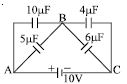
- 9In the circuit shown in figure, four capacitors are connected to a battery. A parallel plate capacitor has an electric field of $10^5\ V/m$ between the plates. If the charge on the capacitor plate is $1\ \mu C$, then the force on each capacitor plate is.....$Nt$View Solution
- 10The election field in a region is given by $\vec E = (Ax + B)\hat i$ where $E$ is in $N\,C^{-1}$ and $x$ in meters. The values of constants are $A = 20\, SI\, unit$ and $B = 10\, SI\, unit$. If the potential at $x =1$ is $V_1$ and that at $x = -5$ is $V_2$ then $V_1 -V_2$ is.....$V$View Solution