Question
Assertion  :   Electrons move away from a low potential to high potential region.
Reason      : Because electrons has negative charge(a) If both assertion and reason are true and the reason is the correct explanation of the assertion.(b) If both assertion and reason are true but reason is not the correct explanation of the assertion.(c) If assertion is true but reason is false.(d) If the assertion and reason both are false.


Answer

(a) If both assertion and reason are true and the reason is the correct explanation of the assertion.

Need a full question paper?

Generate a complete, print-ready paper with questions like this in minutes — across 16+ boards, with answer keys.

Start Generating Free

Similar questions

Assertion  :   Leclanche cell is used, when constant supply of electric current is not required.  
Reason     : The e.m.f. of a Leclanche cell falls, if it is used continuously.(a) If both assertion and reason are true and the reason is the correct explanation of the assertion.(b) If both assertion and reason are true but reason is not the correct explanation of the assertion.(c) If assertion is true but reason is false.(d) If the assertion and reason both are false.


A short magnetic needle is pivoted in a uniform magnetic field of strength $1 T .$ When another magnetic field of strength $\sqrt{3} \mathrm{~T}$ is applied to the needle in a perpendicular direction, the needle deflects through an angle $\theta$, where $\theta$ is
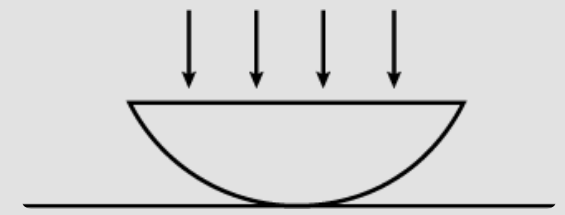
A thin slice is cut out of a glass cylinder along a plane parallel to its axis. The slice is placed on a flat glass plae as shown in figure. The observed interference fringes from this combination shall be:
A charge produces an electric field of $1\ N/C$ at a point distant $0.1 m$ from it. The magnitude of charge is
A nucleus of element X is represented as $^{56}_{26}\text{X}$
Which is an isotope of element X?
When Ge crystals are doped with phosphorus atom, then it becomes(a) Insulator(b) P-type(c) N-type(d) Superconductor
       
A milli voltmeter of 25 milli volt range is to be converted into an ammeter of 25 ampere range. The value (in ohm) of necessary shunt will be:
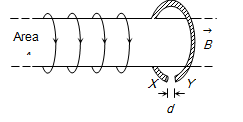
A highly conducting ring of radius $R$ is perpendicular to and concentric with the axis of a long solenoid as shown in fig. The ring has a narrow gap of width $d$ in its circumference. The solenoid has cross sectional area $A$ and a uniform internal field of magnitude $B_0.$ Now beginning at $t=0,$ the solenoid current is steadily increased to so that the field magnitude at any time $t$ is given by $B(t)=B_0+\alpha t$ where $\alpha>0.$ Assuming that no charge can flow across the gap, the end of ring which has excess of positive charge and the magnitude of induced $\text{e.m.f.}$ in the ring are respectively
A hollow sphere of charge does not produce an electric field at any(a) Point beyond 2 metres(b) Point beyond 10 metres(c) Interior point(d) Outer point
   
   
1000 small water drops each of radius r and charge q coalesce together to form one spherical drop. The potential of the big drop is larger than that of the smaller drop by a factor of(a) 1000  (b) 100(c) 10(d) 1