$Assertion :$ For Reynold’s number $Re > 2000$, the flow of fluid is turbulent.
$Reason :$ Inertial forces are dominant compared to the viscous forces at such high Reynold’s numbers.
$Reason :$ Inertial forces are dominant compared to the viscous forces at such high Reynold’s numbers.
AIIMS 2005, Easy
Download our app for free and get started
Reynold number $ =\frac{ Inertial force per unit area}{Viscous force perunit area}$ So for higher value of Reynold’s number, inertial force is dominant.

Download our appand get started for free
Experience the future of education. Simply download our apps or reach out to us for more information. Let's shape the future of learning together!No signup needed.*
Similar Questions
- 1The area of cross-section of a large tank is $0.5 \; m ^{2}$. It has a narrow opening near the bottom having area of cross-section $1 \; cm ^{2}$. A load of $25 \; kg$ is applied on the water at the top in the tank. Neglecting the speed of water in the tank, the velocity of the water, coming out of the opening at the time when the height of water level in the tank is $40 \; cm$ above the bottom, will be $\dots \; cms ^{-1}$. $\left[\right.$ Take $\left.g =10 \; ms ^{-2}\right]$View Solution
- 2A bucket contains water filled upto a height $=$ $15 cm$. The bucket is tied to a rope which is passed over a frictionless light pulley and the other end of the rope is tied to a weight of mass which is half of that of the (bucket $+$ water). The water pressure above atmosphere pressure at the bottom is ....... $kPa$View Solution
- 3View SolutionWith rise in temperature, density of a given body changes according to one of the following relations
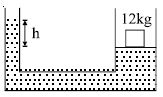
- 4The area of cross-section of the wider tube shown in figure is $800$ $cm^2$. If a mass of $12$ $ kg $ is placed on the massless piston, the difference in heights $h$ in the level of water in the two tubes is ........ $cm$View Solution
- 5The two thigh bones (femurs), each of cross-sectional area $10\; cm ^{2}$ support the upper part of a human body of mass $40\; kg$. Estimate the average pressure sustained by the femurs.View Solution
- 6The area of cross-section of a large tank is $0.5 \; m ^{2}$. It has a narrow opening near the bottom having area of cross-section $1 \; cm ^{2}$. A load of $25 \; kg$ is applied on the water at the top in the tank. Neglecting the speed of water in the tank, the velocity of the water, coming out of the opening at the time when the height of water level in the tank is $40 \; cm$ above the bottom, will be $\dots \; cms ^{-1}$. $\left[\right.$ Take $\left.g =10 \; ms ^{-2}\right]$View Solution
- 7The velocity of a small ball of mass ' $m$ ' and density $d _{1}$, when dropped in a container filled with glycerine, becomes constant after some time. If the density of glycerine is $d _{2}$, then the viscous force acting on the ball, will beView Solution
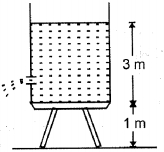
- 8Water is filled in a tank upto $3 \,m$ height. The base of the tank is at height $1 \,m$ above the ground. What should be the height of a hole made in it, so that water can be sprayed upto maximum horizontal distance on ground?View Solution
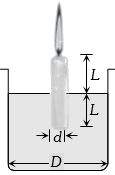
- 9A candle of diameter $ d$ is floating on a liquid in a cylindrical container of diameter $D $ $(D>>d)$ as shown in figure. If it is burning at the rate of $2$ cm/hour then the top of the candle willView Solution
- 10A horizontal right angle pipe bend has crosssectional area $=$ $10 $ $cm^2$ and water flows through it at speed $=$ $20$ $m/s$. The force on the pipe bend due to the turning of water is ........ $N$View Solution