The velocity of a small ball of mass ' $m$ ' and density $d _{1}$, when dropped in a container filled with glycerine, becomes constant after some time. If the density of glycerine is $d _{2}$, then the viscous force acting on the ball, will be
JEE MAIN 2022, Medium


Download our appand get started for free
Experience the future of education. Simply download our apps or reach out to us for more information. Let's shape the future of learning together!No signup needed.*
Similar Questions
- 1A block of ice floats on a liquid of density $1.2$ in a beaker then level of liquid when ice completely meltView Solution
- 2A large open tank has two holes in the wall. One is a square hole of side $L$ at a depth $y $ from the top and the other is a circular hole of radius $ R$ at a depth $ 4y $ from the top. When the tank is completely filled with water the quantities of water flowing out per second from both the holes are the same. Then $ R$ is equal toView Solution
- 3A table tennis ball has radius $(3 / 2) \times 10^{-2} m$ and mass $(22 / 7) \times 10^{-3} kg$. It is slowly pushed down into a swimming pool to a depth of $d=0.7 m$ below the water surface and then released from rest. It emerges from the water surface at speed $v$, without getting wet, and rises up to a height $H$. Which of the following option(s) is (are) correct?View Solution
[Given: $\pi=22 / 7, g=10 ms ^{-2}$, density of water $=1 \times 10^3 kg m ^{-3}$, viscosity of water $=1 \times 10^{-3} Pa$-s.]
$(A)$ The work done in pushing the ball to the depth $d$ is $0.077 J$.
$(B)$ If we neglect the viscous force in water, then the speed $v=7 m / s$.
$(C)$ If we neglect the viscous force in water, then the height $H=1.4 m$.
$(D)$ The ratio of the magnitudes of the net force excluding the viscous force to the maximum viscous force in water is $500 / 9$.
- 4A cubical block of steel of each side equal to $l$ is floating on mercury in a vessel. The densities of steel and mercury ar $\rho _s$ and $\rho _m$ . The height of the block above the mercury level is given byView Solution
- 5If two liquids of same masses but densities ${\rho _1}$ and ${\rho _2}$ respectively are mixed, then density of mixture is given byView Solution
- 6A cubical block is floating in a liquid with one fourth of its volume immersed in the liquid. If whole of the system accelerates upward with acceleration $g / 4$, the fraction of volume immersed in the liquid will be ..........View Solution
- 7We have two (narrow) capillary tubes $T_1$ and $T_2$. Their lengths are $l_1$ and $l_2$ and radii of cross-section are $r_1$ and $r_2$ respectively. The rate of flow of water under a pressure difference $ P$ through tube $T_1$ is $8cm ^3/sec$. If $l_1 = 2l_2$ and $ r_1 =r_2$, what will be the rate of flow when the two tubes are connected in series and pressure difference across the combination is same as before $ (= P)$View Solution
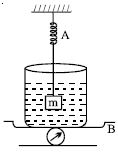
- 8The spring balance $A$ reads $2$ $kg$ with a block $m $ suspended from it. $A$ balance $B$ reads $5$ $kg$ when a beaker with liquid is put on the pan of the balance. The two balances are now so arranged that the hanging mass is inside the liquid in the beaker as shown in the figure in this situation:View Solution
- 9Two uniform solid balls of same density and of radii $r$ and $2r$ are dropped in air and fall vertically downwards. The terminal velocity of the ball with radius $r$ is $1\,cm\,s^{-1}$ , then find the terminal velocity of the ball of radius $2r$ (neglect bouyant force on the balls.) ........... $cm\,s^{-1}$View Solution
- 10A hollow sphere of volume $V$ is floating on water surface with half immersed in it. What should be the minimum volume of water poured inside the sphere so that the sphere now sinks into the waterView Solution