MCQ
$Assertion$ : Frictional forces are conservative forces.
$Reason$ : Potential energy can be associated with frictional forces.
  • A
    If both Assertion and Reason are correct and the Reason is a correct explanation of the Assertion.
  • B
    If both Assertion and Reason are correct but Reason is not a correct explanation of the Assertion.
  • C
    If the Assertion is correct but Reason is incorrect.
  • If both the Assertion and Reason are incorrect.
Answer

Correct option: D.
If both the Assertion and Reason are incorrect.
d
Frictional force is non-conservative as work done against frictional force can not be stored as potential energy.

Need a full question paper?

Generate a complete, print-ready paper with questions like this in minutes — across 16+ boards, with answer keys.

Start Generating Free

Similar questions

A mixture of $2$ moles of helium gas (atomic mass $=4 \ amu$ ), and $1$ mole of argon gas (atomic mass $=40 \ amu$ ) is kept at $300 \ K$ in a container. The ratio of the rms speeds $\left(\frac{\left. v _{ mms } \text { (helium }\right)}{ v _{\text {rms }} \text { (argon) }}\right)$ is :
An ornament weighs $10\, g$ in air and $6\, g$ in water. Density of material of ornament is $20\,\frac{g}{{cc}}$. The  volume of cavity in ornament is ........ $cc$
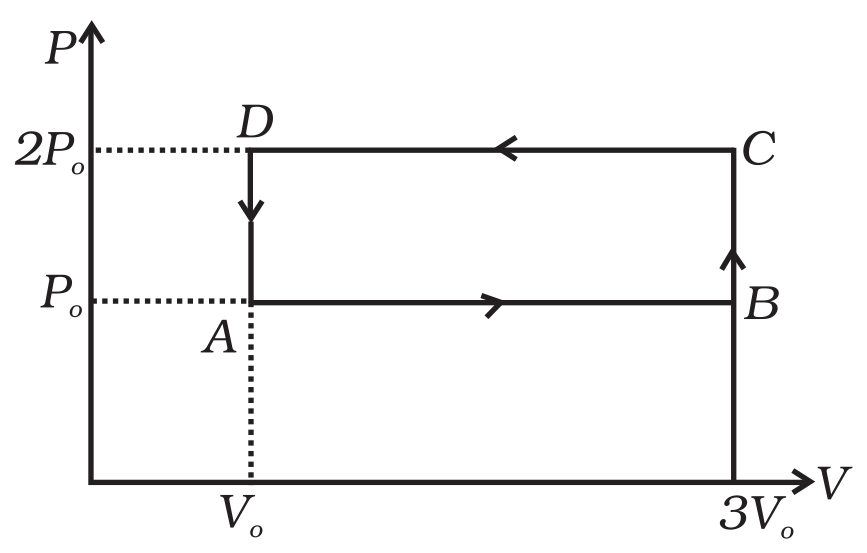
An ideal gas undergoes cyclic process ABCDA as shown in given PV diagram. The amount of work done by the gas is:
A bullet of $'4\,g'$ mass is fired from a gun of mass $4 \,{kg}$. If the bullet moves with the muzzle speed of $50\, {ms}^{-1}$, the impulse imparted to the gun and velocity of recoil of gun are :
A simple pendulum is taken from the equator to the pole. Its period
The moment of inertia of a solid sphere of density $\rho $ and radius R about its diameter is
The moment of inertia of a disc of mass $M$ and radius $R$ about a tangent to its rim in its plane is
A particle is moving with velocity $\vec v = K(y\hat i + x\hat j)$ where $K$ is a constant. The general equation for its path is
Two particles $P_1$ and $P_2$ are moving with velocities $v_1$ and $v_2$ respectively. Which of the statement about their relative velocity $v_{12}$ is true?
The efficiency of carnot engine is $50\%$ and temperature of sink is $500\;K$. If temperature of source is kept constant and its efficiency raised to $60\%$, then the required temperature of the sink will be