Assertion : If the current in a solenoid is reversed in direction while keeping the same magnitude, the magnetic field energy stored in the solenoid remains unchanged.
Reason : Magnetic field energy density is proportional to the magnetic field.
AIIMS 2010,AIIMS 2017, Easy
Download our app for free and get started
Reversing the direction of the current reverses the direction of the magnetic field. However, it has no effect on the magnetic field energy density, which is proportional to the square of the magnitude of the magnetic field.

Download our appand get started for free
Experience the future of education. Simply download our apps or reach out to us for more information. Let's shape the future of learning together!No signup needed.*
Similar Questions
- 1A charged particle (electron or proton) is introduced at the origin $(x=0, y=0, z=0)$ with a given initial velocity $\overrightarrow{\mathrm{v}}$. A uniform electric field $\overrightarrow{\mathrm{E}}$ and magnetic field $\vec{B}$ are given in columns $1,2$ and $3$ , respectively. The quantities $E_0, B_0$ are positive in magnitude.View Solution
column $I$
column $II$ column $III$ $(I)$ Electron with $\overrightarrow{\mathrm{v}}=2 \frac{\mathrm{E}_0}{\mathrm{~B}_0} \hat{\mathrm{x}}$ $(i)$ $\overrightarrow{\mathrm{E}}=\mathrm{E}_0^2 \hat{\mathrm{Z}}$ $(P)$ $\overrightarrow{\mathrm{B}}=-\mathrm{B}_0 \hat{\mathrm{x}}$ $(II)$ Electron with $\overrightarrow{\mathrm{v}}=\frac{\mathrm{E}_0}{\mathrm{~B}_0} \hat{\mathrm{y}}$ $(ii)$ $\overrightarrow{\mathrm{E}}=-\mathrm{E}_0 \hat{\mathrm{y}}$ $(Q)$ $\overrightarrow{\mathrm{B}}=\mathrm{B}_0 \hat{\mathrm{x}}$ $(III)$ Proton with $\overrightarrow{\mathrm{v}}=0$ $(iii)$ $\overrightarrow{\mathrm{E}}=-\mathrm{E}_0 \hat{\mathrm{x}}$ $(R)$ $\overrightarrow{\mathrm{B}}=\mathrm{B}_0 \hat{\mathrm{y}}$ $(IV)$ Proton with $\overrightarrow{\mathrm{v}}=2 \frac{\mathrm{E}_0}{\mathrm{~B}_0} \hat{\mathrm{x}}$ $(iv)$ $\overrightarrow{\mathrm{E}}=\mathrm{E}_0 \hat{\mathrm{x}}$ $(S)$ $\overrightarrow{\mathrm{B}}=\mathrm{B}_0 \hat{\mathrm{z}}$ ($1$) In which case will the particle move in a straight line with constant velocity?
$[A] (II) (iii) (S)$ $[B] (IV) (i) (S)$ $[C] (III) (ii) (R)$ $[D] (III) (iii) (P)$
($2$) In which case will the particle describe a helical path with axis along the positive $z$ direction?
$[A] (II) (ii) (R)$ $[B] (IV) (ii) (R)$ $[C] (IV) (i) (S)$ $[D] (III) (iii)(P)$
($3$) In which case would be particle move in a straight line along the negative direction of y-axis (i.e., more along $-\hat{y}$ )?
$[A] (IV) (ii) (S)$ $[B] (III) (ii) (P)$ $[C]$ (II) (iii) $(Q)$ $[D] (III) (ii) (R)$
- 2A long solenoid is formed by winding $20$ $turns/cm$. The current necessary to produce a magnetic field of $20$ $milli\,tesla$ inside the solenoid will be approximately .....$A$ $(\frac{{{\mu _0}}}{{4\pi }} = {10^{ - 7}}\,tesla - metre/ampere)$View Solution
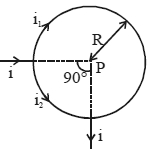
- 3A straight conductor carrying current $i$ splits into two parts as shown in the figure. The radius of the circular loop is $R$. The total magnetic field at the centre $P$ of the loop is$......$View Solution
- 4View SolutionA current carrying wire in the neighborhood produces
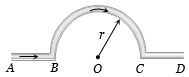
- 5the magnetic induction at $O$ due to the whole length of the conductor isView Solution
- 6A coil having $N$ $turns$ is wound tightly in the form of a spiral with inner and outer radii $a$ and $b$ respectively. When a current $I$ passes through the coil, the magnetic field at the centre isView Solution
- 7A particle of specific charge $(q/m)$ is projected from the origin of coordinates with initial velocity $[ui - vj]$. Uniform electric magnetic fields exist in the region along the $+y$ direction, of magnitude $E$ and $B.$ The particle will definitely return to the origin once ifView Solution
- 8One of the two small circular coils, (none of them having any self- inductance) is suspended with a $V-$ shaped copper wire, with plane horizontal. The other coil is placed just below the first one with plane horizontal. Both the coils are connected in series with a $dc$ supply. The coils are found to attract each other with a force. Which one of the following statements is incorrect ?View Solution
- 9When a galvanometer is shunted with a $4\,\Omega$ resistance, the deflection is reduced to one-fifth. If the galvanometer is further shunted with $2\,\Omega$ wire, the further reduction in the deflection will be (the main current remains same)View Solution
- 10View SolutionA proton beam is going from north to south and an electron beam is going from south to north. Neglecting the earth's magnetic field, the electron beam will deflected (Zero gravity)