Question
$Assertion$ : In a free fall, weight of a body becomes effectively zero.
$Reason$ : Acceleration due to gravity acting on a body having free fall is zero.

Answer

In a free fall, effective weight of a body becomes zero. The reason behind it is the normal force acting on the object is equal to mg which is same as the weight of the object. So, the object feels weightless. Actual weight during Free fall is mg.

The acceleration due to gravity on the object falling down is $9.8 \mathrm{m} / \mathrm{s}^{2} .$ It is non zero.

Need a full question paper?

Generate a complete, print-ready paper with questions like this in minutes — across 16+ boards, with answer keys.
Start Generating Free

Similar questions

An object suspended by a wire stretches it by $10 \,mm$. When object is immersed in a liquid the elongation in wire reduces by $\frac{10}{3} \,mm$. The ratio of relative densities of the object and liquid is $............$
The incorrect statement about the property of a Zener diode is
The decay constant of a radioactive element is $0.01$ per second. Its half life period is .......$sec$
When a $4 \,kg$ rifle is fired, the $10 \,g$ bullet receives an acceleration of $3 \times 10^6 \,cm / s ^2$. The magnitude of the force acting on the rifle (in newton) is ............
If density of a planet is double that of the earth and the radius $1.5$ times that of the earth, the acceleration due to gravity on the surface of the planet is ........
From the following diode circuit. Which diode in forward biased condition
A nuclear fuel rod generates energy at a rate of $5 \times 10^8 \,W / m ^3$. It is in the shape of a cylinder of radius $4.0 \,mm$ and length $0.20 \,m$. A coolant of specific heat $4 \times 10^3 \,Jkg ^{-1} K ^{-1}$ flows past it at a rate of $0.2 \,kgs ^{-1}$. The temperature rise in this coolant is approximately ............ $^{\circ} C$
A mass of $20\, kg$ moving with a speed of $10\,m/s$ collides with another stationary mass of $5\,kg.$ As a result of the collision, the two masses stick together. The kinetic energy of the composite mass will be ............. $J$
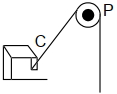
One end of massless rope, which passes over a massless and frictionless pulley $P$ is tied to a hook while the other is free. Maximum tension the rope bear is $360 N$. With what value of maximum safe acceleration (in $m s^{-2}$) can a man of $60 kg$ climb on the rope?
When a wave travels in a medium, the particle displacements are given by $y = a\, sin\, 2\pi\, (bt -cx)$ where $a, b,$ and $c$ are constants. The maximum particle velocity will be twice the wave velocity if