Assertion : In the absence of an external electric field, the dipole moment per unit volume of a polar dielectric is zero.
Reason : The dipoles of a polar dielectric are randomly oriented.
AIIMS 2016, Easy
Download our app for free and get started
$\vec{D}=\varepsilon_{0} \vec{E}+\vec{P}$ where
vector $\mathrm{E}=$ applied electric field and
vector $\mathrm{P}=$ polarisation or dipole moment per unit volume
$=n \vec{p} \times 2$
[vector $\mathrm{P}$ is the component of dipole moment of each molecule in direction vector $E$ and $n$ is the no. of molecules per unit volume]
Now in the absence of an electric field (vector $E=0$ ) the polarisation vector $P$ vanishes (because vector $\mathrm{p}$ is there if vector $\mathrm{E}$ is there).
Therefore displacement vector $\mathrm{D}=0$

Download our appand get started for free
Experience the future of education. Simply download our apps or reach out to us for more information. Let's shape the future of learning together!No signup needed.*
Similar Questions
- 1A capacitor with capacitance $5\,\mu F$ is charged to $5\,\mu C.$ If the plates are pulled apart to reduce the capacitance to $2\,\mu F,$ how much work is done?View Solution
- 2An electron of mass $m$ and charge $e$ is accelerated from rest through a potential difference $V$ in vacuum. Its final velocity will beView Solution
- 3A $20\,F$ capacitor is charged to $5\,V$ and isolated. It is then connected in parallel with an uncharged $30\,F$ capacitor. The decrease in the energy of the system will be.......$J$View Solution
- 4Two electric charges $12\,\mu C$ and $ - 6\,\mu C$ are placed $20\, cm$ apart in air. There will be a point $P$ on the line joining these charges and outside the region between them, at which the electric potential is zero. The distance of $P$ from $ - 6\,\mu C$ charge is.......$m$View Solution
- 5A condenser of capacity ${C_1}$ is charged to a potential ${V_0}$. The electrostatic energy stored in it is ${U_0}$. It is connected to another uncharged condenser of capacity ${C_2}$ in parallel. The energy dissipated in the process isView Solution
- 6Two charges of magnitude $+ q$ and $-\,3q$ are placed $100\,cm$ apart. The distance from $+ q$ between the charges where the electrostatic potential is zero is.......$cm$View Solution
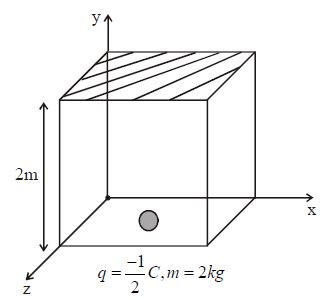
- 7Consider a gravity free container as shown. System is initially at rest and electric potential in the regon is $V = (y^3+2)\ J/C$. A ball of charge $q$ and mass $m$ is released from rest from base starts to move up due to electric field and collides with the shaded face as shown.If its speed just after collision is $1.5\ m/s$ and time for which ball is in contact with shaded face is $0.1\ sec$, find external force required to hold the container fixed in its position during collision assuming ball exerts constant force on wall during entire span of collision.......$N$View Solution
- 8A $60\; pF$ capacitor is fully charged by a $20\; \mathrm{V}$ supply. It is then disconnected from the supply and is connected to another uncharged $60 \;pF$ capactior is parallel. The electrostatic energy that is lost in this process by the time the charge is redistributed between them is (in $nJ$)View Solution
- 9View SolutionWhen one electron is taken towards the other electron, then the electric potential energy of the system
- 10In a parallel plate condenser, the radius of each circular plate is $12\,cm$ and the distance between the plates is $5\,mm$. There is a glass slab of $3\,mm$ thick and of radius $12\,cm$ with dielectric constant $6$ between its plates. The capacity of the condenser will beView Solution