MCQ
Assertion : Mass and volume are extensive properties.
Reason : Mass / volume is also an extensive parameter.
  • A
    If both Assertion and Reason are correct and the Reason is a correct explanation of the Assertion.
  • B
    If both Assertion and Reason are correct but Reason is not a correct explanation of the Assertion.
  • If the Assertion is correct but Reason is incorrect.
  • D
    If both the Assertion and Reason are incorrect.
Answer

Correct option: C.
If the Assertion is correct but Reason is incorrect.
c
The properties of a system which depend upon quantity of matter contained in it are called extensive properties, e.g., mass, volume, heat capacity etc. But mass / volume = density is an intensive property as density does not depend upon quantity of matter in a system.

Need a full question paper?

Generate a complete, print-ready paper with questions like this in minutes — across 16+ boards, with answer keys.

Start Generating Free

Similar questions

Which of the following statements concern with transition metals ?
$KMnO_4$ reacts with oxalic acid according to the equation : 

$2MnO_4^ -  + 5{C_2}O_4^ -  + 16{H^ + } \to 2M{n^{ +  + }} + 10C{O_2} + 8{H_2}O$ 

Here $20\, mL$ of $0.1\, M\, KMnO_4$ is equivalent to

In Brown ring $[Fe(H_2O)_5NO]SO_4$ primary valency of $Fe$ is
$\left( P \right)\,\xrightarrow{\Delta }\,\left( Q \right)$ metallic solid $ + \left( R \right) \uparrow \, + \,\left( S \right) \uparrow $

$\left( X \right)\,\xrightarrow{\Delta }\,\left( Y \right)$ amphoteric $ + \left( R \right) \uparrow \, + \,\left( S \right) \uparrow $

$P$ and $X$ are respectively

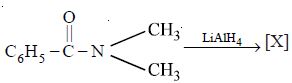
In the given reaction $[X]$ will be :
Write the $IUPAC$ name of the following compound
$STATEMENT-1$: The geometrical isomers of the complex $\left[\mathrm{M}\left(\mathrm{NH}_3\right)_4 \mathrm{Cl}_2\right]$ are optically inactive. and

$STATEMENT-2$: Both geometrical isomers of the complex $\left[\mathrm{M}\left(\mathrm{NH}_3\right)_4 \mathrm{Cl}_2\right]$ possess axis of symmetry.

The decomposition of formic acid on gold surface follows first order kinetics. If the rate constant at $300\, K$ is $1.0 \times 10^{-3} s ^{-1}$ and the activation energy $E _{ a }=11.488\, kJ\, mol ^{-1},$ the rate constant at $200\, K$ is ............  $\quad \times 10^{-5} s ^{-1} .$

(Round of to the Nearest Integer).

(Given : $\left. R =8.314\, J\, mol ^{-1} K ^{-1}\right)$

The mass deposited at an electrode is directly proportional to
Which metal is ultrap urifiedusing carbon monoxide?