MCQ
Assertion : The force of repulsion between atomic nucleus and $\alpha-$particle varies with distance according to inverse square law. 
Reason : Rutherford did a-particle scattering experiment.
  • A
    If both assertion and reason are true and the reason is the correct explanation of the assertion.
  • If both assertion and reason are true but reason is not the correct explanation of the assertion.
  • C
    If assertion is true but reason is false.
  • D
    If the assertion and reason both are false.
Answer

Correct option: B.
If both assertion and reason are true but reason is not the correct explanation of the assertion.

Need a full question paper?

Generate a complete, print-ready paper with questions like this in minutes — across 16+ boards, with answer keys.

Start Generating Free

Similar questions

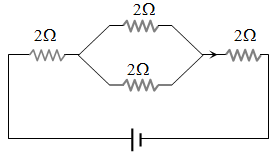
The equivalent resistance of the circuit shown in the figure is
Assertion  :   Magnetic moment of an atom is due to both, the orbital motion and spin motion of every electron.
Reason      : A charged particle produces a magnetic field.
Which among the following is true?
A boat is moving due east in a region where the earth's magnetic field is $5.0 \times 10^{-5}NA^{-1}m^{-1}$ due north and horizontal. The boat carries a vertical aerial $2m$ long. If the speed of the boat is $1.50\ ms^{-1},$ the magnitude of the induced emf in the wire of aerial is:
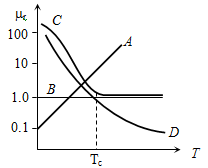
The relative permeability $\left(\mu_{\mathrm{r}}\right)$ of a ferromagnetic substance varies with temperature $(T)$ according to the curve
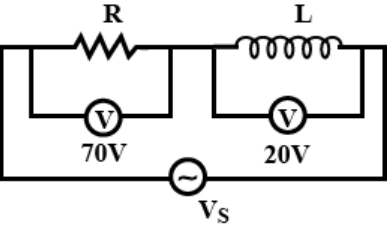
The adjoining figure shows an $AC$ circuit with resistance $R,$ inductance $L$ and source voltage $Vs$. Then.
Image
The wavelength of the most energetic X–ray emitted when a metal target is bombarded by 100 KeV  electrons is approximately (a) 12 Å(b) 4 Å(c) 0.31 Å(d) 0.124 Å
       
A dip needle lies initially in the magnetic meridian when it shows an angle of dip $\theta$ at a place. The dip circle is rotated through an angle $x$ in the horizontal plane and then it shows an angle of dip $\theta^{\prime}.$ Then $\frac{\tan \theta^{\prime}}{\tan _{13} \theta}$
How is the potential within and on the surface of a conductor?
An AM wave has 1800 watt of total power content, For 100% modulation the carrier should have power content equal to (a) 1000 watt(b) 1200 watt(c) 1500 watt(d) 1600 watt