Question
Which among the following is true?

Answer

According to Kirchhoff’s first law, the current flowing towards the junction is equal to the current leaving the junction. Mathematically, this law can be expressed as $∑^n_{K – 1} I_K = 0 ($where n is the number of branches carrying current towards or away from the junction$)$

Need a full question paper?

Generate a complete, print-ready paper with questions like this in minutes — across 16+ boards, with answer keys.
Start Generating Free

Similar questions

A coil with $100$ turns has an inductance of $0.05H$ and $0.02A$ current is passed through it. Flux linked with the coil is
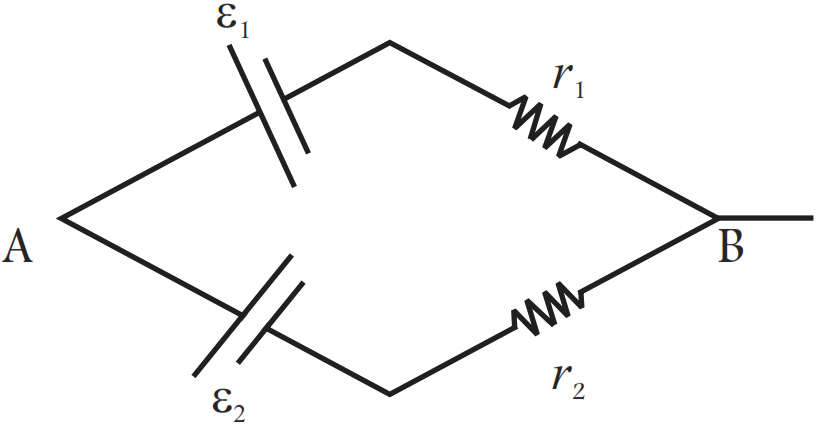
Two batteries of emf $\epsilon_1$ and $\epsilon_2(\epsilon_2>\epsilon_1)$ and internal resistances $r_1$ and $r_2$ respectively are connected in parallel as shown in Fig.
In a process on a system, the initial pressure and volume are equal to the final pressure and volume.
  1. The initial temperature must be equal to the final temperature.
  2. The initial internal energy must be equal to the final internal energy.
  3. The net heat given to the system in the process must be zero.
  4. The net work done by the system in the process must be zero.
$1$ atomic mass unit is equal to
Assertion  :   A charged capacitor is disconnected from a battery. Now if its plate are separated farther, the potential energy will fall.
Reason     : Energy stored in a capacitor is equal to the work done in charging it.(a) If both assertion and reason are true and the reason is the correct explanation of the assertion.(b) If both assertion and reason are true but reason is not the correct explanation of the assertion.(c) If assertion is true but reason is false.(d) If assertion is false but reason is true.


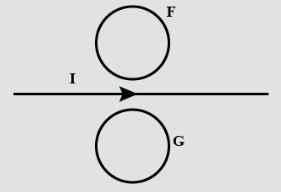
Two conducting circular loops F and G are kept in a plane on either side of a straight current-carrying wire as shown in the figure below. If the current in the wire decreases in magnitude, the induced current in the loops will be.
The electrical circuits used to get smooth d.c. output from a rectifier circuit is called(a) Filter(b) Amplifier(c) Full wave rectifier(d) Oscillator
       
The photoelectric current does not depend upon the:
  1. Frequency of incident light.
  2. Work function of the metal.
  3. Stopping potential.
  4. Intensity of incident light.
An $\alpha -$particle travels in a circular path of radius $0.45 m$ in a magnetic field $B=1.2\ Wb/m^2$ with a speed of $2.6 \times 10^7 m / \sec$ The period of revolution of the $\alpha -$particle is
Which type of current is flowing through a circuit?