$Assertion :$ The pressure of water reduces when it flows from a narrow pipe to a wider pipe.
$Reason :$ Since for wider pipe area is large, so flow of speed is small and pressure also reduces proportionately.
$Reason :$ Since for wider pipe area is large, so flow of speed is small and pressure also reduces proportionately.
AIIMS 2017, Easy


Download our appand get started for free
Experience the future of education. Simply download our apps or reach out to us for more information. Let's shape the future of learning together!No signup needed.*
Similar Questions
- 1Ajet of water having velocity $=$ $10 $ $m/s$ and stream cross-section $=$ $2$ $cm^2$ hits a flat plate perpendicularly, with the water splashing out parallel to plate. The plate experiences a force of ....... $N$View Solution
- 2A hollow spherical shell at outer radius $R$ floats just submerged under the water surface. The inner radius of the shell is $r$. If the specific gravity of the shell material is $\frac{27}{8}$ $w.r.t.$ water, the value of $r$ is$......R$View Solution
- 3View SolutionWhich of the following is not the characteristic of turbulent flow
- 4View SolutionThe three water filled tanks shown have the same volume and height. If small identical holes are punched near this bottom, which one will be the first to get empty.
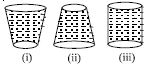
- 5A cylindrical vessel open at the top is $20$ $cm $ high and $10$ $cm$ in diameter. A circular hole whose cross-sectional area $1$ $cm^2$ is cut at the centre of the bottom of the vessel. Water flows from a tube above it into the vessel at the rate $100$ $cm^3$ $s^{^{-1}}$. The height of water in the vessel under steady state is ....... $cm$ (Take $g$ $=$ $1000 $ $cm s^{^{-2}})$View Solution
- 6In an experiment to verify Stokes law, a small spherical ball of radius $r$ and density $\rho$ falls under gravity through a distance $h$ in air before entering a tank of water. If the terminal velocity of the ball inside water is same as its velocity just before entering the water surface, then the value of $h$ is proportional to :View Solution
(ignore viscosity of air)
- 7If the atmospheric pressure is $P_a$, then the pressure $P$ at depth $h$ below the surface of liquid of density $\rho $ open to the atmosphere isView Solution
- 8There are two identical small holes of area of cross-section a on the opposite sides of a tank containing a liquid of density $\rho $. The difference in height between the holes is $h$. Tank is resting on a smooth horizontal surface. Horizontal force which will has to be applied on the tank to keep it in equilibrium isView Solution
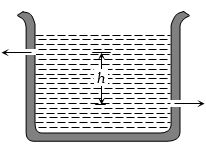
- 9A $U-$ tube containing a liquid moves with a horizontal acceleration a along a direction joining the two vertical limbs. The separation between these limbs is $d$ . The difference in their liquid levels isView Solution
- 10The water is filled upto height of $12\, {m}$ in a tank having vertical sidewalls. A hole is made in one of the walls at a depth $'{h}'$ below the water level. The value of $'h'$ for which the emerging stream of water strikes the ground at the maximum range is $.....\,{m}$.View Solution